Caption Contest 100: Recap & Review
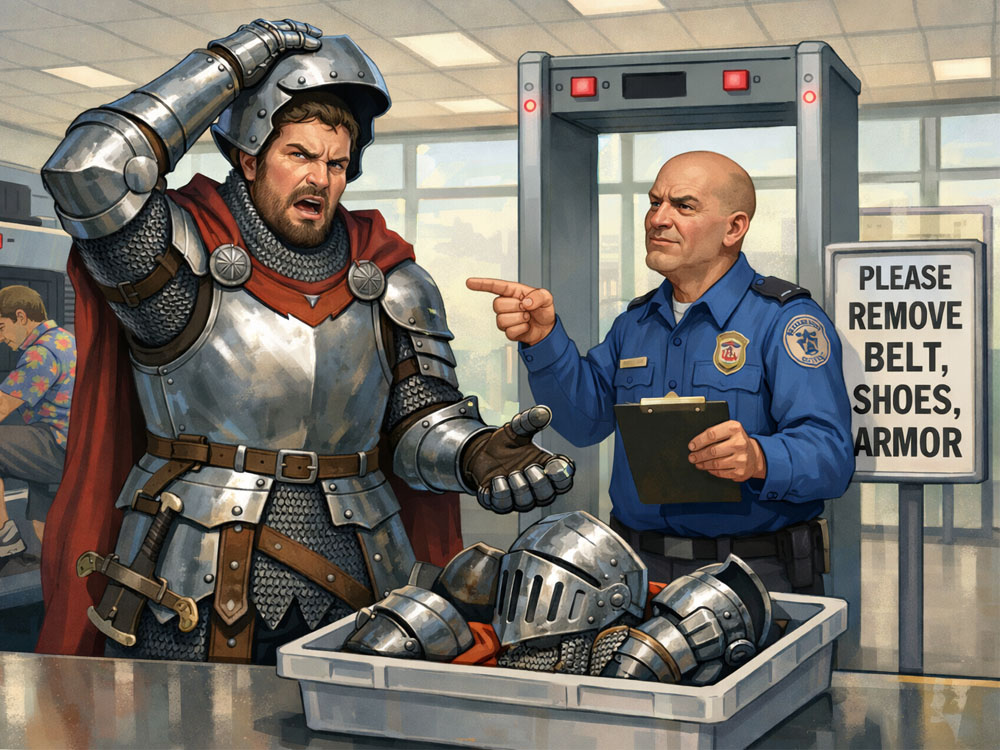
Air travel is already a medieval ordeal: lines, shoes off, dignity removed. So naturally this week we escalated to literal medieval. A fully armored knight steps up to the TSA metal detector — a device whose entire job is to react poorly to knights.
You can almost hear the BEEP before the image loads. Not a possibility. A certainty.
The humor here lives in inevitability. This isn’t “will the alarm go off?” — it’s “how many centuries will this pat-down take?”
Also, important emotional detail: the knight looks offended. Not confused. Not worried. Offended. As if airport security is the rude one in this relationship.
This was a strong prompt for puns, but also a trap. When a joke is obvious, execution matters more than idea. A lot.
What We Saw a Lot
First instinct across submissions: armor/metal/knight wordplay. Totally reasonable. The image practically demands it. We saw:
-
knight/night swaps
-
metal/medieval puns
-
joust jokes
-
iron references
-
chainmail underwear concerns (many)
Second instinct: modern authority vs old authority. Kings vs TSA, rank vs procedure, “I outrank you” energy.
Third instinct: the removal problem. Shoes are annoying. Armor is catastrophic. Many captions leaned into the logistics of undressing a knight in an airport queue.
Overall, people recognized the core tension: a system built for sneakers encountering a lifestyle built for sieges.
Where entries separated wasn’t the premise — it was restraint.
Missed Opportunities
A lot of captions explained the joke instead of letting the image do the heavy lifting.
When the visual already screams “metal detector + metal man,” the job of the caption is not to restate that. It’s to add a perspective: emotional, bureaucratic, or social.
Several submissions aimed for topical commentary (“only in Trump’s world”) or generic complaints about airline rules. Those move away from the scene instead of sharpening it. The funniest captions stayed inside the moment.
Another near-miss category: extended medieval language. When a caption becomes a full theatrical speech, the timing slows down. Short beats fit visual humor better — especially when the joke is inevitability.
The best jokes didn’t describe the beep. They reacted to it.
Head to Head
Finalist:
“We don’t have all knight”
Similar non-finalist:
“This is going to take all knight”
Both use the same pun engine. Both recognize the waiting problem. But the finalist works better because it feels like something a TSA agent would actually say.
“This is going to take all knight” reads like a narrator line — commentary about the situation.
“We don’t have all knight” is policy language. It sounds like a tired employee managing expectations. Specific voice beats general observation.
In visual captions, believable dialogue often beats clever wording.
Red Lines
“Rules and regulations suck for airlines”
This doesn’t engage with the image. It could apply to any airport photo. A caption should anchor itself to a detail unique to the scene — here, that detail is a medieval human alarm bell.
Lesson: If your caption still works on a photo of luggage, it’s not specific enough.
“Um officer you don’t understand I don’t have any underwear on.”
The joke aims for surprise but ignores the stronger existing joke: the armor itself. By pivoting away from the visual centerpiece, it competes with the image instead of collaborating with it.
Lesson: When the image already has a comedic focal point, reinforce it. Don’t replace it.
“Surely, you joust about me taking off all of my armor!”
The pun is clear, but the sentence length dilutes timing. Every extra word delays the laugh and signals effort.
Lesson: Puns work best as quick hits, not monologues.
Winning Captions & Why They Worked
Winner:
“It’s going to be a long day’s knight”
Clean, immediate, and rhythmically natural. It matches the weary inevitability of airport security. Most importantly, it sounds like a thought the knight himself would have. Perspective alignment matters.
Finalists:
“You do realize my underwear is chainmail right???”
Specific escalation. It takes the removal problem and pushes it one layer deeper. The humor comes from logistical despair, not just wordplay.
“And don’t call me Sir-ly”
Classic pun, but concise and placed into dialogue. The authority dynamic makes it feel situational rather than decorative.
“TSA knight shifts”
Short, headline-style phrasing that reframes the entire scene as a workplace routine. Efficient world-building.
“We don’t have all knight”
Believable employee voice. The humor is bureaucratic exhaustion.
“Got a can opener?”
Excellent object-based solution joke. It acknowledges the practical impossibility without describing the beep itself.
Across the finalists, a pattern: they add a reaction to the situation rather than narrating it. The image sets up the absurdity; the caption supplies the human response.
Final Thoughts
This contest was a reminder that obvious setups demand subtle captions. When the joke is loud, the caption should whisper.
Knights are dramatic. TSA agents are not. The funniest entries lived right in that gap — epic hero meets minimum-wage procedure.
Next time you see a “guaranteed beep” image, don’t compete with the alarm. Just react to it.
Now grab your carry-on and head to the next contest — no armor required.