Caption Contest 101: Recap & Review
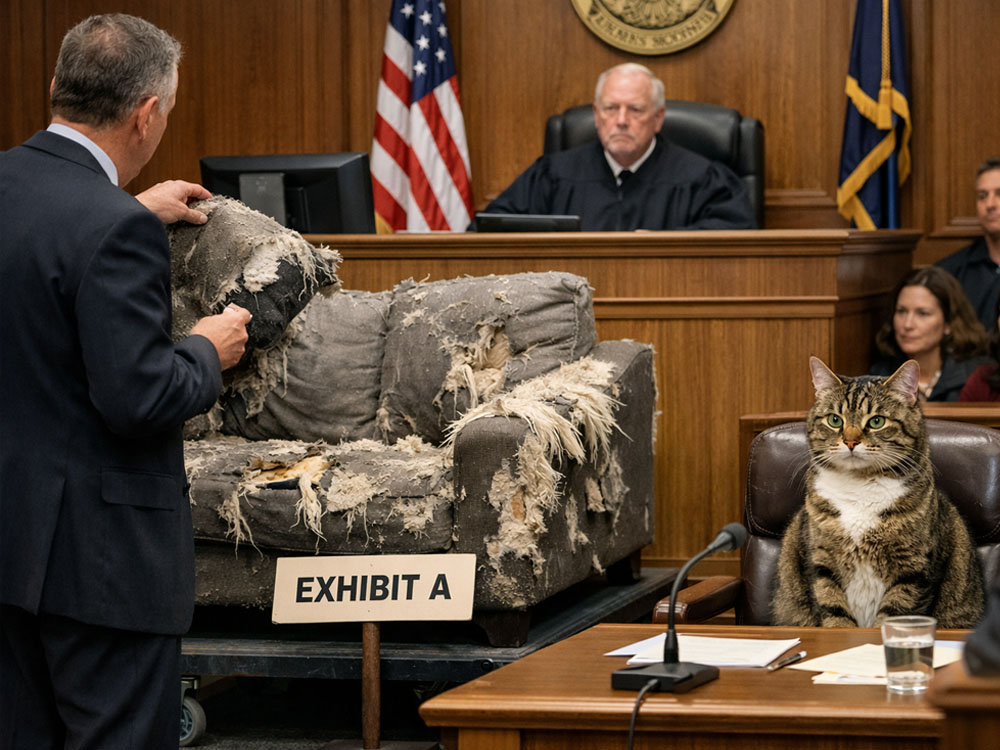
Court is in session, and the defendant is… asleep.
Few images have ever felt more legally airtight: a shredded couch presented as Exhibit A, a solemn courtroom, and a witness whose entire defense strategy is blinking slowly until everyone forgives them.
The real tension isn’t whether the cat did it. The tension is whether the court system can emotionally withstand how little the cat cares.
This was a classic CaptionCo setup — high seriousness colliding with absolute, unapologetic nonsense. The courtroom demands truth. The cat demands snacks.
What We Saw a Lot
You all correctly identified the two engines of the joke: legal language and cat behavior. Most submissions leaned into one of three instincts:
Legal puns
Examples like “purr-jury,” “claw-stitutional rights,” and “Habeas Corpussy” dominated the room. This was the most natural first idea — and many of them were solid.
Excuses and defenses
Late dinners, pre-existing conditions, blaming the dog, mice sightings. This approach worked when it sounded like something a real defense attorney would reluctantly say on behalf of a client who cannot be controlled.
General cat personality jokes
Indifference, naps, entitlement, destruction as routine. These did well when grounded in the courtroom reality rather than floating above it.
Overall, the field had strong instincts. The biggest separator wasn’t idea category — it was precision.
Missed Opportunities
The image gives you something rare: a real physical piece of evidence. The couch is not hypothetical. It’s in court.
Some captions treated the scene like a generic “cat joke” instead of a trial about property damage. When the joke didn’t actively involve testimony, procedure, or evidence, it felt detachable — like it could fit any cat photo.
Another near-miss was over-punning. Once a reader spots the first cat-law pun, they instantly predict the rest. Surprise disappears fast in a courtroom; predictability is acquittal for boredom.
The best captions didn’t just say a legal pun — they behaved like dialogue that would actually occur during a hearing about a destroyed couch.
Head to Head
Finalist:
“Your Honor, the defendant claims it was a pre-existing condition”
Non-finalist:
“I thought I saw a mouse”
Both attempt a plausible excuse, but the finalist works better because it weaponizes legal phrasing against physical reality. A couch cannot logically have a “pre-existing condition” that looks like claw shredding — yet it’s exactly the kind of absurd argument lawyers occasionally make about liability.
The non-finalist is believable for a cat, but not courtroom-specific. A cat saying it saw a mouse is funny; a lawyer arguing upholstery medical history is situational comedy. The image is about procedure, not motive — so the courtroom logic wins.
Red Lines
“He never should have hidden his weed in my couch!!!”
This jumps to a totally different story world. The image gives us structured absurdity (a formal trial). Introducing an unrelated narrative replaces the joke rather than building on it. Lesson: expand the premise, don’t abandon it.
“Hard decision.”
Minimalism can work, but only when the image carries the twist. Here it doesn’t add interpretation — it just observes. A caption should reveal a new angle, not summarize the vibe.
“Trump did it”
Topical references are fragile in caption contests. They age quickly and disconnect from the visual mechanics of the joke. The humor should come from the image logic, not outside headlines.
Winning Captions & Why They Worked
“Your Honor, this is a clear case of purr-jury”
A classic pun, but concise and courtroom-native. It reads exactly like an objection you’d hear aloud.
“The defense rests… mainly on the back of the remaining cushions.”
Excellent specificity. It integrates the legal phrase with the physical evidence — a strong example of the joke living inside the image.
“Objection: leading the witness with laser pointers.”
One of the smartest conceptual turns. It merges courtroom procedure with uniquely cat-specific behavior, and the mental image escalates the scene without overexplaining.
“It was justified, your honor. My dinner was a minute late.”
Perfect character motivation. The disproportionate logic matches both cats and legal defenses: technically stated, wildly unreasonable.
“My client pleads indifference.”
Probably the purest cat joke in the set. No pun required — just an accurate translation of feline psychology into legal language.
“Your Honor, the defendant claims it was a pre-existing condition”
Arguably the sharpest structural joke. It doesn’t rely on cat vocabulary at all. Instead, it uses real courtroom phrasing to create the absurdity.
Final Thoughts
This contest was a good reminder that the funniest captions often sound like they could actually be spoken — just not in a world where reality behaves normally.
You weren’t writing jokes about cats. You were writing dialogue from a trial where the justice system is forced to negotiate with a creature that believes furniture is a suggestion.
In other words: the law seeks the truth. The cat seeks texture.
Check out the next contest and see if you can keep your humor out of contempt of court.