Caption Contest 102: Recap & Review
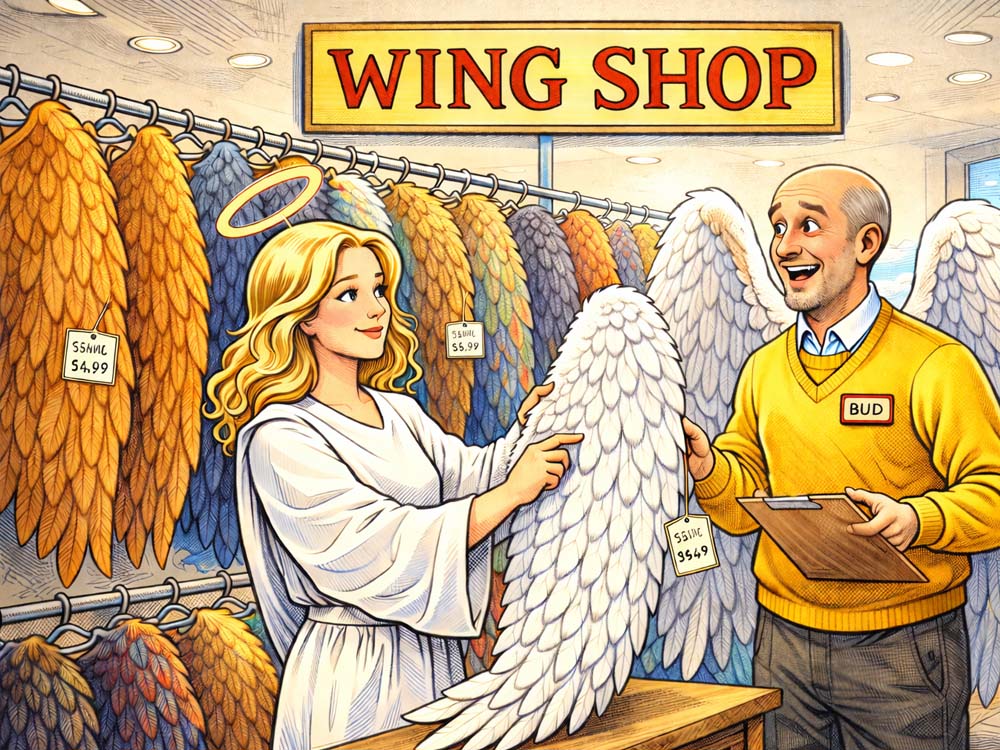
Retail therapy hits different when you literally fall from heaven and your wings are on backorder.
Our angel walks into a specialty wing shop like a commuter whose tires finally gave up halfway through a miracle. There’s a quiet dignity here — no trumpets, no choir — just fluorescent lighting and a polite exchange about feather upgrades. The joke isn’t that angels exist. The joke is that angels have customer service problems.
This image lives in the tension between divine and mundane. Eternity meets inventory. Salvation meets store policy. And once contestants spotted that contrast, the captions started to ascend.
What We Saw a Lot
The most common instinct: wing puns.
Examples ranged from “No thanks, I’ll just wing it.” to “My wife told me to just ‘WING IT’.” These landed because the premise hands you the word — but many stayed at the surface level and never escalated the idea.
Second major category: religious vocabulary wordplay.
We saw altar/alter, prophet/profit, miracles, heaven, higher place. These fit the image naturally and often performed well when they felt like something an employee might realistically say.
Third: food-wing confusion jokes.
Buffalo wings, fries, Red Bull — a logical connection, but it tended to flatten the concept. The more the caption drifted toward restaurant humor, the less the visual specificity mattered.
Finally: generic store dialogue.
Return policies, ringing bells, asking sizes. These worked when the divine angle stayed present — but struggled when they became standard retail jokes that could apply to any store.
Missed Opportunities
A lot of captions correctly noticed the shop but ignored the customer.
This angel is not browsing casually. They need wings to function. That raises stakes: mobility, status, identity, even theology. The strongest captions treated the purchase as necessary, not decorative.
Another underused idea: the employee’s perspective.
Some entries talked about heaven broadly, but fewer explored the awkwardness of a mortal clerk helping a celestial being. That contrast — someone trained to upsell warranties talking to an immortal — had room for sharper specificity.
And while many puns were solid, fewer created a scene. The image offers a full interaction. The captions that felt like overheard dialogue tended to outperform the ones that read like standalone jokes.
Head to Head
Finalist:
“Yes, we can altar these.”
Non-finalist:
“Do these come in ‘miracle-approved’ white?”
Both rely on religious vocabulary, but the finalist wins on economy and structure.
“altar/alter” works because it sounds exactly like a routine tailoring response — the employee is treating divine anatomy adjustments like hemming pants. The joke is embedded in natural dialogue.
“miracle-approved white” is conceptually correct but descriptive. It comments on angel aesthetics rather than dramatizing the interaction. One creates a believable retail moment; the other labels the setting.
The best captions don’t describe the joke — they perform it.
Red Lines
“When HE asked if I was ready for WINGS I thought HE meant buffalo or teriyaki flavor!”
This explains the joke instead of presenting it. The capitalization, setup, and clarification all push the reader through the idea rather than letting them discover it. A shorter line that trusts the image would land harder.
“If you”re interested we have a wet wing contest on Thursday nights. Mild medium or hot buffalo.”
Here the humor shifts entirely into restaurant territory. The image stops mattering — the angel could be replaced with anyone. When a caption works without the visual, it usually means the concept drifted too far from the premise.
“No Thank you. I’m Republican. (Or Democrat!)”
Political humor can work, but only when anchored to the scene. This doesn’t connect to wings, angels, or the shop interaction, so it reads as a separate joke pasted onto the image rather than growing out of it.
Winning Captions & Why They Worked
The finalists:
“Yes, we can altar these.”
“Ring the bell for service”
“This store makes incredible prophets”
“My last pair got ruined in a flood.”
“These wings are guaranteed to take you to a higher place.”
The strongest thread among them: they all sound like something said inside the store.
“Yes, we can altar these.”
Compact, conversational, and visual-specific. It treats celestial anatomy like routine tailoring — the perfect mundane/divine collision.
“This store makes incredible prophets”
Clean wordplay anchored to a believable store boast. It feels like signage or a proud employee pitch.
“My last pair got ruined in a flood.”
Subtle biblical reference. No explanation required. It trusts the audience and fits naturally as customer backstory.
“These wings are guaranteed to take you to a higher place.”
Excellent retail phrasing. Could be a mattress ad — except here it’s literally true. That straight-faced tone elevates the joke.
“Ring the bell for service”
Simple but effective because it implies the angel is subject to store protocol. Divinity waiting politely in line is inherently funny.
Across all winners, the key strength was restraint. No caption tried to out-miracle the image. They treated heaven like a strip mall, and that contrast did the work.
Final Thoughts
Angels usually deliver messages. Here they’re comparing models, asking about warranties, and wondering if store credit transfers between eternities.
That’s the comedic engine: not “angels are funny,” but “angels still have errands.”
Keep looking for that friction — cosmic importance colliding with everyday inconvenience — and your captions will keep rising.
Check out the next contest and see what else the universe forgot to make convenient.