Caption Contest 103: Recap & Review
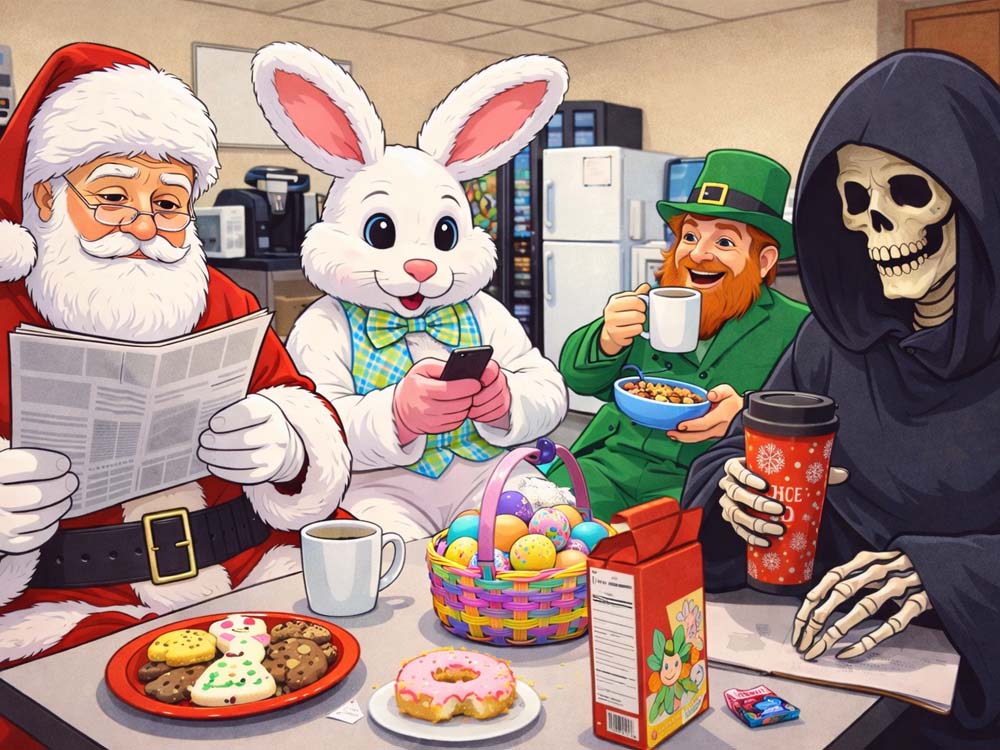
When you put Santa, the Easter Bunny, a leprechaun, and Death in the same break room, you’re not just crossing holidays — you’re crossing existential wires.
Santa’s calmly reading the paper. The Bunny’s doomscrolling. The leprechaun looks like he’s halfway between a union meeting and a pub crawl. And Death? Death is just… there. Which somehow makes everything funnier.
This image worked because it’s corporate mundanity colliding with mythic symbolism. It’s less “North Pole magic” and more “clocking in at 9:00 with your scythe.” You all clearly recognized that tension — and a lot of you leaned into it in smart ways.
What We Saw a Lot
Three major lanes emerged.
First: HR jokes. Break room policies, write-ups, work-life balance, scheduling conflicts. Lines like “We all got written up for scaring children” and “HR said we needed more holiday spirit in the break room… this is not what they meant.” show a strong instinct to frame these characters as coworkers instead of legends. That’s the right move.
Second: crossover and scheduling humor. “Everyone is scheduled on the correct holiday. Reeper, no showing up on the wrong day this year!” and “I love my job, I only work holidays” lean into the idea that these figures share a calendar system. It’s a clean premise with lots of room to escalate.
Third: Tooth Fairy and missing-character references. “The tooth fairy’s out. He never gets a day off.” and “Tooth Fairy is always late.” tapped into the broader “holiday mascot shared universe.” Expanding the cast — even offscreen — was a strong instinct.
Overall, you understood the assignment: treat them like employees, not icons.
Missed Opportunities
Where some captions came up just short was in specificity.
The image gives you precise physical details: Santa reading the news, Bunny on a phone, Death sitting casually in a fluorescent-lit break room. When captions stayed general — “We are all in this together” or “Now that we are all together” — they didn’t capitalize on the visual contrast.
Another missed angle: tone contrast between cheer and doom. Santa and the Bunny represent joy and sugar highs. Death represents finality. A few captions brushed against that tension, but many stayed in the “office meeting” lane without twisting the knife (or the candy cane).
The funniest entries used the image as evidence, not just backdrop.
Head to Head
Let’s compare:
Finalist:
“We all got written up for scaring children”
Non-finalist:
“You three make peple happy , i scare them !”
Both hinge on the same premise: Death doesn’t fit the brand.
The finalist works because it reframes everyone equally. Santa and the Bunny scare children too — just differently. It democratizes the joke. The punchline isn’t “Death is scary.” It’s “HR thinks all of you are liabilities.” That twist makes it feel sharper and more communal.
The non-finalist keeps the joke at surface level: Death scares, others don’t. That’s accurate, but predictable. Comedy needs the second beat — the angle that makes us reconsider the premise.
Red Lines
“Fantasy has always captured uneducated minds”
This moves away from the image and into commentary. The humor becomes abstract and detached from what we’re seeing. In a visual caption contest, always anchor the joke in the scene. If someone unfamiliar with the image could read the line and still get the joke, it’s probably too generic.
“Close the Government? We go on STRIKE! With pay!!!”
Big energy, but unclear target. Is this about public employees? Union rules? Government shutdowns? The reference feels imported rather than organically connected to Santa and Death in a break room. When a caption introduces a new premise, it needs a clear bridge back to the image.
“Hangin’ with the holidays!”
This is playful word association, but it stops at recognition. It tells us what we already see — holidays hanging out. Strong captions add friction, not labels.
“Now that we are all together”
This is an example of stating the setup without delivering a punchline. If your caption could serve as a photo description, you likely need one more twist.
Winning Captions & Why They Worked
Winner-level sharpness came from tight framing and subtle escalation.
“Santa finds the news more grim than a co-worker.”
This one layers the joke beautifully. “Grim” nods to the Grim Reaper without overexplaining. It also cleverly ties to Santa reading the paper — a detail many overlooked. The humor comes from combining visual evidence (the newspaper) with wordplay that feels earned, not forced.
“Cupid sends his regards, fellas…but he’s sending over some chocolate hearts for our brunch.”
This caption expands the universe while maintaining tone. It treats them like coworkers coordinating perks. The specificity — chocolate hearts, brunch — grounds the absurdity. It feels like an actual Slack message from Cupid.
“I just received a text, Tom Turkey is running a little late.”
Strong offscreen world-building. It suggests a larger scheduling ecosystem and keeps the workplace framing intact. Clean, simple, efficient.
“Tooth Fairy is always late.”
Minimalist and effective. It leans on shared folklore expectations. Sometimes brevity wins.
“The tooth fairy’s out. He never gets a day off.”
This one adds character commentary. It’s not just that he’s missing — it’s that his job is relentless. That small addition adds personality.
“HR said we needed better work-life balance, so Death brought snacks”
This is sharp because it collides corporate jargon with existential inevitability. “Work-life balance” is already ironic in a room with Death. The snack twist adds an unexpected, mundane layer.
“We all got written up for scaring children”
As discussed earlier, this one succeeds by spreading the blame evenly. It treats all mascots as problematic employees. That shared accountability is what elevates it.
Final Thoughts
This contest proved one thing: if you give mythical figures a microwave and a folding table, they instantly become coworkers.
You did a strong job humanizing legends without losing their symbolism. The next step? Push one beat further. If Santa’s reading the news, what headline would shake him? If Death’s in the break room, what’s in his Tupperware?
Keep looking for the detail inside the detail — that’s where the punchlines live.
Now clock out of this recap and clock in to the next contest — your caption career depends on it.