Tips for Caption Contest 105
There’s something deeply unsettling about a referee arguing with… himself.
Not pacing the sidelines. Not shouting at a coach. Not reviewing a call on a screen. Just locked in heated debate with the mirror like it just challenged his authority.
It’s the ultimate power struggle: the only person who can overrule you is… you.
And that’s where the comedy lives. ⚖️
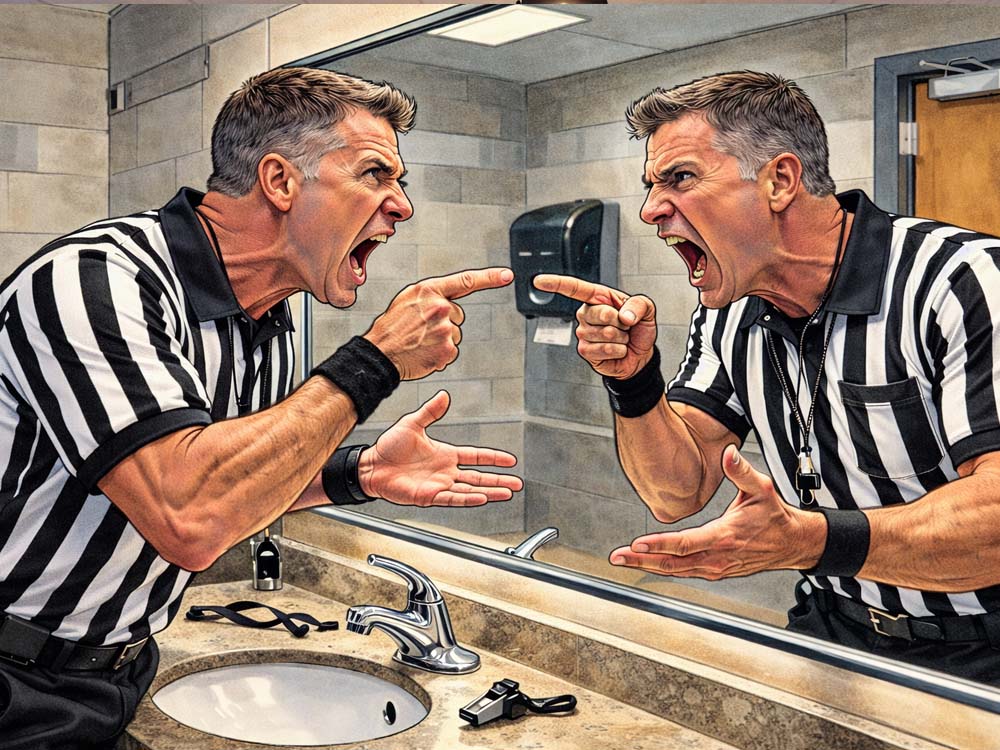
Getting Started: What’s in the Image?
Let’s inventory the obvious.
-
A referee in full uniform.
-
Striped shirt, whistle, probably mid-gesture.
-
Intense body language — pointing, arguing, animated.
-
A mirror directly in front of him.
-
His reflection matching the aggression.
The key visual tension: referees are authority figures. They are the final word. Yet here, he’s disputing a call with his own reflection — a perfectly synchronized opponent.
That symmetry matters.
There’s no external chaos. No players. No crowd. No scoreboard. Just self-conflict.
Also important: referees are associated with controversial decisions. Fans yell at them. Coaches protest. But now the ref is the one protesting.
That role reversal is fertile ground.
Think Beneath the Surface
At first glance, this is “ref arguing with himself.” That’s solid.
But the stronger captions will push past the literal.
What does this imply?
-
Second-guessing your own decision.
-
Ego vs. conscience.
-
Power struggling with accountability.
-
Instant replay taken too personally.
-
Internal monologue turned external meltdown.
You can also explore:
Identity jokes
Is the reflection the “real” official? Who’s in charge?
Relationship jokes
This is what it looks like when someone refuses to admit they’re wrong.
Workplace satire
HR complaint filed against self.
Philosophical angles
If you overturn your own call, who wins?
Meta sports humor
The only person who hates referees more than fans… is referees.
The mirror isn’t just a mirror. It’s a symbol of self-review, doubt, pride, and absurd authority.
The best jokes won’t just say “he’s arguing with himself.” They’ll assign meaning to that argument.
General Tips on How to Be Funny
-
Pick one clear premise.
Don’t stack ideas. Is this about ego? Replay review? Marriage? Therapy? Commit to one angle and sharpen it.
Example: “Example: Instant replay has gotten very personal.”
-
Escalate the logic.
If he’s arguing with himself, what’s the next step? Ejection? Technical foul? Suspension?
Example: “Example: Ref issues warning to reflection.”
-
Exploit authority tension.
Referees represent final judgment. Humor often comes from seeing power turned fragile.
Example: “Example: When you can’t even overrule yourself.”
-
Be specific.
“Arguing with himself” is a description, not a joke. Add a twist — a rulebook detail, sports jargon, workplace analogy, or emotional stake.
Specificity beats generic phrasing every time.
-
Don’t over-explain.
Trust the image. You don’t need to describe every visual element. Let the mirror do some of the work. -
Look for universal relatability.
Everyone has replayed an argument in their head. Everyone has defended a bad decision longer than necessary. That shared experience is your leverage.
Example: “Example: Still defending a call from 2009.”
-
Keep it tight.
Strong captions are surgical. If a word doesn’t add clarity or surprise, cut it.
Final Thought
This image is about authority colliding with self-doubt — and that’s a tension most of us understand a little too well. Pick your angle, keep it sharp, and make the mirror the real opponent.
Now blow the whistle and enter your caption in Contest 105.