Caption Contest 107: Recap & Review
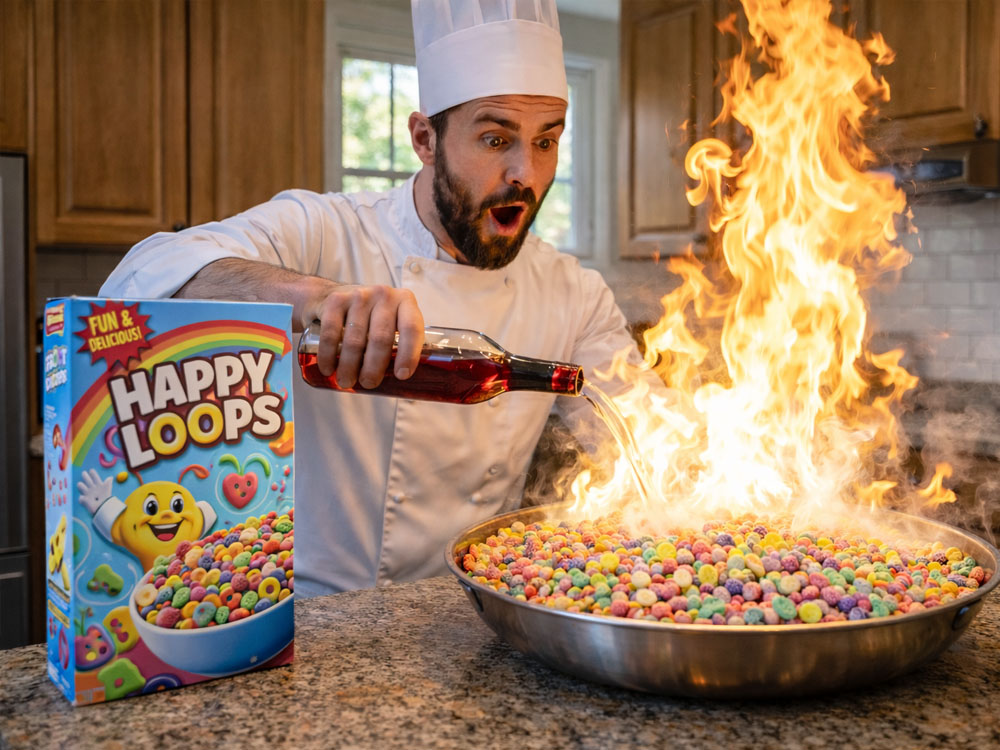
A professional chef. A pristine white coat. A towering toque.
And he’s committing arson against a bowl of children’s cereal.
There’s something uniquely funny about high culinary authority applied to aggressively low-stakes food. This isn’t a line cook burning a steak — this is a man trained in emulsions and reductions setting fire to marshmallow circles in a suburban kitchen. The gap between training and task is doing most of the comedic heavy lifting here.
Also important: the cereal is called Happy Loops. Not “Fiber Bran.” Not “Rustic Oats.” We are watching joy itself ignite.
This image basically asks one question: How seriously should anyone take breakfast?
What We Saw a Lot
Many captions gravitated toward three clear instincts:
Cereal wordplay.
“A cereal offender.”
“Cereal Killer”
“Cereal Flambe!”
Logical, immediate, and understandable — the visual screams “pun me.”
Fire alarm escalation.
“They’re always after my lucky 4-alarms”
“Where there’s snap, crackle and pop, there’s fire!”
Once flames appear, people naturally go emergency-mode. You all collectively heard a smoke detector and grabbed the nearest joke extinguisher.
Chef prestige vs. incompetence.
“The secret ingredient is… negligence”
“Much to everyone’s dismay, Rob is in the flambe section of his culinary course.”
This angle leaned into the funniest tension: trained expertise misapplied to the simplest food on earth.
All three directions were valid — the separation came down to precision. Not the idea you chose, but how tightly you expressed it.
Missed Opportunities
A few captions approached stronger ideas but stopped one step early.
Several jokes described what we already saw instead of reframing it:
“Oh no! It exploded. Cut to commercial. Hurry!”
“Fire fire pans on fire”
They react to the image instead of adding a perspective. Comedy here rewards reinterpretation — not narration.
Another near-miss category: references that outgrew the image.
“Chef Goatsey on a new episode of Heaven’s Kitchen”
“Bob thinks he’s a chef, but he’s really just an alcoholic.”
These introduce entirely new stories. The moment the caption requires backstory, the visual loses control of the joke. The strongest captions let the image remain the star and simply tilt how we understand it.
The image is about overqualification applied to nonsense. The more you stay in that lane, the stronger it gets.
Head to Head
Finalist:
“They want happy I’ll give them happy”
Non-finalist:
“Happy Loops now come in ‘campfire.’”
Both use the brand name and fire. Both valid directions.
The non-finalist adds a fake flavor. That’s a straightforward extension — cereal + fire = toasted product. Clean but predictable.
The finalist instead reframes motivation. The chef isn’t cooking — he’s emotionally escalating. It turns the act into a dramatic overreaction to the concept of “happy.” The joke moves from product to psychology.
One describes a result.
The other invents intent.
Intent is almost always funnier.
Red Lines
“Cereal Killer”
Classic pun structure: fast recognition, fast expiration. The audience solves it instantly and has nowhere else to go. A pun that ends at recognition rarely wins — it needs either a second meaning or a specific twist.
Lesson: If the reader can predict the punchline before finishing the caption, add a second layer or abandon it.
“It’s not ‘burnt,’ it’s ‘deconstructed charcoal breakfast”
This introduces restaurant language, which fits the chef angle, but the phrasing becomes the joke instead of the idea. Length diluted impact — the audience spends energy parsing instead of laughing.
Lesson: When the humor comes from contrast (fine dining vs cereal), clarity beats elaboration. Precision amplifies absurdity.
“Just adding a little tenture and this will be the best edibles on the market”
This tries to pivot into a different concept entirely. The visual never suggests that direction, so the reader has to rebuild the scene mentally.
Lesson: A caption shouldn’t relocate the image. It should reinterpret the existing reality.
Winning Captions & Why They Worked
Finalists:
“Cereal Flambe!”
This works because it does three things simultaneously:
-
Uses authentic culinary terminology
-
Applies it to a ridiculous food
-
Requires zero extra explanation
The chef finally makes sense — he would flambe something. The joke resolves the image instead of commenting on it. Clean, visual, immediate.
“They want happy I’ll give them happy”
Strong emotional overreaction. Turns breakfast into a personal vendetta.
“They’re always after my lucky 4-alarms”
Great escalation: mascot logic collides with emergency severity.
“Where there’s snap, crackle and pop, there’s fire!”
Familiar phrase upgraded logically to match the flames — recognizable but freshly contextualized.
“A cereal offender.”
A classic pun, but phrased naturally enough to feel like a description rather than a setup.
“Baked Alaska? Try Baked Milwaukee!”
The specificity carries it. A fancy dessert mirrored with a mundane location heightens the chef/cereal contrast.
Across the finalists, notice the pattern: they didn’t describe the fire — they justified it.
Final Thoughts
This contest rewarded restraint. The image already contained chaos; the best captions didn’t add more, they organized it. Once the audience understands why a chef would flambé breakfast, the absurdity locks into place.
You weren’t writing jokes about cereal. You were writing jokes about seriousness applied to triviality — one of comedy’s most reliable engines.
And honestly, if your morning routine doesn’t occasionally resemble a Michelin-star meltdown, are you even awake yet?
Check out the next contest and bring the heat — ideally without the smoke alarm.