Tips for Caption Contest 107
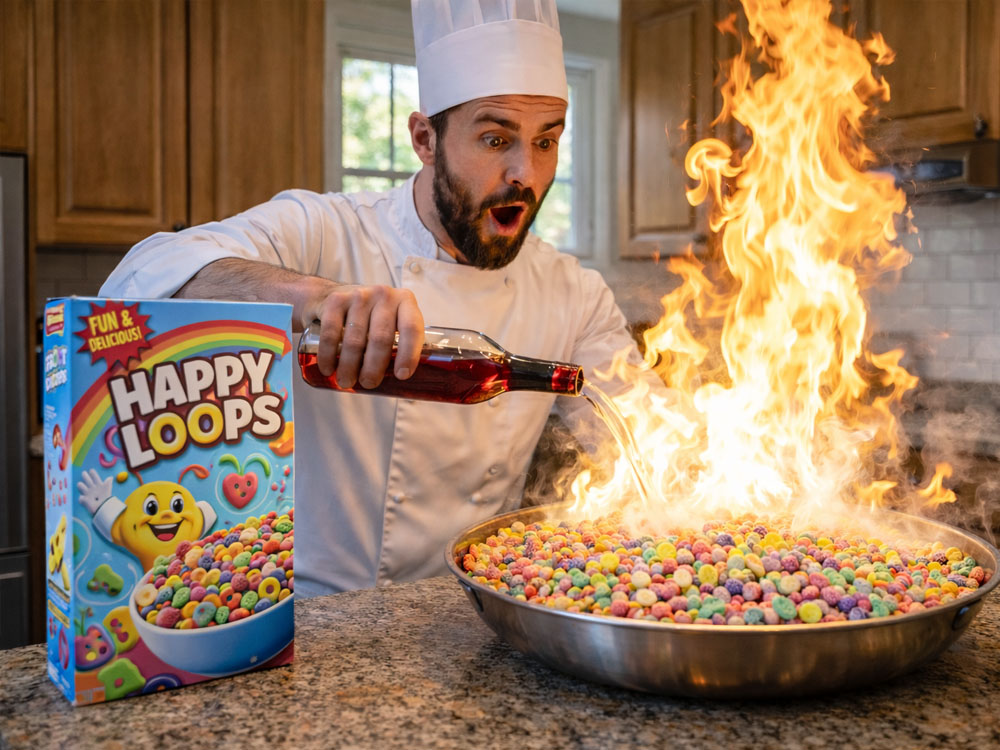
Somewhere, a professional culinary career has collided with a Saturday morning. The chef has the full uniform — crisp coat, towering hat, the posture of a person who insists on clarifying the difference between sautéing and pan-frying — and yet he’s standing over a bowl of cereal like it personally insulted him.
And not just cereal. Branded cereal. Cheerful, brightly named cereal. The kind designed to require zero skill beyond milk-adjacent behavior.
Yet here we are: smoke, flame, and the unmistakable look of a man plating breakfast as if the Michelin guide might swing by the kitchen island.
The image lives in the gap between extreme competence and complete failure — which is prime comedy territory.
Getting Started: What’s in the Image?
Start literal. What can the audience actually see?
-
A formally dressed chef (white coat, tall toque)
-
A normal residential kitchen — not a restaurant
-
A bowl or pan of cereal called Happy Loops
-
Active burning/smoke/fire
-
A mismatch between skill level and task difficulty
Important detail: he didn’t ruin a soufflé. He ruined cereal. That contrast is the engine of the joke.
Also note tone: this isn’t chaotic panic. It looks methodical. Intentional. Almost professional. The humor depends on the idea that he’s treating cereal preparation as haute cuisine — and still losing.
You’re not captioning a mistake. You’re captioning a philosophy.
Think Beneath the Surface
Now move from what to why is this funny.
This image is about overqualification. About applying expertise where it doesn’t belong. About elevating the trivial until it collapses.
Good angles include:
-
Fine dining vs everyday life
-
Adults overcomplicating simple things
-
Branding optimism (“Happy”) vs catastrophic reality
-
Professional pride refusing to acknowledge failure
-
Treating breakfast like a tasting menu
Avoid the obvious “he can’t cook” premise. He clearly can. The humor works better when he’s too good — and that’s the problem.
You can also explore the idea that expertise doesn’t scale downward. A surgeon struggles with scissors. A race car driver stalls in a parking lot. The chef can orchestrate twelve burners but cannot coexist peacefully with toasted sugar loops.
Unexpected directions often outperform food puns. The joke may be culinary, psychological, or existential — not necessarily edible.
General Tips on How to Be Funny
1) Punch at the mismatch, not the fire
Fire is visual noise. The comedy is the seriousness applied to nonsense.
Example: “Chef’s Table: Breakfast Edition”
2) Treat the cereal as a formal dish
Elevating trivial things makes readers participate in the absurdity.
Example: “Tasting notes: aggressively caramelized optimism”
3) Give the chef dignity
The stronger his professionalism, the funnier the failure. Avoid making him incompetent; make him committed.
4) Use confident language
Authority voice beats panic voice.
Example: “This is intentional”
5) Short beats beat explanations
If the caption requires explaining the joke mechanics, you’re writing commentary, not a punchline.
6) One idea per caption
Do not stack: chef joke + fire joke + breakfast joke. Pick the cleanest contrast and commit.
7) Let branding do work
The cereal name matters. Happy things burning creates irony without extra words.
8) Avoid kitchen-equipment trivia
Readers shouldn’t need culinary knowledge to get it. Broad recognition beats niche accuracy.
Final Thought
Great captions here don’t describe what happened — they reveal what the chef believes happened. The laugh lives in his interpretation of events, not the smoke alarm.
Enter your caption and prove you can ruin cereal better than a professional.