Caption Contest 108: Recap & Review
Nothing says “deep sea adventure” like porcelain and a rubber duck.
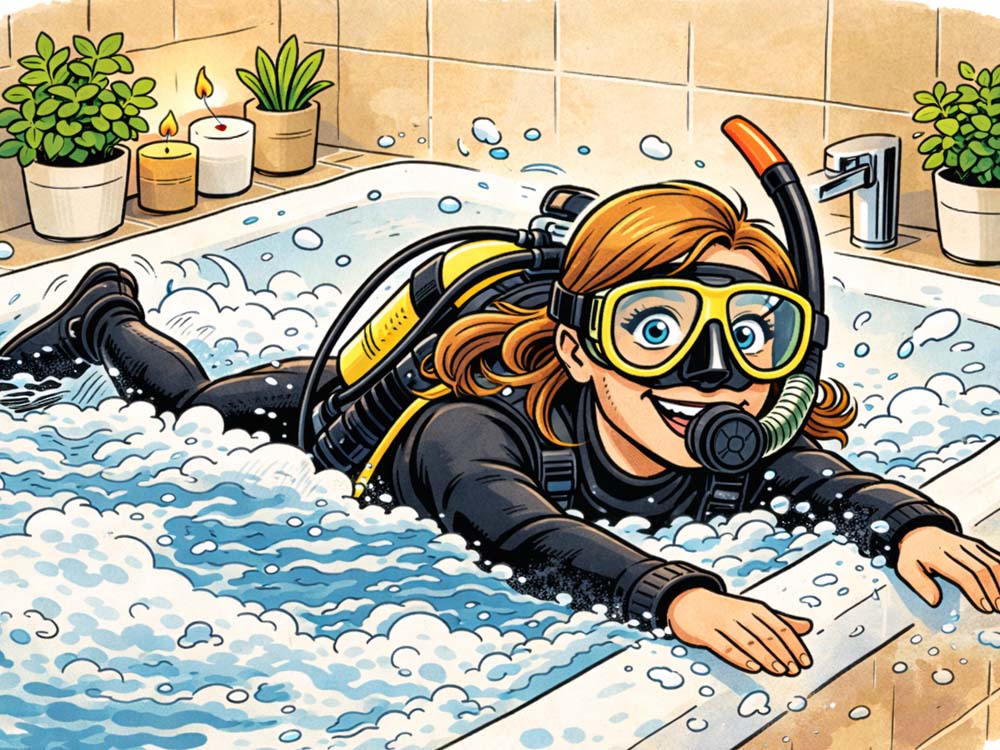
This image gave us a full wetsuit, oxygen tank, mask, fins… and about four feet of lukewarm bathwater. The commitment is Olympic. The setting is suburban Tuesday night.
It’s high-stakes gear in the lowest-stakes environment possible — and that tension is where the comedy lives. When you put Jacques Cousteau energy into a shampoo commercial backdrop, you’re already halfway to funny.
Let’s dive in. (Yes. We had to.)
What We Saw a Lot
First: puns. So many puns. Sink or swim. Tub-a diving. De-compress. Diving for duckies. The word “tub” did a lot of heavy lifting this week.
Second: poverty vacation jokes. “Home vacation.” “I couldn’t afford a beach vacation.” “Just practicing for the English Channel.” The “this is the budget version” instinct was strong.
Third: Jacques Cousteau references. “Cousteau always said explore every body of water.” “Uncle Jacques would be so proud.” When you hand the internet a scuba diver, they will summon Cousteau. It’s basically law.
Fourth: sharks. Or lack thereof. “Hey!! Guess what? No sharks!!” “Petrified of sharks.” The safety angle makes sense — bathtubs are famously shark-free.
None of these instincts were wrong. But when a lane gets crowded, execution becomes everything.
Missed Opportunities
A few captions were conceptually solid but didn’t quite sharpen the blade.
“I’m snorkeling in the bathtub!” names the joke but doesn’t elevate it. We already see that she’s in a bathtub. Comedy needs a shift — either escalation or misdirection.
“So much fun in such a small space.” is observational, but it stops at description. The audience is left to do the comedic lift.
“Petrified of sharks” is clean and clear, but it stays at the obvious surface-level irony. The image invites something slightly more specific — fear of something absurdly tiny, or an overblown internal monologue.
And “Ok practicing for the English Channel” goes big, which we like — but without a twist, it reads as a single-note exaggeration rather than a joke with a second beat.
The common thread: many captions identified the absurdity but didn’t twist it. Absurdity is step one. Surprise is step two.
Head to Head
Finalist:
“Cousteau always said explore every body of water”
Non-finalist:
“Uncle Jacques would be so proud”
Both lean on the Cousteau reference. Both understand the scale joke.
The finalist works better because it adds a layered pun. “Every body of water” reframes the bathtub as technically valid exploration while winking at the literal human body in the tub. There’s a conceptual turn there.
“Uncle Jacques would be so proud” is charming, but it stops at the reference. It’s a reaction, not a joke structure. The finalist creates a premise and then delivers a twist within the sentence.
In crowded territory, extra specificity and wordplay win.
Red Lines
“I’m feeling a bit pressured to get out, but I’m just going with the flow.”
This one reaches for scuba terminology — pressure, flow — which is smart. But stacking multiple watery metaphors dilutes the impact. Pick the strongest term and build the joke around that. When everything is a pun, nothing stands out.
“Howdy there!! Do you have a couple minutes about your car insurance?”
This is a classic non sequitur approach. Randomness can work — but only if it connects back to the image in a surprising way. Here, the scuba diver and the insurance pitch don’t intersect, so the absurdity feels arbitrary rather than earned.
“Wow just made it back from the nautilus it was quite a dive it’s amazing I could make it back easy”
Big imagination, but the joke lives entirely in exposition. We’re told a whole imaginary adventure, but there’s no clean punchline or reversal. When building an alternate reality, land it with a sharp, specific detail.
General lesson: clarity plus one strong twist beats a paragraph of underwater lore.
Winning Captions & Why They Worked
Let’s talk finalists.
“I’m told the visibility is better if you move the loofah out of the way.”
This works because it treats the bathtub like a legitimate dive site. The loofah becomes reef obstruction. The specificity (loofah!) grounds the absurdity. That’s precision.
“Scuba dub dub, one girl in a tub”
Pure rhythm play. It’s quick, musical, and immediately visual. Not overcomplicated — just a clean nursery-rhyme flip.
“Just taking a little me-time to de-compress”
Strong because it fuses self-care language with scuba terminology. “De-compress” operates in both worlds. That dual meaning is efficient and satisfying.
“Cousteau always said explore every body of water”
It stood out because it balanced clarity, wordplay, and conceptual layering in a single clean line. It doesn’t over-explain. It trusts the audience to catch the twist.
“When it’s sink or swim, choose tub.”
This one reframes a cliché in a way that fits the setting. It’s concise, direct, and relies on familiar language twisted just enough.
Final Thoughts
A scuba diver in a bathtub is already funny. Your job isn’t to shout over the image — it’s to find the one angle no one else thought to snorkel toward.
This week proved that even four feet of water can feel deep if you bring the right pressure.
Dry off, re-oxygenate, and then go make waves in the next contest — the water’s fine.
Check out the new image and submit your best caption before the bubbles settle.