Caption Contest 110: Recap & Review
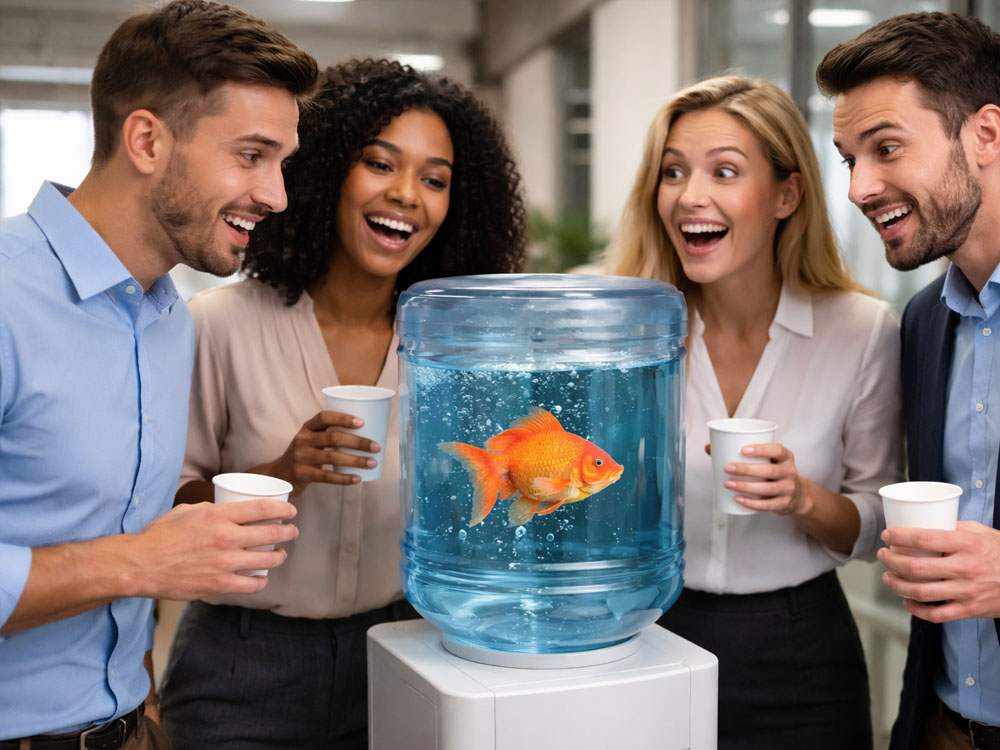
Office culture runs on two fuels: coffee and gossip. But in this office, the water cooler has upgraded to something a little more… aquatic.
The classic water cooler scene is already comedy territory. A circle of coworkers, whispering half-truths, pretending to work while discussing who got promoted, who’s leaving, and whether the breakroom microwave has finally crossed into biohazard territory.
Now add a fish to the tank.
Suddenly the water cooler isn’t just a place for gossip — it’s also the world’s most judgmental audience. Every whisper, every awkward pause, every questionable lunch choice… all happening directly in front of a creature that definitely did not sign an NDA.
And judging by this contest, CaptionCo writers were more than happy to go fishing for laughs.
What We Saw a Lot
Two main instincts surfaced quickly in this contest: fish puns and office culture jokes.
Fish puns were everywhere, which makes sense — the image practically invites them. Lines like “Good Morning, nice to see everyone is trying to be more e-fish-ient at work”, “Fresh and fishy”, and “There is something fishy about this water.” show how tempting that wordplay can be.
The challenge with fish puns is that they’re extremely common territory. Once several people reach for the same joke structure, the humor depends heavily on how clean and surprising the execution is.
The second strong instinct was workplace satire. Submissions like “Management finally scaled up hiring”, “The company is testing a fishbowl culture.”, and “Management’s way of telling us we spend too much time at the water fountain?” leaned into corporate language — a smart move, since the office setting gives those jokes context.
A third cluster centered on the fish overhearing gossip. “The fish hears everything” and “Great, now even the cooler is fishing for gossip.” both explored the idea that the fish is silently absorbing office secrets.
Overall, writers recognized the three big joke engines in the image: fish puns, office culture, and overheard gossip. The trick, as always, is not just identifying the engine — it’s driving it somewhere interesting.
Missed Opportunities
One area that felt underexplored was the coworkers themselves.
Most captions focused on the fish or the water cooler, but the image actually shows a group of people gathered around it. That dynamic opens up possibilities: office politics, group reactions, awkward meetings, or the idea that everyone is treating the fish like a coworker.
Another angle that could have been pushed further is the absurdity of the situation. A fish in a water cooler is such a strange solution to a problem that it invites bigger imaginative leaps. Why is it there? Is this corporate wellness? Surveillance? A new employee?
Several captions brushed against these ideas but stopped short of a stronger twist.
In comedy, the difference between a good joke and a memorable one is often that extra step — the moment where the caption commits fully to the weirdness of the premise.
Head to Head
Let’s compare two captions built around the same core idea: the fish hearing workplace gossip.
Finalist:
“Great, now even the cooler is fishing for gossip.”
Non-finalist:
“The fish hears everything”
Both captions recognize the same premise: the water cooler is where gossip happens, and now there’s literally a fish listening in.
But the finalist adds two key ingredients.
First, it uses the phrase “fishing for gossip,” which ties the fish concept directly into a familiar expression. That layered wordplay strengthens the connection between image and language.
Second, the phrasing “Great, now even…” creates a conversational voice. It sounds like an annoyed coworker reacting to the situation, which fits the scene naturally.
“The fish hears everything,” by contrast, identifies the idea but doesn’t add an extra turn. It’s a clean observation, but it stops where the finalist keeps going.
That extra linguistic twist is often what separates a solid caption from a finalist.
Red Lines
“Wow look at this new water flavor!!”
This caption leans into the idea that the water might taste like fish. That’s a workable direction, but the joke stops at the initial observation. For a concept like this to land, it usually needs a sharper framing — perhaps a character speaking, or a more specific reaction.
A useful rule: if the caption simply describes the oddity of the image, it often needs a second beat to become a joke.
“The company couldn’t afford team building at the aquarium, so this was the next best thing”
There’s a funny premise here — the fish as a substitute for an aquarium visit — but the caption carries a lot of setup before reaching the punchline. Longer captions can work, but they need a very strong payoff to justify the extra words.
In caption contests, brevity is usually an advantage. A tighter version of the same idea might have landed harder.
“Drink tank”
This is a clever phrase swap, playing on “think tank.” The issue is that the connection to the image isn’t immediately clear. Without a character speaking or a clearer setup, the joke feels slightly detached from the scene.
Wordplay works best when the visual context makes the pun feel inevitable.
Winning Captions & Why They Worked
Finalists:
“He’s got his own think tank!”
This caption is a near-perfect fit for the image. The pun works on multiple levels: a literal tank containing a fish and the idea of a “think tank” as a group generating ideas. It’s short, clean, and immediately understandable.
Most importantly, it feels natural to the scene. The coworkers gathered around the cooler could plausibly be joking about the fish like this.
“At Google they had an octopus.”
This caption works because it implies a larger world. It references tech-company experimentation and hints that some other office has already tried something even stranger. The understatement makes the joke feel effortless.
“He’s been here three days and he’s already been promoted to Head of Liquidity.”
This one shines through specificity. “Head of Liquidity” is an excellent corporate-style title that ties directly into the water cooler concept. It’s a smart example of using workplace jargon to elevate a visual gag.
“Management finally scaled up hiring”
A compact fish pun that also reads like corporate speak. The phrase “scaled up” works both as a business expression and as a literal reference to fish scales.
“Great, now even the cooler is fishing for gossip.”
As discussed earlier, this caption combines wordplay with character voice. It feels like something an employee would mutter while standing at the cooler, which helps it land naturally.
Together, these finalists show the ingredients that tend to perform well: brevity, clear connection to the image, and a twist that rewards the reader once they get it.
Final Thoughts
This contest proved that when you drop a fish into the workplace, the comedy starts swimming immediately.
The strongest captions didn’t just notice the fish — they treated it like part of the office ecosystem: a coworker, a management decision, or a silent witness to the daily gossip cycle.
And in a room full of office chatter, sometimes the quietest employee — the one literally in a tank — ends up with the funniest punchline.
Keep casting those lines, CaptionCo writers. There are plenty more jokes in the sea.
Check out the next CaptionCo contest and throw your line in the water. 🎣