Caption Contest 111: Recap & Review
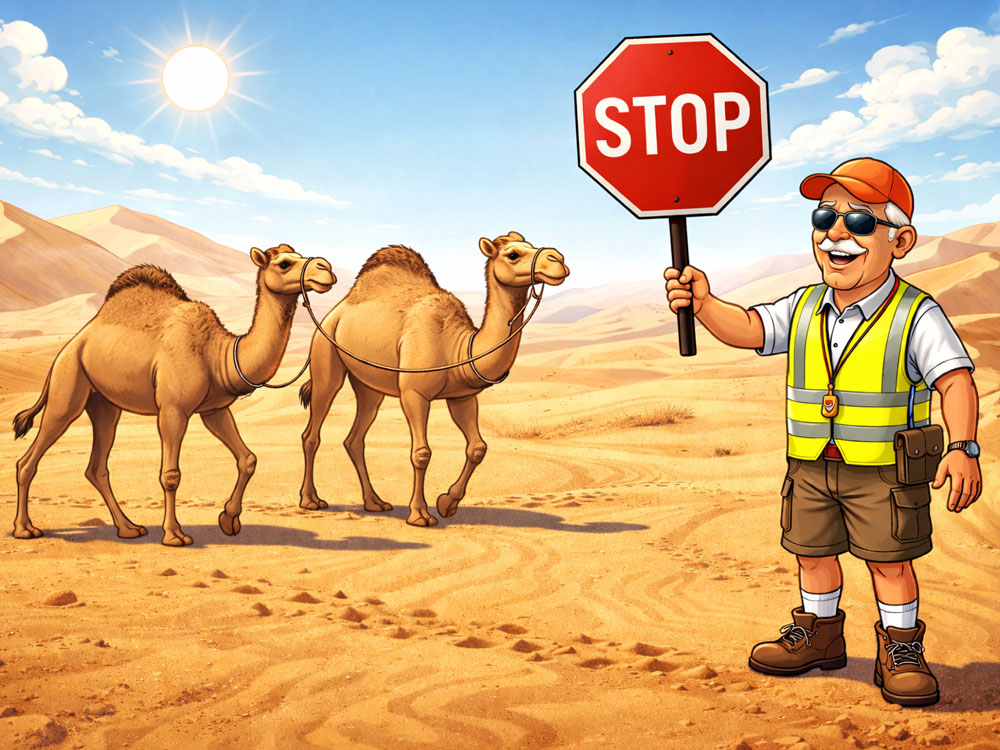
A lonely crossing guard stands in the middle of the desert, dutifully holding up a stop sign while two camels shuffle past like commuters who forgot their coffee. No road. No cars. No school buses. Just sand, sun, and two extremely unimpressed ungulates.
It’s the kind of scene that raises more questions than it answers. Who assigned this post? What traffic are we regulating out here? And most importantly: are camels required to obey crossing guards?
Naturally, the submissions leaned heavily into desert wordplay, camel anatomy, and the absurdity of bureaucratic order appearing in the most unnecessary place imaginable. In other words: exactly the right comedic instincts for this image.
Let’s walk it across the sand together.
What We Saw a Lot
Two major joke engines powered this contest: camel wordplay and desert bureaucracy.
Camel jokes came in a few varieties. There were hump jokes, lump jokes, and Hump Day jokes, all riffing on the famous camel silhouette. Examples include:
“It’s a two hump stop.”
“Slow down for the double hump.”
“One lump or two?”
“It’s almost “Hump Day””
These jokes worked because the visual gave you a literal two-hump setup. The challenge was simply finding the cleanest way to exploit it.
The second big lane was the absurdity of enforcing rules in a place that clearly doesn’t need them. Submissions like:
“School’s back in session at Oasis Elementary”
“Your Taxes at work”
“Simon says… Stop!”
all tapped into the strange logic of assigning a crossing guard where there’s nothing to cross.
Finally, several captions leaned into desert wordplay, especially with the double meaning of desert.
“It’s a quiet crossing, but he won’t desert his post”
“Desert traffic’s been brutal since the mirage detour”
Those jokes fit the scene naturally and allowed the captions to feel grounded in the environment instead of just floating above it.
Missed Opportunities
One thing this image offered—but wasn’t always fully explored—was the complete mismatch between job and environment.
A crossing guard suggests a school zone, a busy street, impatient drivers. Instead we have sand dunes and two camels walking at the speed of geological time.
Some captions gestured toward this idea but didn’t push it far enough. “School’s back in session at Oasis Elementary” was close to something great because it starts building a fictional desert infrastructure. The stronger move would have been to lean deeper into that imagined world.
Another opportunity was the camels themselves as characters. They’re not just animals passing through—they look like pedestrians being inconvenienced by a strangely enthusiastic hall monitor.
Captions that treated the camels as passive scenery tended to feel flatter than those that imagined them interacting with the guard or the rules.
Head to Head
Let’s compare one finalist with a nearby idea.
Finalist:
“No parking allowed in the Camelot”
Non-finalist:
“Camel crossing only..!”
Both captions attempt the same general strategy: building a sign-style rule that applies to camels.
But “No parking allowed in the Camelot” wins for a few reasons.
First, it adds a layered pun. “Camelot” evokes the Arthurian kingdom, which creates a quick moment of recognition before the viewer realizes the word has been camel-ified.
Second, it implies a broader world. The caption suggests there are parking rules in Camelot, which is funny precisely because we’re staring at a patch of empty desert.
Meanwhile, “Camel crossing only..!” is conceptually correct but stops at the obvious. It labels the scene instead of adding a twist.
The difference is small but important: one expands the joke; the other simply describes it.
Red Lines
“Are you carrying OIL ?”
This caption gestures toward geopolitical humor, but the connection between camels crossing the desert and oil inspection isn’t immediately clear. In caption writing, the audience shouldn’t have to reverse-engineer the premise. If the mental bridge takes too long to build, the joke loses its timing.
A helpful rule: if the reader has to ask “Wait, why?” before laughing, the setup probably needs sharpening.
“Stop those camel toes right in their tracks”
This caption goes for shock-value wordplay. The challenge with this type of joke is that the phrase itself becomes the entire punchline. Once the reader recognizes the expression, there’s nowhere else for the humor to go.
Stronger captions usually include a second beat—a twist, a situation, or a perspective shift that expands the idea beyond the phrase itself.
“STOP, in the name of Sand!”
This parody attempts to riff on the famous lyric “Stop! In the Name of Love.” The structure is there, but the swap (“Sand”) doesn’t create a strong enough payoff.
Parodies tend to work best when the replacement word deepens the visual logic of the scene rather than simply rhyming or sounding similar.
Winning Captions & Why They Worked
Finalists:
“I’m not saying we’re lost, but the nearest school is three countries away.”
This caption leans directly into the core absurdity of the image: a crossing guard with no school in sight. The escalation to “three countries away” pushes the scale wide enough to feel ridiculous, which is exactly what the visual needs.
“No parking allowed in the Camelot”
As discussed earlier, the layered pun plus the implied rule system gives the joke extra depth.
“It’s a quiet crossing, but he won’t desert his post”
A classic wordplay structure that fits the scene neatly. The pun is clean, and the phrase “won’t desert his post” perfectly captures the guard’s unnecessary dedication.
“Desert traffic’s been brutal since the mirage detour”
This caption expands the world of the joke. Suddenly there’s desert traffic, detours, and mirages causing infrastructure problems. It’s a funny mental image because it treats the desert like a congested city.
“When the crossing guard can’t slow traffic, they deploy the humps.”
This one uses the camels themselves as a traffic-calming device, which is a clever inversion of real-world speed bumps. The phrase “deploy the humps” adds a mock-official tone that fits the crossing guard theme.
Final Thoughts
This contest proved one thing: even the quietest stretch of desert can generate a surprising amount of traffic—at least in the pun department.
Between humps, mirages, Camelots, and one very committed crossing guard, the captions managed to turn a silent sand dune into a fully regulated school zone.
The best jokes treated the image like a tiny world with its own strange rules. Once that world exists, the humor almost writes itself.
And remember: if you ever find yourself directing camel traffic in the middle of nowhere… hold the sign high and trust the humps.
Now head over and check out the next CaptionCo contest—and see if your joke can cross safely into the winner’s circle.