Tips for Caption Contest 111
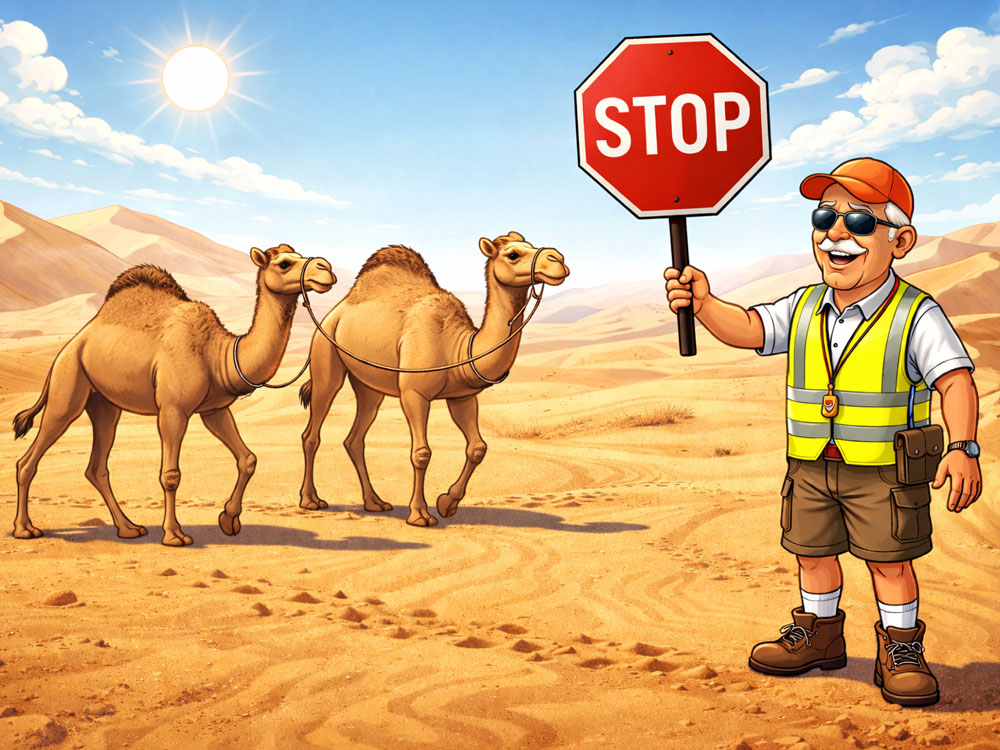
There are few things more committed to routine than a crossing guard. Reflective vest. Stop sign. A deep belief in the sanctity of crosswalks.
Now place that same crossing guard in the middle of a vast, empty desert. No road. No painted lines. No minivan in sight.
And yet—there he stands. Dutifully ushering two camels across… something.
It’s the confidence that makes it funny. The absolute certainty that traffic rules apply, even when traffic does not. 🛑🐪
Getting Started: What’s in the Image?
Let’s inventory the literal scene.
A human crossing guard in full gear. Reflective vest. Handheld stop sign. The posture of someone who has done this a thousand times.
Two camels crossing in front of him.
And nothing else. No cars. No crosswalk. Just open desert stretching in every direction.
The key visual tensions:
-
Official safety ritual vs. total emptiness
-
Urban job vs. remote wilderness
-
Structured rules vs. wild animals
-
Serious body language vs. absurd setting
The camels aren’t stampeding. They’re calmly walking. The crossing guard isn’t confused. He’s focused. That seriousness is fuel for your joke.
Think Beneath the Surface
This isn’t just “a weird job in a weird place.” It’s about misplaced professionalism.
Why is he here? Is this:
-
Overregulation gone too far?
-
A bureaucratic assignment mix-up?
-
A desert suburb with very specific HOA rules?
-
The camels’ first day of kindergarten?
You can also explore scale. In a city, a crossing guard manages chaos. Here, he’s imposing structure on infinity.
Or flip the perspective:
-
Maybe the camels requested a crossing guard.
-
Maybe this is rush hour in the Sahara.
-
Maybe he’s wildly overqualified for camel traffic.
There’s also something inherently funny about applying human systems to nature. Stop signs. Safety vests. Order. As if the desert filed a permit.
Another angle: commitment. This is someone who shows up no matter what. Budget cuts? Sandstorms? Still clocking in.
The stronger jokes won’t just say, “This doesn’t belong here.” They’ll answer: Why does he think it belongs here?
General Tips on How to Be Funny
Lean into specificity.
“Wrong place” is broad. “Assigned to Camel Crossing Sector 7 after a clerical error” is specific.
Example: “They said remote work. They didn’t mean this remote.”
Give the camels agency.
Animals with opinions are almost always funny. What do they think of this human intervention?
Example: “Honestly, we could’ve handled it.”
Play with language.
“Crosswalk,” “rush hour,” “traffic jam,” “yield,” “school zone”—these phrases gain new life in sand.
Example: “Sahara School District takes safety very seriously.”
Escalate the bureaucracy.
Forms. Certifications. Desert compliance training. Imagine the paperwork required to justify this position.
Example: “Camel Crossing Guard Level II.”
Avoid stating the obvious.
We all see that there are no cars. Don’t stop at “No traffic for miles.” Push further—what’s the system he believes he’s enforcing?
Contrast confidence with absurdity.
The crossing guard’s seriousness is your straight man. The more he believes in the rule, the funnier the rule becomes.
Restraint matters.
A clean, one-beat joke that reframes the scene will usually beat a long explanation. Find the angle and trust it.
Final Thought
The desert is empty—but your joke shouldn’t be. Find the rule that doesn’t belong, the system that’s gone too far, or the camel that filed a complaint, and build from there.
Now grab your stop sign and guide your best caption across the finish line—enter Contest 111 before it disappears into the dunes.