Caption Contest 113: Recap & Review
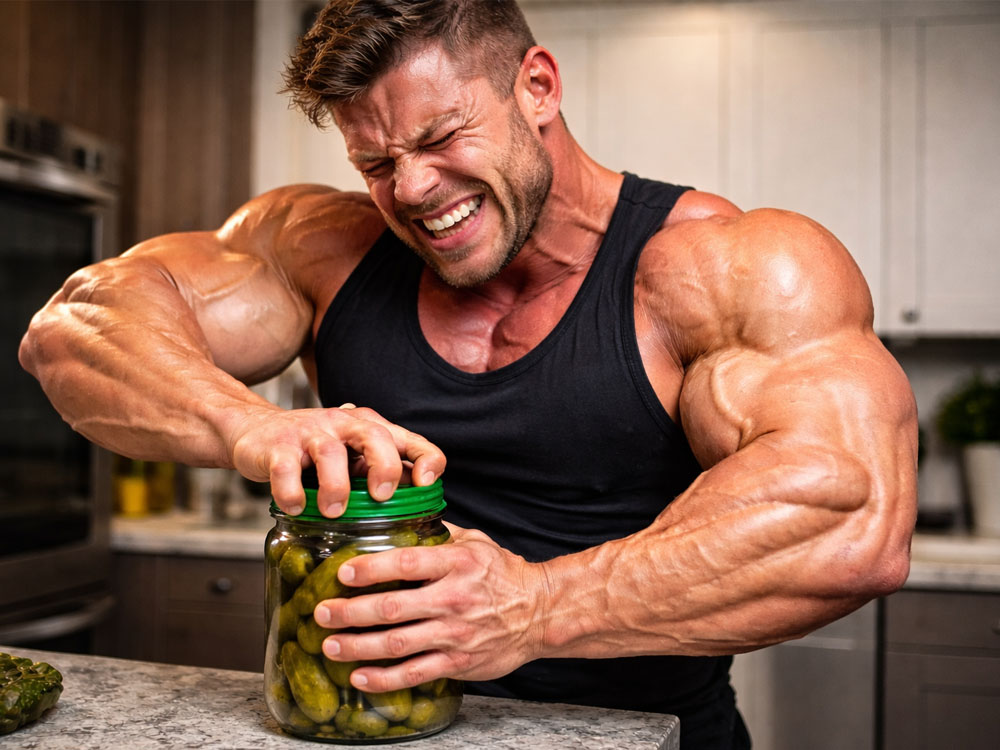
There are few images more humbling than a giant, sculpted bodybuilder locked in combat with… a pickle jar.
This is the classic mismatch comedy loves: overwhelming physical strength versus a tiny, stubborn household object. The man can deadlift a Buick, but the lid on a jar of pickles has him reconsidering his entire identity.
And that tension — between muscles and impotence, confidence and embarrassment, strength and snack time — gave this contest a lot of juicy comedic territory.
Naturally, many of you leaned into the obvious pickle territory. Which, to be fair, is hard to resist. When life hands you a jar of pickles, the instinct is to relish the opportunity.
Let’s crack this lid and see what worked.
What We Saw a Lot
The most common instinct was pickle wordplay. Once the brain locks onto the word “pickle,” it’s like opening a pun vending machine.
We saw variations like:
-
“Damn I’m in a pickle!”
-
“Looks like he’s in a pickle.”
-
“If I can’t open this, it’s a big dill!”
-
“Relish the moment you meet your match”
-
“Relish-ing the challenge 💪”
This direction makes sense. The image is literally about pickles, and food puns are a familiar caption contest move. But because so many captions leaned into the same word family, the jokes started competing with each other instead of standing out.
Another common approach focused on strength versus weakness — the humiliation of a bodybuilder losing to a jar. Captions like:
-
“Hold on, I’ve almost got it.”
-
“Muscles do not make the man!”
-
“You know what they say about men with tiny hands”
These tapped into the core joke of the image: this guy’s entire identity is based on strength, and he’s losing to something normally solved with a dish towel and mild determination.
Finally, a smaller group leaned into domestic embarrassment — the idea that someone else (often a woman, a mom, or a child) could open it easily. That’s fertile ground for comedy because it flips the bodybuilder’s power dynamic completely.
The finalists tended to combine a clear joke with quick execution, rather than piling on explanation.
Missed Opportunities
One opportunity that wasn’t explored much was the bodybuilder’s internal narrative.
This image almost begs for the voice of someone whose entire worldview is cracking in real time. A man who has built his life around strength is suddenly staring down a jar like it’s an existential threat.
Another underused angle was gym culture specificity. The bodybuilding world is full of very specific language — reps, sets, rest days, supplements — and bringing that vocabulary into the kitchen would have been a strong contrast.
Some captions also drifted into explanatory territory — describing the situation rather than sharpening the joke inside it. The funniest captions usually trust the image to do half the work.
When the caption simply nudges the audience toward the punchline, the humor lands faster.
Head to Head
Let’s compare one finalist with a similar idea that didn’t quite break through.
Finalist:
“Never skip jar day.”
Non-finalist:
“Hold on, I’ve almost got it.”
Both captions work with the core premise: the bodybuilder is struggling with the jar.
But “Never skip jar day.” succeeds because it borrows the familiar gym phrase “Never skip leg day” and swaps in the object from the scene. That twist lands instantly. It’s tight, visual, and uses existing cultural language.
“Hold on, I’ve almost got it.” captures the situation accurately, but it stays at the surface level. It describes the moment instead of reframing it.
The difference is subtle but important: the finalist reinterprets the image, while the non-finalist simply narrates it.
Red Lines
Let’s look at a couple captions that were close but illustrate useful lessons.
“Wish I were a jar”
This caption has an intriguing premise. There’s a strange, almost philosophical angle here — the jar has power, the man doesn’t.
But the joke stops before it fully forms. The audience is left wondering what the speaker means. Is this about strength? Envy? Some deeper metaphor? Comedy usually benefits from a clearer turn.
A small shift toward clarity or context could turn this into something sharper.
“I’m going to go to store and buy one that will open, I’d never live this down”
This caption introduces a funny idea: the bodybuilder abandoning the jar entirely to avoid embarrassment.
The challenge here is length and focus. The caption contains several beats — the store trip, the jar replacement, the social humiliation — which dilutes the punchline.
Often the stronger move is to compress the idea to its funniest core. The more direct the line, the faster the laugh.
“I fixed his ego when I gottilla-glued the pickle jar lid.”
There’s a solid setup here: sabotage as revenge against a bodybuilder’s ego.
But the caption spends too much time explaining the mechanism (how the jar got stuck) instead of letting the audience infer it. In many jokes, mystery is funnier than explanation.
If the caption focuses more on the revenge angle and less on the logistics, the idea becomes sharper.
Winning Captions & Why They Worked
“A woman’s work is never done! Sweetie I’ll get it”
This caption succeeds because it completely flips the power dynamic.
The bodybuilder is visually imposing, but the caption introduces a voice — likely a woman — who treats the problem as trivial. The humor comes from that casual confidence.
It also creates a clear character relationship: the massive strongman humbled by an everyday domestic reality.
The finalists each found slightly different ways to exploit the image.
“Relish-ing the challenge 💪”
This one leans into wordplay, but keeps it simple. The pun is clean and the flex emoji reinforces the bodybuilder context without overexplaining.
“Never skip jar day.”
Arguably the cleanest joke in the group. It reframes the struggle as a gym training principle, turning the kitchen into a workout setting.
“Turns out the real pickle is the jar.”
This caption works by subverting the idiom “in a pickle.” The audience expects the phrase to mean a difficult situation, but the caption points back to the literal object causing the trouble.
“Ego jar-ring”
A quick visual pun that connects the jar to the bodybuilder’s wounded pride. The brevity helps the joke land quickly.
Across the finalists, a pattern emerges: tight phrasing, one clear idea, and trust in the image.
Final Thoughts
This contest proved one timeless comedic truth: the bigger the muscles, the funnier the struggle.
Watching a powerful character lose to something tiny is a reliable recipe for humor. It’s the same reason slipping on a banana peel is funny — strength meets sudden helplessness.
And the pickle jar is a perfect comedic villain. Small. Silent. Stubborn. The kind of opponent that doesn’t care how many reps you did this morning.
So keep lifting those captions, keep tightening those punchlines, and remember: sometimes the biggest laughs come from the smallest jars.
Check out the latest contest and see if you can crack the next caption before someone else twists the lid.