Caption Contest 114: Recap & Review
There are few phrases more dangerous in the English language than “Insert Name.”
It lives quietly inside templates, contracts, and forms, waiting patiently for someone to forget it exists. And when that happens, chaos follows. Birthdays are ruined. Office memos become existential poetry. And occasionally, a very confused baker pipes it directly onto a cake.
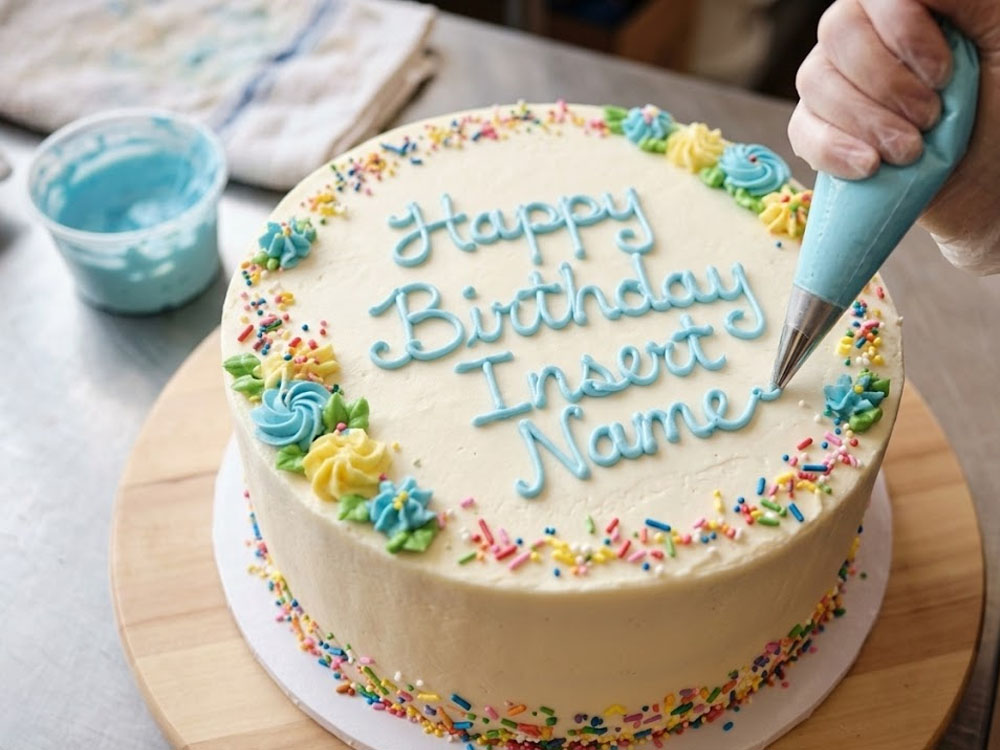
This week’s image captured that exact moment: a baker carefully icing the words “Happy Birthday Insert Name.” Not a placeholder. Not a draft. A finished product.
It’s the culinary equivalent of sending an email that begins with “Dear [Client Name],” except now there are candles involved and someone’s grandmother is waiting to sing.
Naturally, the captions leaned into bureaucracy, laziness, automation, and the strange philosophical implications of a birthday cake that refuses to commit to an identity. Let’s slice into it.
What We Saw a Lot
The dominant instinct this week was placeholder humor. Once contestants spotted “Insert Name,” they quickly explored the obvious implications: templates, forms, contracts, and clerical errors.
Captions like:
“Just sign above the frosting line.”
“When the training manual is followed TOO closely.”
“Proof that Ctrl+C and Ctrl+V can be dangerous in the kitchen.”
all orbit the same central idea: the baker treating the cake like paperwork.
Another strong cluster involved AI or automation jokes:
“What happens when you hire A.I. at the bakery.”
This is a natural modern reflex when something looks templated or robotic.
We also saw several captions interpreting “Insert” as a literal name, including:
“Odd name, sounds foreign”
“Well, Mr and Mrs Name, do you think your son Insert will like it?”
“That’s my brother’s name!”
That approach can work if the framing commits fully to the absurdity. The challenge is that once the audience recognizes the placeholder gag, these interpretations have to push harder to create a second layer.
Finally, there was a nice pocket of dark humor, especially around funerals and gravestones — a clever tonal pivot considering the cake-writing aesthetic overlaps heavily with memorial inscriptions.
Missed Opportunities
One comedic seam that was only lightly explored was the baker’s perspective.
The image shows someone confidently decorating the cake, which implies a level of professional commitment to the mistake. That opens the door to jokes about craftsmanship, stubbornness, or overconfidence.
For example, the humor could lean into:
-
Bakers who refuse to admit errors
-
Bakeries that mass-produce celebration cakes without context
-
A baker who thinks “Insert” really is the name
Another underused direction was party guest reactions. A cake like this would immediately spark confusion, awkward explanations, and passive-aggressive family debates.
The best captions tend to widen the comedic frame slightly beyond the object itself. When the joke expands to include the baker, the customer, or the celebration, the situation becomes richer and more cinematic.
Head to Head
Let’s compare a finalist with a caption exploring a similar bureaucratic idea.
Finalist:
“Just sign above the frosting line.”
Non-finalist:
“Don’t worry about blowing out the candles, just initial here and we can start your celebration.”
Both captions translate the cake into a legal document, which is a smart instinct.
The finalist works better primarily because of compression.
“Just sign above the frosting line.” lands quickly and cleanly. It mirrors the familiar phrase “sign above the dotted line,” which means the audience processes the joke almost instantly.
The longer caption expands the premise but loses some comedic snap. By the time we reach “start your celebration,” the punch has already occurred.
Comedy often rewards the shortest path between setup and recognition, and the finalist travels that path efficiently.
Red Lines
A useful lesson this week comes from captions that identified the idea correctly but stopped one step too early.
For example:
“The baker really took the cake with this one.”
This uses a familiar idiom tied to cakes, which makes thematic sense. The challenge is that the phrase doesn’t interact directly with the image’s specific mistake. It could apply to almost any cake scenario. Strong captions tend to exploit the unique detail of the image — in this case, the placeholder text.
Another example:
“Making the party more inclusive.”
The concept here is interesting: a cake that applies to anyone. But the caption leaves the audience to do most of the interpretive work. A stronger version would push the idea further so the payoff becomes clearer and sharper.
One more instructive case:
“What an unusual name!”
This caption recognizes the “Insert Name” ambiguity but stops just short of building a full comedic frame. If the joke leaned into a specific character reacting to the name — a confused baker, a proud parent, or a celebrity baby announcement — it would gain specificity and momentum.
The takeaway: spotting the funny detail is step one; building a situation around it is step two.
Winning Captions & Why They Worked
The finalists showcased strong instincts.
“Just sign above the frosting line.”
As discussed earlier, this one excels through clarity and familiarity. It instantly transforms the cake into legal paperwork.
“What the blank!”
A simple but effective pivot. The phrase normally expresses frustration, but here it cleverly references the literal blank space where the name should go.
“He also does gravestones!”
This one stood out because it changes industries. The piping style used on cakes resembles engraved memorial lettering, and the caption exploits that visual overlap to create a dark, unexpected shift.
“Following directions to the “T””
A nice commentary on over-literal interpretation. The baker received instructions and executed them exactly — perhaps too exactly.
“Whisking you batter baker next time.”
A dense stack of baking wordplay. While busier than the other finalists, it embraces the kitchen setting and commits fully to the pun-driven style.
Together, these captions demonstrate several winning qualities: brevity, specificity, and a clear comedic frame.
Final Thoughts
This contest was a good reminder that comedy often hides inside small details. One overlooked placeholder text created an entire buffet of jokes about bureaucracy, automation, stubborn bakers, and existential birthday cakes.
The strongest captions didn’t just point at the mistake — they reframed it. They turned the cake into a legal contract, a philosophical statement, or a suspiciously funeral-adjacent bakery service.
And if nothing else, this image provides an important life lesson: always double-check your templates before frosting anything.
Otherwise, somewhere out there, a very confused person named Insert is about to blow out some candles.
Check out the next CaptionCo contest and see if you can pipe up a winner of your own.