Caption Contest 117: Recap & Review
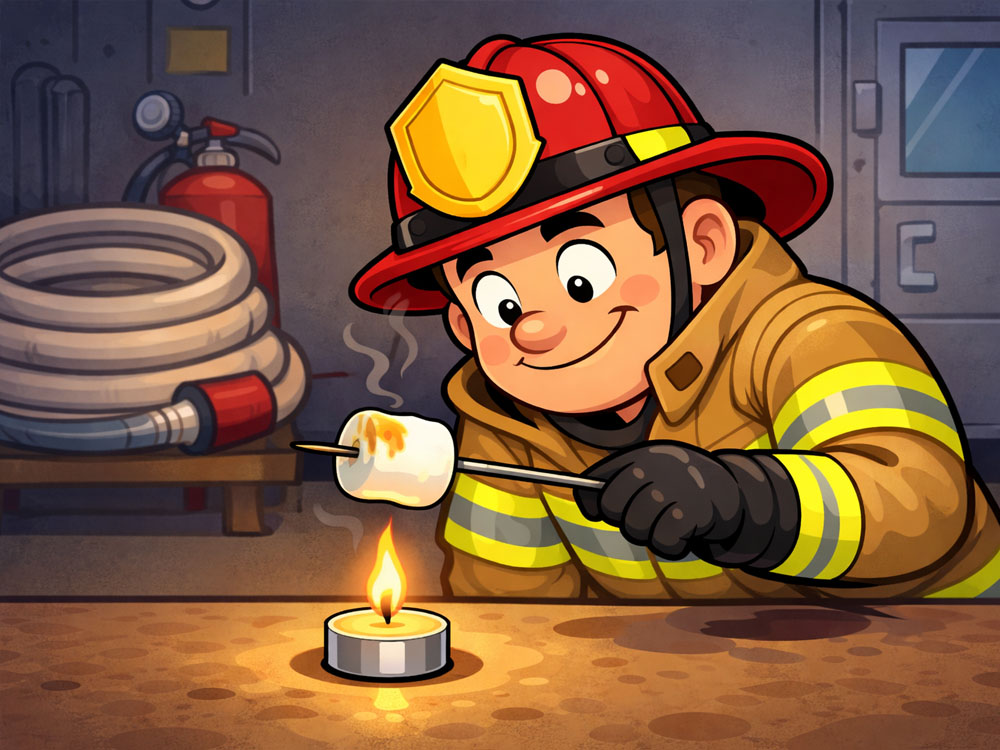
This firefighter isn’t battling a five-alarm blaze. He’s facing something far more delicate: the perfect marshmallow toast.
Instead of roaring flames and billowing smoke, our hero has a single tiny candle. It’s less “inferno” and more “birthday party.” The contrast between firefighter bravado and candle-level heat turned out to be fertile ground for jokes.
The image invites a simple question: if you spend your whole career putting fires out… how do you feel about using one to make snacks?
Contestants clearly enjoyed playing in that space. And while many captions warmed up nicely, the best ones found just the right amount of heat—golden brown, not charred.
Let’s take a look at what caught fire.
What We Saw a Lot
The dominant instinct this round was fire-related wordplay. Not surprising. When you give caption writers a firefighter, a flame, and a marshmallow, the pun engine practically starts itself.
Many captions leaned into alarm/fire terminology:
-
“This snack is alarmingly good”
-
“All fired up for snack time”
-
“Extinguishing my hunger”
-
“Extinguishing hunger, one mallow at a time”
This approach makes sense. Firefighting vocabulary is naturally dramatic, and dropping that language into a snack situation creates a funny mismatch.
Another popular lane was s’mores wordplay, including entries like:
-
“Where there’s smoke, there’s s’mores.”
-
“It’s s’more than a job — it’s a calling.”
-
“That’s s’more like it”
You also saw several captions built around job irony — the idea that firefighters usually put out flames but are now carefully nurturing one.
Examples include:
-
“Technically, I’m still on a ‘controlled burn.’”
-
“Training exercise: patience.”
-
“I’m doing light duty today.”
Overall, the instincts were solid. The trick, as always, was making the idea feel specific and surprising, not just expected.
Missed Opportunities
One opportunity that many captions brushed up against but didn’t fully exploit was the tiny size of the flame.
This firefighter presumably handles raging fires for a living, yet here he is treating a candle like a full-scale operation. That scale mismatch is where a lot of the comedic potential lives.
A few entries hinted at it:
-
“At least this votive candle won’t get out of hand”
-
“This works so much better than the LED light the chief gave me”
But many captions stayed focused on generic fire jokes rather than the ridiculous seriousness of the moment.
Another underused angle was the hyper-professional mindset of firefighters. These are people trained to assess risk, follow protocols, and respond to danger quickly. Applying that mindset to a marshmallow would have created strong character-driven humor.
For example, imagine the firefighter treating the marshmallow roast like a full emergency response. That tension between high-stakes training and low-stakes snack time is where a lot of comedy could have lived.
In other words: the candle wasn’t just a flame. It was a very small emergency.
Head to Head
Let’s compare a finalist with a similar idea that didn’t quite rise to the top.
Finalist:
“Training exercise: patience.”
Non-finalist:
“I’m doing light duty today.”
Both captions rely on the same general premise: the firefighter treating marshmallow roasting as part of the job.
But the finalist works better for a few reasons.
First, “Training exercise: patience.” sounds like an official instruction or drill name. It instantly creates a mental image of firefighters being trained to slowly toast marshmallows as part of their professional development.
Second, the wording is tight and understated. No extra explanation. Just the label of the “exercise.”
“I’m doing light duty today.” communicates a similar concept but feels more generic. It’s a common phrase that doesn’t introduce a new perspective on the image.
The finalist reframes the scene. The non-finalist mostly describes it.
That small shift makes a big difference.
Red Lines
Let’s look at a couple submissions that were close but could have sharpened their punch.
“I hope it catches on fire, so I can put it out.”
This caption captures a funny thought: a firefighter secretly hoping for a problem so he can solve it. The comedic premise is strong.
Where it struggles is efficiency. The idea takes a few extra words to land, which softens the impact.
In captions, shorter phrasing often helps the joke snap into place faster. A tighter version of this concept would likely hit harder.
Another example:
“Afraid of fire, but love those toasted marshmallows!”
The idea here flips the expected personality of a firefighter, suggesting someone who paradoxically fears fire.
The issue is that it doesn’t quite connect to the image. The firefighter clearly isn’t afraid of the flame — he’s calmly roasting a marshmallow over it.
When the caption contradicts the visual too strongly, the joke can feel detached from the scene instead of playing off it.
A final one worth noting:
“I love the smell of burning marshmallow in the morning”
This references the famous Apocalypse Now line. Cultural callbacks can work well, but they tend to land best when the object of the parody matches the tone of the original line.
Here the dramatic war reference clashes with a fairly gentle marshmallow moment, making the parody feel a bit forced.
Lesson: references work best when they feel inevitable, not imported.
Winning Captions & Why They Worked
The standout winner was:
“Where there’s smoke, there’s s’mores.”
This caption succeeds because it’s clean, familiar, and perfectly matched to the image.
It riffs on the well-known phrase “Where there’s smoke, there’s fire,” but swaps in the snack context with minimal effort. That economy makes the joke feel effortless.
It also connects directly to what we’re seeing: smoke, flame, marshmallow, firefighter.
Simple idea. Perfect fit.
Other finalists also showed strong instincts.
“Technically, I’m still on a ‘controlled burn.’”
This one works because it frames the marshmallow roasting as legitimate fire management. It uses authentic-sounding firefighting language while quietly acknowledging how small and harmless the situation actually is.
“This snack is alarmingly good”
A solid pun built around firefighting vocabulary. The structure is clean and the phrase reads naturally, which helps the joke land quickly.
“Training exercise: patience.”
As discussed earlier, this caption creates a funny training scenario inside the image. It’s understated and specific — two reliable ingredients for caption success.
“This marshmallow is like a backdraft—looks calm on the outside, pure chaos on the inside”
This entry stands out for its specificity. “Backdraft” is a very firefighter-specific concept, which adds authenticity and raises the stakes humorously.
Even though it’s a bit longer than most winning captions, the vivid comparison helps carry it.
Together, these finalists all share one trait: they feel rooted in the firefighter’s world while still embracing the absurdity of the marshmallow situation.
Final Thoughts
Roasting marshmallows usually happens around campfires. This week, it happened under the careful supervision of a professional.
The challenge with an image like this is avoiding the obvious flame jokes long enough to find the angle hiding inside the scene. The best captions did exactly that — spotting the contrast between heroic firefighting and delicate candle-powered snack time.
In the end, the winning captions struck the perfect balance: warm, crisp, and just a little bit smoky.
Which, coincidentally, is also how you want your marshmallow.
Now grab a stick and head over to the next contest before this one cools off.