Caption Contest 118: Recap & Review
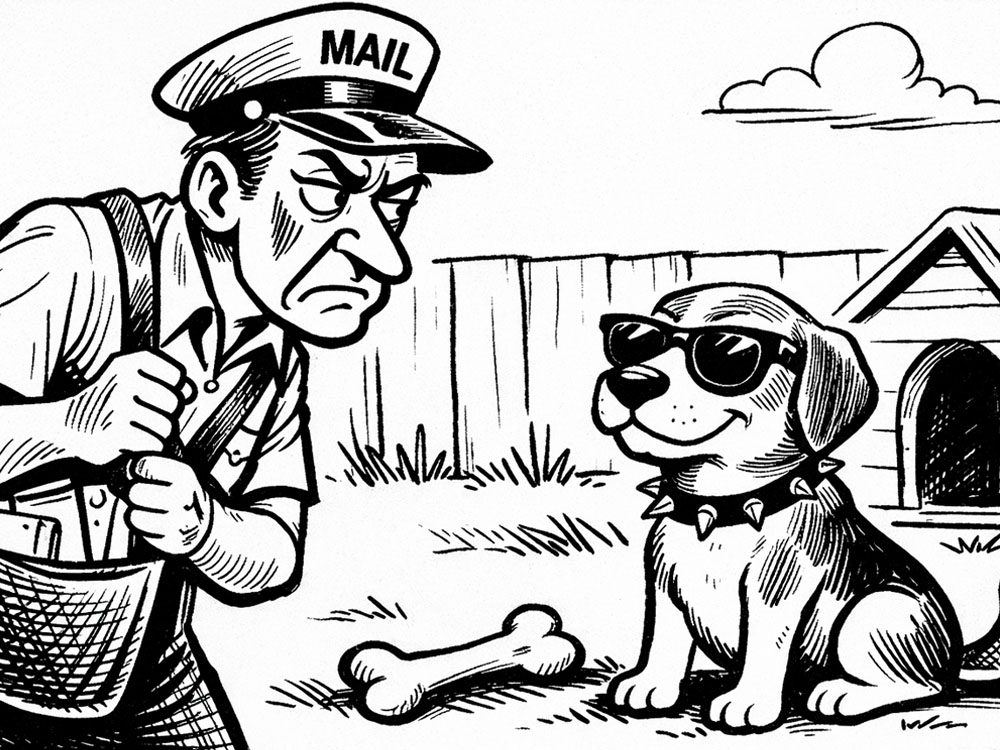
Somewhere in America, a mail carrier has encountered the one thing training manuals never prepared him for: a dog who looks like he’s about to critique his quarterly performance.
The sunglasses change everything. This isn’t a barking, tail-wagging dog. This is a dog leaning back in his lawn chair energy, silently judging the contents of your delivery bag like a neighborhood HOA president.
Mail carriers are used to dogs chasing them. But when a dog shows up looking cooler than you? That’s psychological warfare.
Contest 118 produced a nice mix of “cool dog,” “mailman anxiety,” and “role reversal” humor. Let’s sort through the mail pile and see what got delivered.
What We Saw a Lot
The dominant instinct in this contest was coolness humor. Once the sunglasses enter the frame, writers naturally gravitated toward the dog being stylish, confident, or suspiciously relaxed.
Captions like “Future is so bright have to wear my shades,” “Peace out mailman I’m too cool for you,” and “Man don’t I look good” all leaned into the sunglasses as shorthand for attitude.
Another popular direction was mailman vs. dog power reversal. Normally the mailman fears the dog. Here, writers flipped the script and gave the dog the upper hand. Examples include “Respect my territory or lose the mail,” “I’ll act like I’m blind. Then, bite him!” and “Normally the dog chases the mailman. This one audits him.”
A third recurring theme was mail-related jokes—packages, deliveries, and subscriptions. “Has my copy of ‘Cool Dogs Monthly’ arrived?” and “Who’s not getting their Crewy order?” both worked in that space.
All solid instincts. The image gives you a cool dog and a cautious mailman; most captions built around one or both of those ingredients.
Missed Opportunities
Where the field occasionally stalled was staying on the surface of the sunglasses joke.
A cool dog is funny, but it’s the starting point—not the punchline. Many captions described the dog’s coolness without adding a twist or escalation.
For example, captions like “Peace out mailman I’m too cool for you” or “Man don’t I look good” capture the vibe but don’t introduce a second idea. The best captions tend to pivot—they begin with the visual but end somewhere unexpected.
Another opportunity was playing more with the mailman’s paranoia. The image shows a mail carrier staring at the dog like he’s trying to determine whether this is a trap. That tension opens the door to jokes about surveillance, disguises, or quiet intimidation.
A few captions got close to this idea but didn’t quite sharpen the framing. The image has a lot of comedic fuel in that silent standoff.
Head to Head
Let’s compare a finalist with a caption exploring a similar idea.
Finalist:
“Normally the dog chases the mailman. This one audits him.”
Similar submission:
“You get that I’m a mailman right?”
Both captions recognize the same underlying dynamic: the mailman is unsettled because the dog isn’t behaving like dogs usually do.
The finalist succeeds because it adds a specific twist. The word “audits” instantly reframes the dog as an accountant-like authority figure reviewing the mailman’s work. That single word escalates the joke and paints a vivid picture.
“You get that I’m a mailman right?” captures the confusion but stops short of a punchline. It’s more of a reaction than a comedic concept.
The difference is subtle but important: one caption describes discomfort, while the other creates a comedic scenario.
Red Lines
Some captions wandered away from the image entirely.
“Quit being mean Trump supporter”
The strongest CaptionCo entries stay grounded in the visual moment. Political commentary can sometimes work, but it needs a clear connection to what’s happening in the image. Without that link, the joke feels detached from the scene.
Another example worth discussing:
“I am going to make a bone about it”
This plays on the phrase “make a bone to pick,” but the word swap alone doesn’t create a strong comedic image. Puns tend to land best when they’re anchored in the situation. Here, the phrase doesn’t connect strongly to the sunglasses or the mailman-dog interaction.
One more instructive case:
“Seeing is disbelieving.”
There’s an interesting idea hiding here—the mailman being shocked by what he’s seeing—but the caption stays abstract. Comedy benefits from specificity. Instead of summarizing disbelief, stronger captions usually show us what kind of disbelief is happening.
In general, captions gain strength when they move from general reaction → concrete scenario.
Winning Captions & Why They Worked
The finalists all succeeded by sharpening the central tension of the image.
“Normally the dog chases the mailman. This one audits him.”
This one is beautifully economical. It flips the expected relationship and lands on a surprising verb—“audits”—that instantly elevates the dog into a quiet authority figure.
“He didn’t bark… he just nodded slowly.”
This caption works through restraint. The slow nod implies menace without spelling it out. It turns the dog into a silent enforcer, which makes the scene funnier than a simple bark joke.
“Even the dogs are working from home now.”
A clever topical twist. The joke reframes the dog as a remote employee receiving deliveries, and the understatement keeps the line clean.
“A ‘Good Boy’ certificate doesn’t change you looking like you’re running a treat-laundering scheme.”
This one wins on specificity and escalation. “Treat-laundering scheme” expands the scene into an absurd criminal enterprise. The sunglasses suddenly feel like part of a canine organized crime operation.
“May I take that parcel, or would that be risky business?”
This caption layers a smooth pun with the visual attitude of the dog. The phrasing fits the cool, sunglasses-wearing persona while still connecting to the mail theme.
Each finalist does at least one of three things well: adds specificity, introduces a twist, or escalates the scenario beyond the surface of the image.
Final Thoughts
This contest proved an important comedic truth: sunglasses instantly make any character 40% more suspicious and 60% more confident.
But the real humor wasn’t just in the dog looking cool—it was in the mailman realizing he might be dealing with someone who knows exactly what’s inside that bag.
When a dog starts behaving like a tax auditor, the safest move is probably to hand over the mail and back away slowly.
Until next time, keep your captions sharp, your setups clear, and remember: if the dog is wearing sunglasses, assume he already knows what you’re delivering. 😎
Check out the next CaptionCo contest and throw your hat—or your mailbag—into the ring.