Tips for Caption Contest 123
Some chess matches are about strategy. Others are about survival.
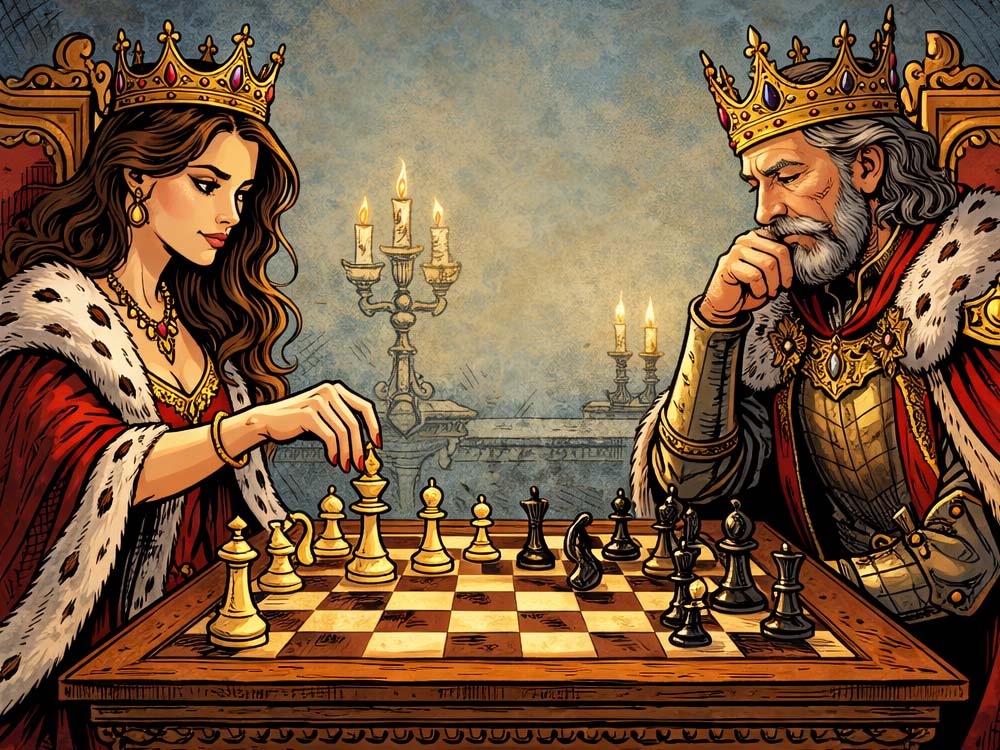
In this one, the Queen and King have apparently decided to settle things personally. No pawns. No bishops. No polite opening gambits. Just two monarchs staring each other down across a chessboard like a royal family dispute that’s finally escalated past passive-aggressive holiday dinners.
There’s something inherently funny about powerful figures being forced into mundane situations. Kings and queens are supposed to command armies, rule nations, and appear on commemorative coins — not sit hunched over a board worrying about whether they just blundered their rook.
This image invites you into that tension: the grandeur of royalty colliding with the petty anxiety of a board game.
And that’s fertile ground for jokes. ♟️
Getting Started: What’s in the Image?
Start by inventorying the literal elements on the board.
Two characters are present: a Queen and a King. They’re sitting across from each other, actively playing chess.
That alone creates a layered joke setup because, in chess, the queen is actually the most powerful piece on the board while the king is famously limited. He moves slowly, one square at a time, and spends most of the game trying not to get captured.
In other words: the power dynamic here is already weird.
Other visual elements to consider:
-
The formal setting of a chess match
-
The royal identities of both players
-
The tension of a competitive game
-
The fact that both characters are chess pieces playing chess
That last detail is particularly useful. When characters exist inside their own metaphor, things get interesting fast.
Your caption can explore:
-
strategy
-
royal relationships
-
ego
-
hierarchy
-
or the awkwardness of monarchs forced to follow the rules of a game.
The image provides a clean stage. Your caption decides what kind of scene it becomes.
Think Beneath the Surface
The best captions usually come from the second idea, not the first.
At the surface level, this is simply a chess match between two royal figures. But once you zoom out a little, several funny tensions emerge.
Power vs. vulnerability
In real life, kings and queens represent absolute authority. In chess, however, the king is the most fragile piece. The entire game revolves around protecting him.
That inversion is comedic gold.
Example:
Example: “Technically I’m the most important piece, emotionally I’m the weakest.”
Relationship dynamics
This could easily be interpreted as a married couple, political rivals, or long-standing royal adversaries. The chess match becomes a proxy for a larger argument.
The board becomes a battlefield for ego, pride, or passive-aggressive competition.
Meta-humor
Remember: these are chess pieces playing chess.
That creates opportunities for jokes about self-awareness, identity crises, or the absurdity of the situation.
Example:
Example: “It’s unsettling watching smaller versions of ourselves get sacrificed.”
Role confusion
In chess, the queen is the powerhouse. The king mostly just survives.
That imbalance opens the door to jokes about authority that looks impressive but doesn’t actually do much.
And comedy often lives in exactly that gap.
General Tips on How to Be Funny
Lean into the power dynamic
Whenever a scene contains unequal authority, there’s humor to mine.
Is the queen clearly dominating the match?
Is the king nervous?
Is someone pretending they understand strategy when they clearly don’t?
Captions that highlight imbalance tend to feel sharper and more specific.
Avoid explaining chess
You don’t need to teach the rules of the game.
If the caption relies on a long explanation about how knights move or what castling means, the joke will likely collapse under its own weight.
Simple beats clever.
Pick one comedic angle
The image offers many directions: royalty, relationships, competition, strategy, identity.
But the strongest captions usually commit to one idea and execute it cleanly.
A caption that tries to juggle three different concepts tends to dilute the punchline.
Let the image do some work
You don’t need to restate the obvious.
We can already see a queen and king playing chess. The caption should introduce a new idea — a hidden motive, internal thought, or unexpected interpretation.
Think of your caption as the missing line of dialogue.
Surprise beats cleverness
A technically clever line is nice. A surprising line is better.
If readers can predict the punchline halfway through the sentence, the laugh will fade quickly.
Try flipping expectations in the final few words. That small shift is often where the humor lands.
♟️
Final Thought
This image works because it blends grandeur with something small and human: competition, insecurity, and the quiet panic of realizing you might be losing. The best captions take that royal tension and give it a relatable twist.
Now it’s your move — head over to the contest and submit your caption.