Tips for Caption Contest 125
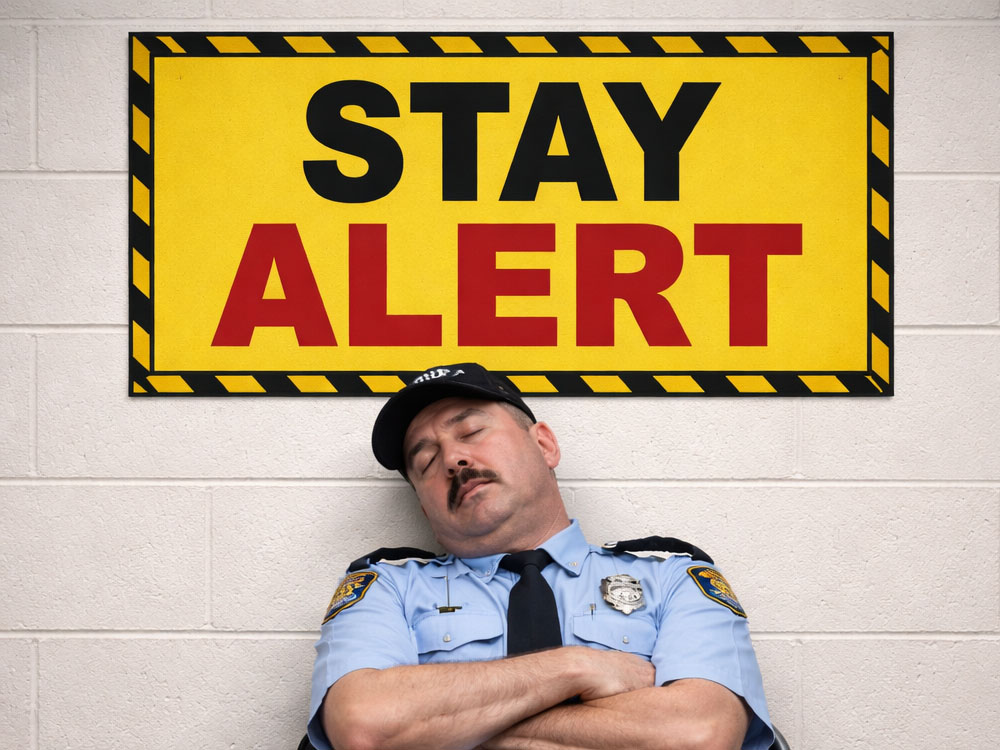
There are signs… and then there are signs. This one says “Stay Alert,” which is already funny. What’s funnier is the man directly beneath it, doing the exact opposite with impressive commitment.
This image is a perfect little contradiction machine. It doesn’t need much help—you’ve got authority, expectation, and immediate failure all in one frame. The joke is already halfway written. Your job is deciding how to finish it.
Also, let’s acknowledge the boldness here. Falling asleep under a warning sign isn’t just ironic—it’s confident. This isn’t a mistake. This is a lifestyle.
So the question becomes: are you pointing out the irony… or are you building something bigger on top of it?
Getting Started: What’s in the Image?
Start with the basics. A security guard—someone whose entire job is vigilance—is asleep. Not just tired. Fully out.
Above him is a clear, direct sign: “Stay Alert.” It’s not subtle. It’s not metaphorical. It’s a command.
The composition matters. The sign is likely positioned prominently, making the contrast unavoidable. This isn’t a hidden detail—it’s the whole joke engine.
You’ve got:
-
A role (security guard = vigilance)
-
A directive (Stay Alert = expectation)
-
A contradiction (he is asleep = failure)
That triangle is your foundation. Most captions will orbit around it. The key is how you angle your take.
Think Beneath the Surface
At the surface level, this is about irony. But if you stop there, you’ll land in a crowded zone.
Push one level deeper.
This could be about workplace burnout. Maybe he tried to stay alert. Maybe this is hour 19 of a shift no one else wanted.
It could be about selective enforcement. He’s technically “on duty”… just not participating.
Or zoom out further—this could be about systems that look functional but aren’t. The sign is doing its job. The guard is not. And somehow, that’s acceptable.
You can also flip perspective. What if the sign is wrong? What if staying alert is overrated? What if this guard has seen enough and chosen peace?
Another angle: treat the situation as intentional. This isn’t failure—it’s strategy. He’s guarding dreams. He’s undercover. He’s testing whether anyone else is alert.
The deeper you go, the more original your caption will feel.
General Tips on How to Be Funny
Don’t just point at the irony—add a layer.
If your caption simply says “he’s not staying alert,” you’re describing the image. The best captions introduce a new idea.
Example: “Technically, he’s on sleep mode.”
Be specific about the situation.
Vague jokes fade. Specific ones stick. Is this a long shift? A training video gone wrong? A performance review moment?
Example: “Day 3 of the ‘self-guided vigilance seminar.’”
Treat the sign as a character.
The sign isn’t just text—it’s a voice. You can play with it agreeing, judging, or being ignored.
Example: “The sign has filed three complaints.”
Escalate the logic.
Take the premise and push it further than expected. If he’s asleep, what does that imply about everything else?
Example: “Security has entered REM phase.”
Avoid the obvious phrasing.
Words like “ironic,” “alert,” or “asleep on the job” will show up a lot. Try to sidestep them and find a fresher angle.
Lean into tone shifts.
Serious language applied to a silly situation often works well here.
Example: “We are currently monitoring the situation internally.”
Keep it tight.
This is a clean visual with a clear joke engine. Long setups will weigh it down. Aim for quick hits with a twist.
Final Thought
This image gives you a strong, simple contradiction—use that as a launchpad, not a landing spot. The best captions won’t just notice the joke; they’ll reinterpret it in a way that feels sharper, stranger, or more specific.
Now go stay alert… or don’t—and enter your caption.