Tips for Caption Contest 57
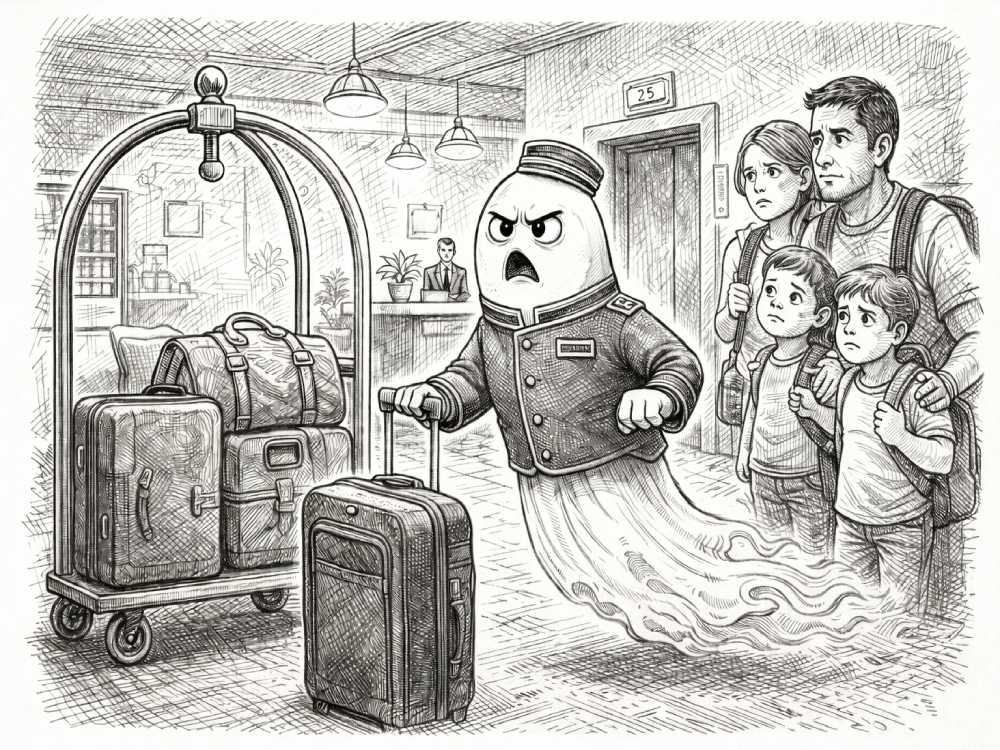
Somewhere between “historic hotel” and “this place definitely has a vibe,” a ghost has decided to pick up a shift. Not to haunt. To help. Bags, keys, the whole customer-service package. 👻
He’s doing his job. Upright posture. Attentive stance. Probably angling for tips he can’t physically hold. Meanwhile, a perfectly alive family stands nearby, doing that special face reserved for Is this real, or are we about to be Yelp reviewers?
The humor here lives in the mismatch: a calm, professional ghost versus a family silently renegotiating every belief they’ve ever had about hotels, death, and carry-on luggage.
This isn’t a scream-and-run ghost. This is a corporate policy ghost. And that’s where you come in.
Getting Started: What’s in the Image?
Let’s inventory the scene before you start swinging for jokes.
-
A ghost, visibly deceased, yet gainfully employed.
-
A bellhop uniform, implying rules, hierarchy, and customer expectations.
-
A hotel, a place already loaded with temporary lives, strangers, and awkward encounters.
-
A family, clearly concerned, not panicked—concerned is funnier.
-
An unspoken moment of pause, like everyone’s waiting for someone else to react first.
Notice what’s not happening: no screaming, no fainting, no chaos. The ghost is composed. The family is frozen. The hotel carries on. Comedy thrives in that stillness.
Think Beneath the Surface
Once you’ve clocked the obvious (“ghost bellhop”), dig one layer deeper.
Why is the ghost working here?
-
Is this purgatory with a dress code?
-
Is this a labor shortage issue?
-
Is this the worst hotel benefits package imaginable?
Why is the family concerned?
-
Are they worried about safety, service, or the afterlife?
-
Are they mid-vacation meltdown?
-
Did they specifically request a non-haunted room?
What does the hotel represent?
-
Hospitality taken too far.
-
Capitalism undefeated.
-
A place where even the dead can’t check out.
Strong captions don’t just describe the image—they explain the emotional logic of it. The best jokes make us think, “Oh. Yeah. That would actually be the problem here.”
General Tips on How to Be Funny
1. Play the reaction, not the reveal.
The ghost is already funny. The family’s response is where you win. Comedy often lives in the silent thought bubble.
2. Treat the absurd as normal.
The straighter you play it, the funnier it gets. A ghost who’s just doing his job is inherently better than a ghost who knows he’s a joke.
3. Aim for specificity.
“Haunted hotel” is broad. “Front desk HR nightmare” is tighter. The more precise the angle, the bigger the laugh.
4. Short beats hit harder.
This image supports clean, punchy lines. If your caption needs a paragraph, trim it until it doesn’t.
5. One clear idea beats three okay ones.
Pick one lens—customer service, family vacation stress, eternal employment—and commit.
Example (for structure only): A one-line observation that reframes the moment through a modern or mundane lens.
6. Let the image do half the work.
You don’t need to say “ghost,” “hotel,” and “family” all in one line. We have eyes. Use them.
Final Thought
This image is funny because it’s polite about the impossible. No one is screaming. No one is running. Everyone is just… processing. Your job is to give that pause a voice—sharp, human, and slightly uncomfortable in the best way.
Write like you’re the one standing there, bags half-packed, wondering if this stay comes with complimentary breakfast and an existential crisis.
Enter Caption Contest 57 and show us what you’d say in the exact moment you realize the bellhop has unfinished business.