Nothing kills mystique faster than a shattered crystal ball.
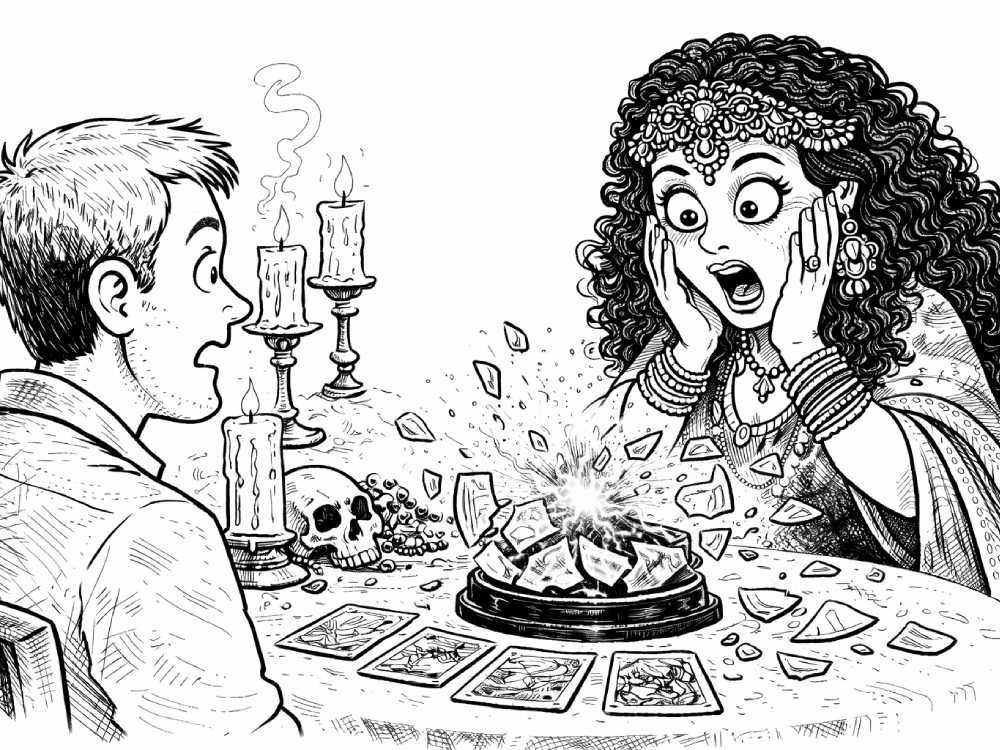
This fortune teller didn’t just miss a sign—she missed the future. The candles are lit, the tarot cards are laid out, and the vibes are doing their best. But the centerpiece of the whole operation looks like it lost a bar fight. 🔮
Meanwhile, the guy across the table didn’t come here for abstract art. He came for answers. Instead, he’s getting shards, smoke, and a psychic who clearly didn’t see this coming.
The comedy lives in that quiet moment after the disaster: when everyone pretends this is still a professional service.
Getting Started: What’s in the Image?
Before you get clever, inventory the chaos.
We’ve got:
-
A woman fortune teller mid-reading
-
A man sitting across the table, presumably expecting insight
-
A crystal ball that is not cracked but fully shattered
-
Tarot cards, candles, and the full mystical setup still trying to do its job
The contrast is key. Everything else says “ancient wisdom.” The broken ball says “warranty void.”
Ask yourself who’s clocked the problem. Is the fortune teller shocked? Defensive? Improvising? Is the man confused, worried, or mentally calculating how much this session cost?
Comedy often starts with the moment right after something goes wrong.
Think Beneath the Surface
This image isn’t really about fortune telling. It’s about confidence collapsing in real time.
A fortune teller is supposed to know what’s coming. A shattered crystal ball suggests the opposite: surprise, incompetence, or fate intervening with a sense of humor.
Good captions will zoom in on one of these tensions:
-
Expertise vs. reality
-
Confidence vs. evidence
-
Mysticism vs. customer service
There’s also an unspoken transactional awkwardness here. The table is still set. The candles are still burning. No one has officially called it off. That awkward commitment—continuing despite obvious failure—is fertile ground.
Try framing the joke around what happens next, not just what already happened.
Example (one line): “Okay, but the cards still say we’re good.”
General Tips on How to Be Funny
Lean into understatement.
Big disasters paired with calm reactions are funnier than panic. The more casually someone treats the broken ball, the better.
Choose a clear POV.
Is the joke from the fortune teller’s perspective, the customer’s, or the universe watching this mess unfold? Pick one and commit.
Avoid explaining the joke.
We can see the ball is broken. You don’t need to point it out directly—imply the consequences instead.
Play with professional language.
Any situation becomes funnier when formal wording is applied to chaos. Think policies, guarantees, or vague reassurances.
Keep it tight.
This image rewards precision. One sharp turn of phrase will outperform a long setup.
Example: “This has never happened before. Probably.”
Final Thought
The magic here isn’t in predicting the future—it’s in watching someone try to save face when the future literally explodes on the table. Aim for that moment of quiet denial, awkward reassurance, or desperate spin, and your caption will feel inevitable.
👉 Enter Caption Contest 61 and tell us what happens when fate needs customer support.