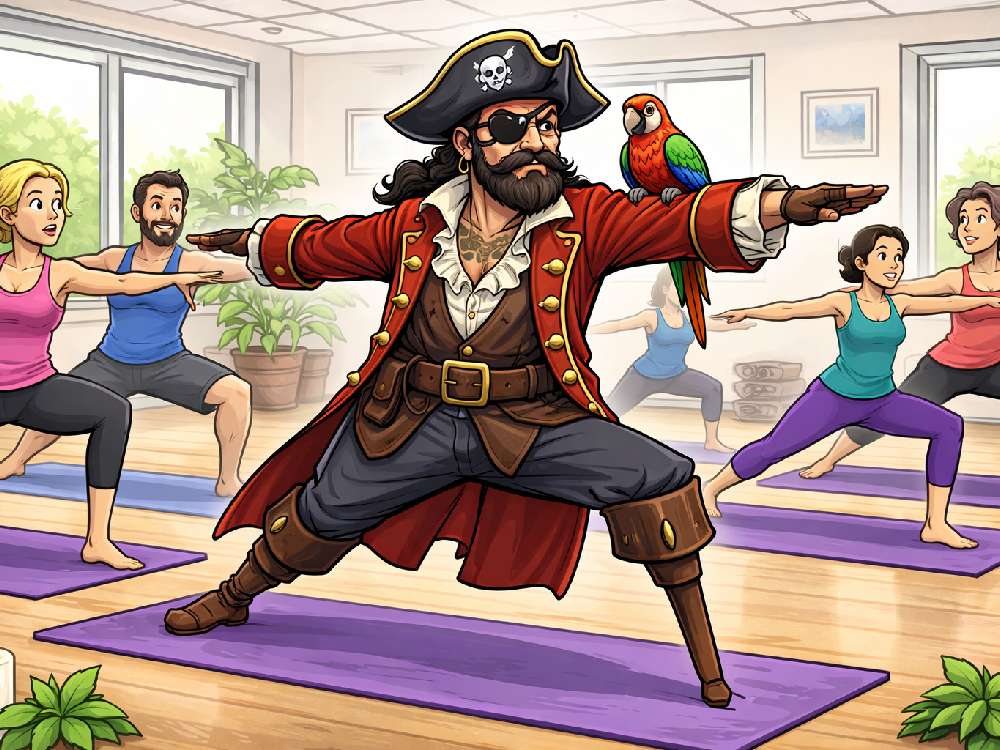
There are few places a pirate expects to be judged. A tavern, maybe. A gallows, occasionally. A yoga studio? Absolutely not.
Yet here we are: peg leg planted on a mat, parrot perched like a questionable life coach, eye patch firmly on during a class built entirely around balance, focus, and inner peace. Somewhere between “Downward Dog” and “Plank,” this pirate has realized flexibility is harder when you’ve spent most of your life pillaging instead of stretching.
The comedy lands in the mismatch. Yoga promises serenity. Pirates promise chaos. Watching those two worlds collide is like seeing someone bring a cannon to a breathing exercise. 🏴☠️🧘♂️
And the best part? He’s trying. This isn’t a pirate crashing class to cause trouble. This is a pirate earnestly attempting self-care.
Getting Started: What’s in the Image?
Before you write anything clever, inventory what you’ve actually got.
We see:
-
A pirate with the full costume commitment: peg leg, eye patch, and parrot.
-
A yoga class setting—mats, calm energy, likely very patient instructors.
-
A physical mismatch: a body built for deck-swabbing now expected to flow.
-
A parrot who may or may not be more balanced than its owner.
This isn’t just “pirate somewhere funny.” It’s pirate trying to belong somewhere deeply un-piratey. That effort matters.
Ask yourself:
-
Is the pirate confident or struggling?
-
Is the parrot judging, coaching, or outperforming him?
-
Is the humor in the pose, the mindset, or the setting?
Your caption should grow out of what the pirate is attempting, not just what he looks like.
Think Beneath the Surface
At a deeper level, this image is about reinvention.
Yoga is personal improvement. Pirates are famously resistant to personal growth unless it involves treasure. So why is this pirate here? Court-ordered anger management? A midlife crisis? A desperate attempt to fix his lower back before the next raid?
The joke sharpens when you imply a reason.
Strong captions often hint at:
-
A backstory (why this is happening).
-
A goal (what he thinks yoga will fix).
-
A misunderstanding (what he thinks yoga is vs. what it actually is).
For example (example):
“Turns out inner peace doesn’t come with a map.”
Notice how the humor isn’t just visual—it’s conceptual. The pirate expects one thing. Reality gives him something else.
Also, remember the parrot. That bird is a silent character with enormous potential. It can:
-
Be more flexible than the pirate.
-
Be the real reason he’s here.
-
Act like this is completely normal.
Side characters amplify jokes when they’re doing less but meaning more.
General Tips on How to Be Funny
A few craft notes to help your caption land cleanly:
-
Lean into contrast. Calm vs. chaos, mindfulness vs. menace, stretching vs. swashbuckling.
-
Avoid stating the obvious. “A pirate doing yoga” is the premise, not the punchline.
-
Keep it tight. Short captions feel more like punchlines than explanations.
-
Let the image do some work. You don’t need to name every prop the viewer can already see.
-
Choose one angle. Balance issues, pirate philosophy, or yoga culture—don’t stack them all.
If you find yourself writing multiple clauses, ask what can be cut without losing the laugh. Comedy loves efficiency.
And remember: jokes that feel like they could only belong to this image tend to outperform generic ones.
Final Thought
This pirate isn’t funny because he’s out of place—he’s funny because he’s trying very hard to be in the right place, and the universe did not design yoga for peg legs.
Enter Caption Contest 63 and see if you can stretch this image into something unforgettable.