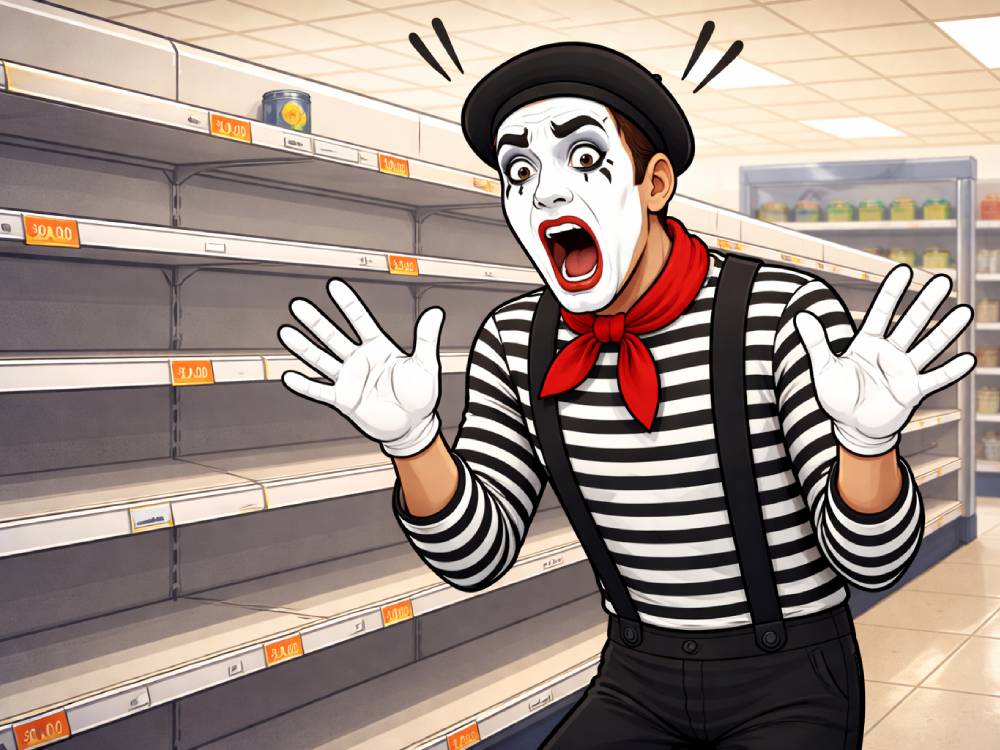
There are few professions that rely on abundance quite like mime. Invisible walls. Endless ropes. Bottomless boxes. And yet—here he is—trapped in a supermarket where even the real shelves are empty.
He’s not trapped in a box. He’s trapped in a supply chain crisis.
The tragedy lands quietly. No honking horns. No screaming shoppers. Just a mime, a cart, and the deafening silence of nothing to buy. 🤐
And because he’s a mime, he can’t complain about it. He has to perform his disappointment.
Getting Started: What’s in the Image?
Before you reach for a punchline, inventory the scene.
We’ve got:
-
A mime (white face, stripes, beret—classic visual shorthand)
-
A supermarket setting
-
Empty shelves where abundance should be
-
An implied audience: us, the witnesses to this quiet meltdown
The comedy already exists before a single word is written. A grocery store is a place of choice. A mime is a person defined by imaginary objects. Put them together, remove the food, and you’ve got a perfect visual paradox.
Ask yourself what the mime is doing right now. Is he browsing? Performing? Bargaining with the void? His posture, hands, and expression are doing a lot of the work for you—your caption should add perspective, not repeat the obvious.
Think Beneath the Surface
At first glance, this looks like a joke about empty shelves. But that’s just the surface aisle.
Underneath, this image is about powerlessness. A mime already has no voice. Now he’s in a place designed to offer solutions—and there are none.
That opens up deeper angles:
-
Scarcity vs. performance: He’s trained to pretend things exist. Now even reality won’t cooperate.
-
Modern anxiety: Shortages, panic buying, and that unsettling feeling of “Wait…where did everything go?”
-
Existential comedy: If you mime grabbing food and there is no food, did you ever need food at all?
Strong captions don’t just say what’s missing—they comment on what it feels like to be missing it.
One-line example (label only, not a submission):
Example: “When even your imaginary groceries are out of stock.”
General Tips on How to Be Funny
Let the mime do the heavy lifting.
This character is already absurd. You don’t need to stack jokes on top of jokes. A clean, confident angle beats a crowded one every time.
Avoid explaining the silence.
“Yes, mimes don’t talk” is baked in. Treat that as known information and build forward, not sideways.
Pick one idea per caption.
Shortage joke? Identity joke? Social commentary? Choose one lane and stay in it. Swerving weakens the impact.
Contrast is your friend.
Supermarkets promise abundance. Mimes promise illusion. Empty shelves promise neither. That triangle is where the laughs live.
Punch up, not outward.
The best captions here aren’t mocking the mime—they’re letting him represent all of us staring at an empty option list.
One-line example (label only, not a submission):
Example: “Practicing my invisible shopping list.”
Final Thought
This image works because it’s quiet. No chaos. No explosions. Just a character built on imagination facing a reality that’s run out of props. If your caption respects that stillness—and adds one sharp, specific thought—you’re already ahead of the cart.
Enter Caption Contest 64 and show us what your inner mime has to say without saying anything at all.