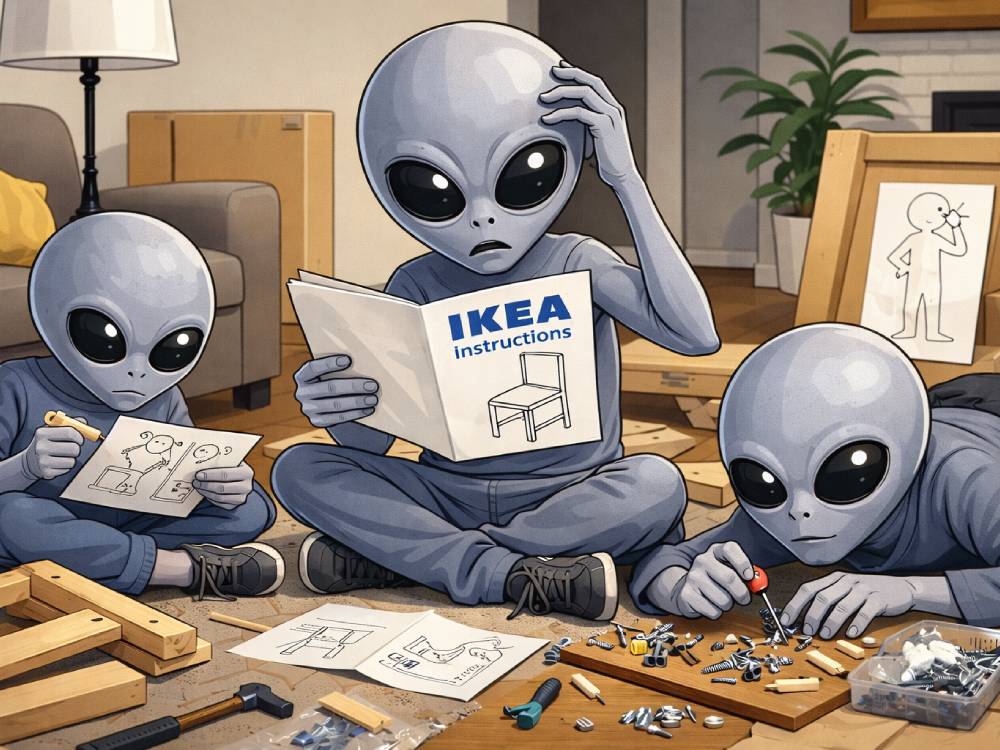
Somewhere in the universe, a species that mastered interstellar travel has been brought to its knees by a hex key.
The aliens in this image have crossed galaxies, survived wormholes, and cracked faster-than-light travel—only to discover that IKEA instructions contain no words, no units of measurement, and at least one extra piece that feels important.
You can practically hear the tension in the room. One alien is holding the manual upside down. Another is staring at the pile of wooden planks like it’s a riddle from an ancient god. This is not a moment of discovery. This is a moment of regret. 👽
That contrast—cosmic intelligence vs. earthly frustration—is where the joke lives.
Getting Started: What’s in the Image?
Before you go big, inventory the scene.
We’ve got:
-
A group of aliens (non-human, advanced, unfamiliar with Earth norms)
-
IKEA-style flat-pack furniture
-
Visual instructions only—no language, just diagrams
-
Confusion, struggle, and mounting despair
-
A shared task that should be simple, but isn’t
This isn’t about aliens building furniture. It’s about aliens encountering a very specific human experience: the quiet realization that this project is going to take all day.
Ask yourself who’s losing confidence fastest. Who thinks they understand the instructions (but doesn’t)? Who’s blaming the furniture instead of themselves?
Comedy starts when you assign emotional roles.
Think Beneath the Surface
On the surface, it’s “aliens can’t do IKEA.” Fine. That’s a starting point.
But the deeper joke is about overqualification meeting bureaucracy.
These aliens are brilliant—but brilliance doesn’t help when the system itself is the problem. IKEA instructions are famously universal, yet somehow incomprehensible. That irony scales perfectly to aliens: if they can’t figure this out, what hope did we ever have?
Other angles worth exploring:
-
False confidence: The moment someone says, “I’ve got this,” and immediately proves they do not.
-
Missing pieces: Is the furniture incomplete, or did someone mess up three steps ago?
-
Cultural mismatch: The aliens may assume the instructions are symbolic, ceremonial, or a test.
-
Power dynamics: One alien clearly didn’t read the instructions and is now pretending it was someone else’s job.
A strong caption doesn’t explain the joke—it reveals the wrong assumption everyone made at the start.
Example: “They conquered space. Step 4 conquered them.”
(That’s the level of economy you’re aiming for.)
General Tips on How to Be Funny
A few reminders to keep your caption competitive:
-
Specific beats generic. “Aliens confused” is vague. “Aliens realizing the diagram lied” is sharper.
-
Let the image do work. You don’t need to mention aliens and IKEA and furniture if the picture already shows it.
-
Short beats smart. IKEA humor works best when it feels resigned, not ranty.
-
Avoid explaining the premise. Trust the reader to see what’s happening.
-
Punch up the ending. The last word should land the frustration, not restate it.
If your caption sounds like a setup without a payoff, trim it. If it sounds like a rant, tighten it. If it sounds like something everyone thought of immediately, dig one layer deeper.
The funniest captions often feel like a single, exhausted thought someone mutters under their breath.
Final Thought
This image isn’t about aliens failing—it’s about the universal moment when confidence collapses in the face of a badly drawn diagram, and suddenly the smartest beings in the room are all equally lost.
Find that moment. Name it cleanly. Then stop.
That’s where the laugh is.
👉 Enter Caption Contest 65 and show us how you’d translate intergalactic intelligence into flat-pack despair.