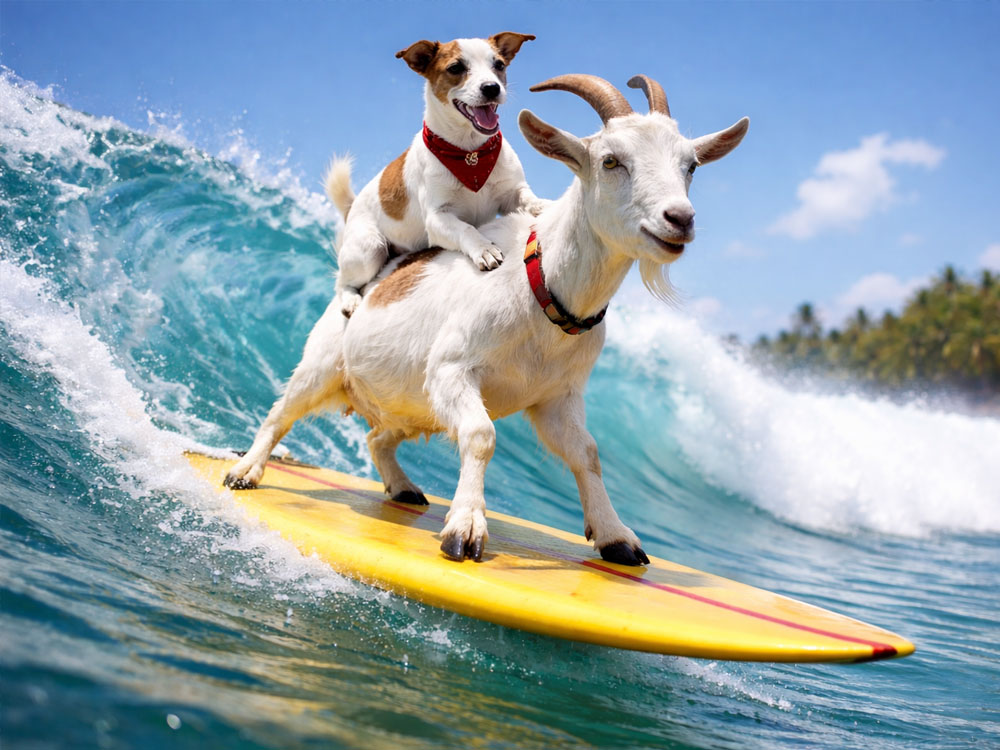
This image did not whisper. It paddled up, caught a clean wave, and shouted, “PUT WORDS ON ME.” A goat surfing with a dog on its back is already doing most of the work; your job was to not trip over it on the way to the punchline.
Unsurprisingly, the room leaned hard into puns, barnyard wordplay, and GOAT-capitalization enthusiasm. And honestly? That instinct was right. When an image is this joyful and dumb-in-the-best-way, going playful is the correct first move. The challenge here wasn’t finding a joke — it was finding the cleanest, funniest version of a joke everyone else could also see.
This contest became a great case study in how small choices — one extra word, one extra pun, one unnecessary explanation — can mean the difference between “cute” and “finalist.”
What We Saw a Lot
Three big lanes dominated the submissions:
First: animal-word mashups. “Goat,” “dog,” “paw,” “baa,” “bleat,” “GOAT,” and “woof” were doing CrossFit-level reps in this contest. A lot of captions were built almost entirely out of replacing syllables with animal noises. That’s not wrong — but it is crowded.
Second: extreme enthusiasm. Exclamation-heavy reactions like “Woohoo!” or “Wheee doggie!” leaned into the excitement of the wave itself. These worked best when they added a specific twist; when they didn’t, they blended together into a general vibe of surf joy.
Third: familiarity plays. Idioms (“bet the farm,” “teach an old dog new tricks”), surf clichés (“hang ten”), and pop-culture echoes showed up a lot. Again, not a bad instinct — recognizable scaffolding helps jokes land fast — but the strongest captions either subverted the phrase or used it with restraint.
Overall, the field showed good instincts and a lot of fun energy. The gap between mid-pack and finalist wasn’t imagination; it was editing.
Missed Opportunities
The biggest missed opportunity here was point of view.
You had three characters: the goat, the dog, and the implied human viewer. Most captions treated them all the same — just “animals doing something wild.” A few captions got closer by implying relationship or experience (“You should have seen them on the jet ski”), but many stopped just short of choosing a clear perspective.
Another common near-miss: stacking jokes. Several captions tried to cram goat + dog + surf + idiom + pun into one line. The result wasn’t confusion — it was dilution. When everything is a joke, nothing gets to be the joke.
There was also room for more visual specificity. The wave, the balance, the sheer absurd physics of this situation — those details could have been pushed further instead of relying on wordplay alone.
Head to Head
Finalist: “You should have seen them on the jet ski”
Non-finalist: “Woohoo!”
Both captions react to the thrill of surfing. But only one adds a second layer.
“Woohoo!” captures excitement — and nothing else. It could apply to almost any action image involving motion or fun. There’s no escalation, no implication beyond what we already see.
“You should have seen them on the jet ski” does something smarter. It implies history. It suggests this goat-and-dog duo has been doing extreme recreational activities together for a while, and that surfing isn’t even their peak. That single sentence expands the world beyond the frame, which is why it feels bigger, funnier, and more replayable.
Red Lines
“They said you can’t teach old dogs’ new tricks what do you think? BAAAAAAAAH”
This caption has a solid core idea — flipping a familiar saying — but it tries to explain itself on the way out. The added commentary and extended reaction soften the punch. A tighter version that trusted the flip would have landed harder.
“Surfing is fun with two friends”
This is accurate, sweet, and unfortunately not doing enough work. It describes the image without transforming it. As a rule of thumb: if your caption could double as stock photo alt text, it probably needs another angle.
“Cowabunga, dude? More like goat-abunga!”
This one shows good energy and a clear joke, but it leans too hard on a single substitution. Once the pun is decoded, there’s nowhere else to go. Layering in either specificity or surprise would have given it more staying power.
Winning Captions & Why They Worked
“They bet the farm and won.”
This caption works because it’s calm. Against a very loud visual, restraint becomes contrast. The idiom fits the goat perfectly, and the line lets the image do the heavy lifting without stepping on it.
“Paw-sitively un-baaa-lievable wave”
Yes, it’s pun-forward — but it’s clean, rhythmic, and confident. The cadence sells it. There’s no extra explanation, no clutter, just a smooth ride from setup to punch.
“Goatally Tu-baaah-ler”
This one commits fully to sound and silliness, and that commitment matters. It’s absurd, self-aware, and leans into the image’s cartoon logic instead of fighting it.
“You should have seen them on the jet ski”
As discussed earlier, this caption expands the universe. It rewards the reader for imagining more than what’s shown, which is always a strong move.
“The kid’s found the GOAT way to bleat the heat”
This one packs a lot in, but it earns it by centering on a single clever phrase and letting the rest orbit around it. When density is intentional, it can still work.
Final Thoughts
This contest proved something important: when the image is already funny, your job isn’t to out-funny it — it’s to aim the funny. The strongest captions here didn’t shout louder; they surfed cleaner, cut smoother lines, and trusted their balance.
If this goat can stay upright with a dog on its back, you can probably afford to lose one extra pun and still ride the wave. 🏄♂️🐐🐕
Check out — and jump into — the next CaptionCo contest while the surf’s still up.