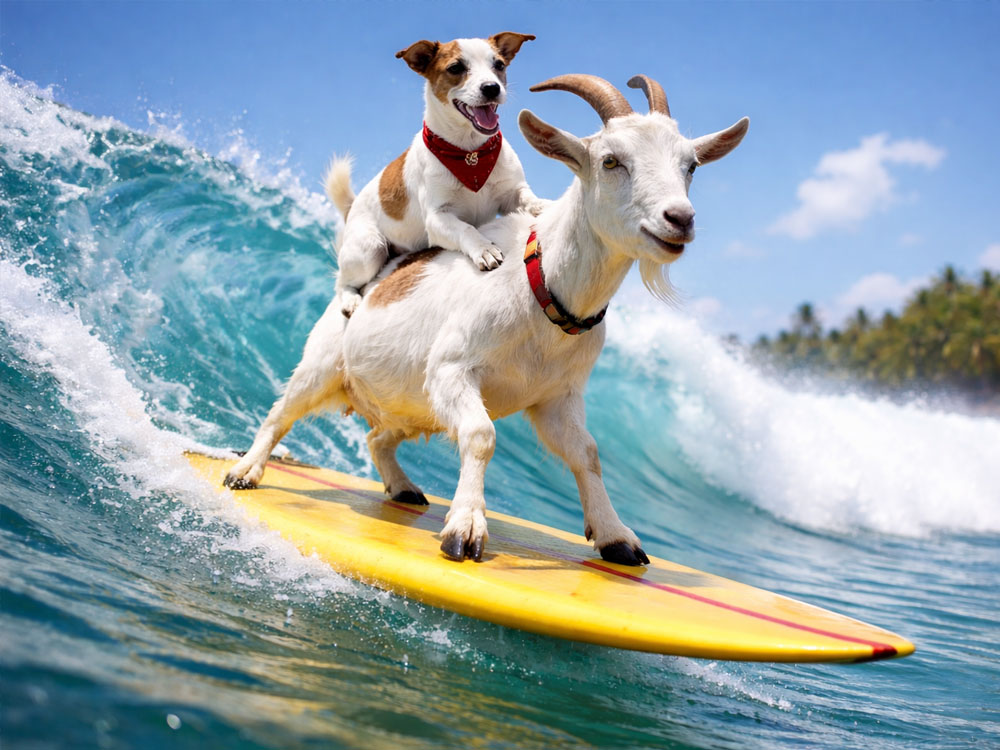
This image does not ask for your permission. It simply arrives, already mid-wave, already confident, already better at balance than most of us. A goat is surfing. A dog is riding shotgun. Physics has clocked out early. 🏄♂️
There’s no panic here. No flailing. No “how did this happen?” energy. This duo looks like they planned it. Like this is just another Tuesday between vet appointments and beach parking validation.
The comedy lives in that calm. The goat isn’t shocked it’s surfing. The dog isn’t surprised it’s on a goat. Everyone involved seems to agree this is normal behavior.
That confidence is your way in.
Getting Started: What’s in the Image?
Before you go for the joke, inventory the scene.
You’ve got:
-
A goat (already a slightly chaotic animal choice)
-
On a surfboard (already an unlikely skill)
-
Catching a clean wave (competently)
-
With a dog on its back (escalation, not decoration)
Important detail: nothing looks accidental. No wipeout. No fear. No struggle.
This isn’t “animals in trouble.” This is “animals who figured something out.”
Also worth noting:
-
The goat is doing the hard part.
-
The dog is trusting the goat completely.
-
The ocean is cooperating.
That hierarchy matters. Who’s in charge? Who’s freeloading? Who’s the real athlete here?
Your captions should respond to that dynamic, not ignore it.
Think Beneath the Surface
At its core, this image is about effort versus credit.
The goat is working. The dog is riding. That imbalance is instantly relatable.
This can also be read as:
-
Teamwork where roles are wildly unequal
-
Confidence bordering on delusion
-
A partnership that makes no sense but somehow works
-
One friend who always says “we” when they mean “you”
There’s also a quiet absurdity in how normal it all feels. No one is breaking the fourth wall. No one is reacting. That straight-faced presentation invites dry humor.
You can also zoom out and treat this like:
-
A professional sport
-
A startup
-
A leadership structure
-
A lifestyle brand
-
A philosophical stance on control
Example (single-line, minimal):
Example: “Trust exercises are getting out of hand.”
Notice how the joke doesn’t explain the image—it reframes it.
That’s the goal.
General Tips on How to Be Funny
1. Don’t stack chaos on top of chaos.
The image is already absurd. Your job is to add interpretation, not more randomness. One clean angle beats five noisy ones.
2. Let confidence do the work.
Jokes land harder when they sound like statements, not reactions. This image rewards certainty.
3. Pick a power dynamic and commit to it.
Is the goat the professional and the dog the burden? Or is the dog the mastermind? Decide early.
4. Avoid explaining why it’s funny.
“Because it’s a goat surfing” is not a punchline—it’s a description. Assume the audience has eyes.
5. Short captions win here.
This image reads instantly. The best captions feel just as fast.
6. Dry beats loud.
A calm, almost bored tone often outperforms big exclamation-point energy with images this surreal.
Example (single-line, minimal):
Example: “He insisted this was a two-person sport.”
Simple. Specific. No overreach.
Final Thought
This image works because it treats the impossible like routine. The funniest captions do the same—meet the absurdity at eye level, trust the audience, and don’t blink first.
Enter Caption Contest 73 and see if you can ride the wave without wiping out.