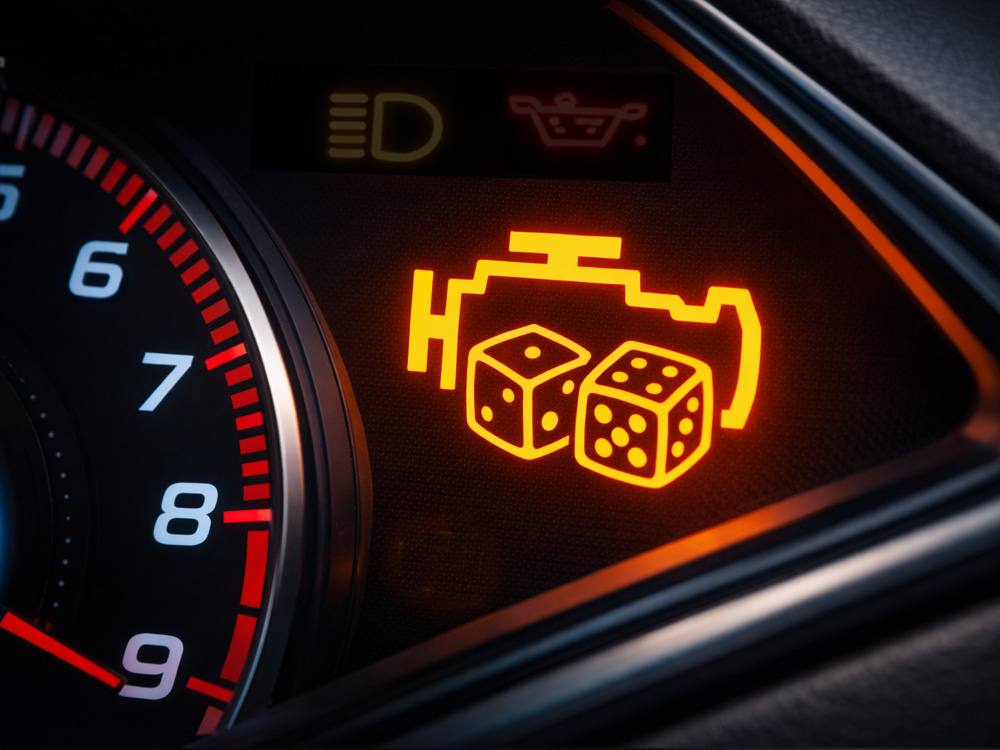
Every dashboard light has a personality. Some are calm and instructional. Some are dramatic. This one looks like it just rolled snake eyes at 70 mph.
An engine-shaped warning light with two dice inside is not subtle. It’s not saying “please schedule maintenance.” It’s saying “good luck, buddy.” The car has officially stopped believing in preventative care and started believing in vibes.
There’s something deeply unsettling about a machine outsourcing responsibility to chance. You didn’t ignore maintenance—fate did. 🎲
Getting Started: What’s in the Image?
Start by inventorying exactly what we see. This is a car dashboard. A warning light is illuminated. The icon resembles a standard “check engine” symbol—but instead of a cog or piston, there are two dice sitting inside it.
That contrast matters. Dice are clean, iconic, instantly readable. They carry cultural meaning. Engines usually signal control, engineering, and predictability. Dice signal chaos, gambling, and decisions made with a shrug.
Also note: this is a warning light. Something is already wrong. The dice aren’t decorative—they’re diagnostic. The car is communicating… just not helpfully.
Think Beneath the Surface
Once you’ve clocked the visuals, zoom out to what the image implies. A dice-engine suggests randomness replacing expertise. Skill replaced by luck. Planning replaced by “let’s see what happens.”
There’s also a subtle emotional shift. Most warning lights induce anxiety. This one adds irony. It’s not panicking—it’s smirking. That opens the door to humor rooted in resignation, denial, or false optimism.
Another angle: blame displacement. If something goes wrong, it’s not your fault—or the car’s—it’s the dice. The dashboard becomes a tiny casino where the house always wins.
You can also play with tone mismatches. Cars are serious. Dashboards are official. Dice are unserious. Humor often lives in that collision between authority and absurdity.
General Tips on How to Be Funny
-
Anchor the joke to the icon. The dice aren’t a side detail—they’re the punch engine. Make sure the humor wouldn’t work without them.
-
Let the implication do the work. You don’t need to explain randomness or risk-taking. Trust the audience to connect dice with gambling, luck, and bad decisions.
-
Keep it dashboard-scale. This isn’t a road-trip epic. The joke should feel like something you notice in half a second while driving.
-
Choose one idea and commit. Is the joke about fate? Negligence? Optimism? Pick one lane and stay in it.
-
Avoid over-explaining the mechanic. The fun is that the car isn’t helpful. Your joke shouldn’t be either—clarity in setup, restraint in explanation.
-
If you use an example, keep it tight.
Example: A single-line joke framing the light as a gamble instead of a warning. -
Specificity beats cleverness. “Luck” is vague. “Rolling the dice at 65 mph” paints a picture.
-
Let the car have a personality. Anthropomorphizing the dashboard can add voice without adding words.
Final Thought
Great captions here feel inevitable, like the dashboard light itself came up with the joke while you weren’t looking—short, sharp, and confidently unhelpful. 😄
Ready to roll the dice? Enter Caption Contest 78 and see if luck—or skill—wins this one.