Caption Contest 79: Recap & Review
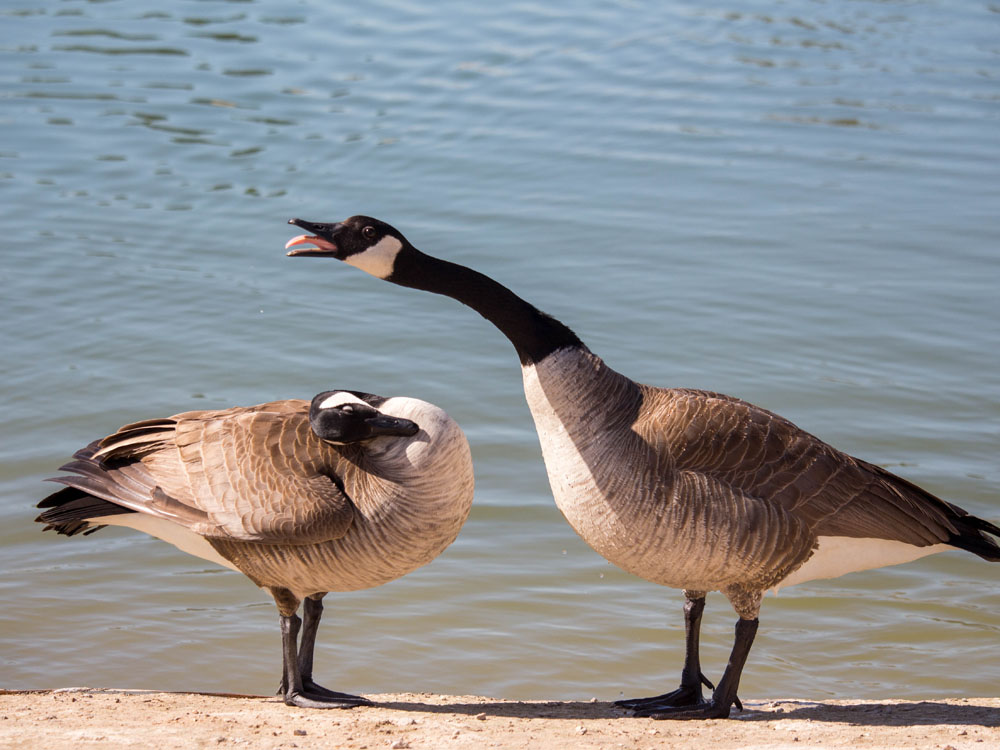
This image is doing a lot with very little: one goose aggressively committing to the bit, neck fully extended, while another goose clearly did not consent to whatever’s happening next. It’s confrontation without context, drama without dialogue, and that’s catnip for caption writers.
What made this contest fun is that geese are already funny before you write a word. They’re loud. They’re territorial. They look like they’re always about to file a complaint. The trick here wasn’t finding a joke — it was choosing the right one and getting out of its way.
Let’s wade in. 🪿
What We Saw a Lot
Three instincts dominated the submissions:
First, wordplay clusters. “Duck,” “goose,” “gander,” “honk,” “neck,” “fowl” — once someone stepped on one of those rakes, a lot of others followed. That’s not a bad instinct; it’s often where the fastest jokes live. But it does mean those captions had to work harder to stand out.
Second, playground logic and familiar phrases. Variations on duck duck goose, idioms involving birds, and well-known sayings re-skinned with feathers showed up frequently. These jokes rely heavily on recognition, so clarity and timing mattered a lot.
Third, human confrontation mapped onto goose behavior. Traffic cop energy. Spousal arguments. Boundary violations. The strongest captions treated the geese like people without forgetting that they’re still animals in a lakeside standoff.
In short: lots of solid instincts, lots of overlap, and a premium on execution.
Missed Opportunities
A number of captions were circling a good idea but never quite landed it.
Some leaned too hard on being a phrase, not a moment. If the caption could apply equally well to any image of geese, it tended to feel flatter. This image is specific: one goose is dominant, the other is retreating, and the neck extension is the whole story.
Others had too much explanation baked in. The funniest captions trusted the image to do its share of the work. When the caption started narrating or clarifying what we can already see, the joke lost momentum.
And finally, a few jokes had a strong premise but no turn. They arrived, set the table, and… stayed there. In a field this crowded, the captions that popped added either a twist, a sharp POV, or a surprise escalation.
Head to Head
Finalist:
Back up so I can have a gander too!
Non-finalist:
Goose, duck!
Both captions lean on bird-word recognition. Both are short. Both are clean.
The difference is specificity and spatial awareness. “Back up so I can have a gander too!” directly references what’s happening in the image: one goose physically blocking the other’s view, neck intruding into personal space. The phrase isn’t just clever — it’s activated by the scene.
“Goose, duck!” is tidy and recognizable, but it floats above the image instead of engaging with it. It doesn’t tell us who’s saying it or why this moment prompted the line. The finalist wins by anchoring the wordplay to the visual conflict.
Red Lines
Just Goosing Around!
This is a classic example of a caption that’s pleasant but inert. It names the subject without adding a perspective or conflict. As a rule of thumb: if the joke could be the title of a stock photo, it probably needs another beat.
When you’re unsure where that high pitched squeak came from.
There’s an observational idea here, but it frames the joke from too far away. The image is loud, confrontational, and directional. A caption that centers uncertainty feels mismatched to the aggression on display. Aligning tone with visual energy usually strengthens the punch.
You didn’t pack a lunch
This hints at scarcity or annoyance, but it doesn’t clearly connect to what the geese are doing to each other. Without a clear cause-and-effect link to the neck-sticking or cowering, the line feels more like a stray thought than a reaction to the scene.
Winning Captions & Why They Worked
I don’t stick my neck out for just anybody!
This one earned its place by doing several things at once. It uses a familiar idiom, yes — but it literalizes it perfectly. The phrase becomes both metaphor and physical description, and the confidence in the voice matches the goose’s posture. It’s concise, image-dependent, and character-driven.
Other finalists brought their own strengths:
No, no, no! It’s duck, duck, goose. Not goose. goose, duck!
This works because it escalates a familiar concept into absurd pedantry. The repetition mirrors the goose’s persistence, and the frustration feels earned by the image’s intensity.
Hey flat foot, move it before I honk!
A strong POV joke. It gives the dominant goose a personality — impatient, territorial, and just aggressive enough to feel true to species. The threat of “honk” is doing real comedic work here.
He came to the water to ponder and reflect, but things headed south
This caption succeeds by contrast. The calm expectation (“ponder and reflect”) collides with the chaos of the moment. It reads almost literary, which makes the goose-on-goose confrontation funnier by comparison.
Back up so I can have a gander too!
As discussed earlier, this one nails spatial logic and restraint. It doesn’t over-explain; it lets the image complete the joke.
Final Thoughts
This was a strong field, and the best captions remembered one key thing: geese are already ridiculous, but assertive geese are comedy gold. When you let the body language lead and use language to sharpen — not smother — the moment, the joke honks itself.
If this contest taught us anything, it’s that sticking your neck out can pay off — especially if someone else is trying to bite it. 😉
Check out the current contest and throw your caption into the pond.