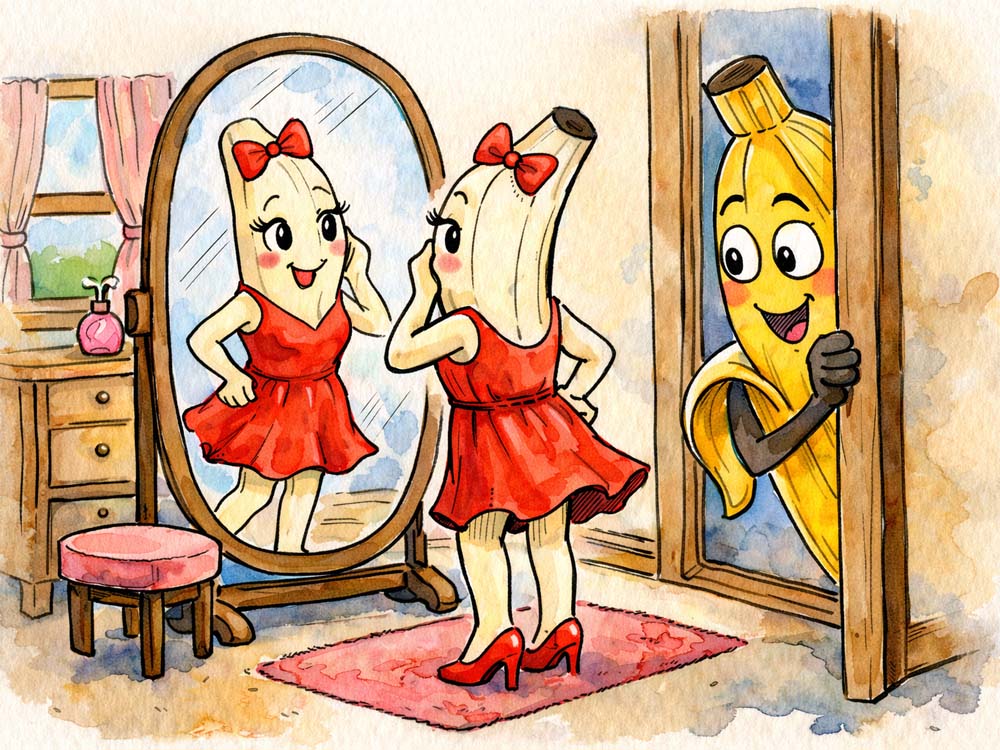
At first glance, this image feels like a children’s book that took a hard left into therapy. We’ve got a banana in a dress, standing at a mirror, fully peeled, while another banana—still safely jacketed in yellow—watches from behind. It’s cute. It’s strange. It’s quietly devastating.
This is not a slapstick banana peel slip. This is a banana having a moment. A vulnerable, mirror-facing, identity-questioning moment. The kind where the room is silent and you suddenly notice how loud your thoughts are.
Which is great news for caption writers. Because whenever an image looks cheerful but feels complicated, there’s comedy hiding in the tension. 🍌
The challenge here isn’t finding jokes—it’s choosing which layer to joke from. And how deep you’re willing to peel back.
Getting Started: What’s in the Image?
Let’s inventory what’s actually happening before we jump to cleverness. Comedy loves specifics.
-
Two anthropomorphic bananas. One appears feminine-presenting, wearing a dress. One appears masculine-presenting, still fully peeled.
-
The banana in the dress is standing in front of a mirror—and notably, has no peel.
-
The mirror matters. This is a self-reflection setup, not a random pose.
-
The peeled banana looks inward; the unpeeled banana looks at them.
-
There’s an implied relationship. Partners? Spouses? Dates? At the very least: witnesses.
The visual contrast is doing most of the work for you. Peeled vs. unpeeled. Seen vs. seeing. Private moment vs. public presence. When an image gives you that many binaries, you’re standing in a comedy aisle with options on both sides.
Before you write anything, decide what the center of gravity is. Is the joke about the mirror? The relationship? The dress? The missing peel? Or the awkward silence between two bananas who clearly have a history?
Think Beneath the Surface
This image isn’t about bananas. (Sorry.) It’s about vulnerability. Presentation. Self-image. The gap between how we see ourselves and how others see us.
The peeled banana isn’t slipping—they’ve already slipped. They’re exposed. And they’re choosing to look. That choice matters. Comedy can come from bravery, from insecurity, or from the absurdity of treating fruit like it has an inner life more complicated than ours.
You can also flip perspectives. Most people will write from the point of view of the peeled banana. But the unpeeled banana is doing something too: watching, reacting, possibly judging, possibly supporting, possibly wishing they hadn’t walked in right now.
Another rich angle: timing. This feels like a moment that’s mid-process. Not a reveal, not a conclusion. The mirror suggests something is changing—or about to. Comedy loves moments that are unfinished.
If you want to go darker or smarter, you can lean into social performance. Clothes vs. skin. Costumes vs. truth. Or how easy it is to be confident when you’re still protected by a peel.
If you want to go lighter, lean into the absurdity of fruit having emotional arcs at all. A banana confronting itself is funny before you say a single word.
(Example: A single-line example might frame the mirror as an unexpected place for honesty.)
General Tips on How to Be Funny
Anchor the joke to one clear idea.
This image invites overthinking. Resist it. Pick one tension—exposure, judgment, self-recognition—and build around that.
Let the image do the explaining.
You don’t need to restate what we see. We already know it’s a banana. We already know it’s peeled. Use your words to add a perspective, not a description.
Short beats work better than speeches.
A quick realization, a quiet dread, a dry observation—those tones fit the stillness of the image better than a big, loud punchline.
Contrast is your friend.
Protected vs. exposed. Confident vs. uncertain. Dressed vs. undressed (which is objectively funnier when applied to fruit). Comedy lives in the gap.
Avoid being vague.
“Feeling weird” isn’t funny. Why is it weird? Is it the mirror? The audience? The timing? Specific discomfort beats general anxiety every time.
Don’t rush the joke.
This is a pause image. Let the silence breathe. The best captions here feel like a thought someone had but didn’t say out loud.
Trust the audience.
You don’t need to explain the metaphor. People get it. Let them connect the dots—and enjoy feeling smart when they do. 😏
Final Thought
This image rewards restraint. The funniest captions won’t shout; they’ll hover—just long enough for the realization to land and the laugh to sneak up from behind.
Ready to peel back a layer? Enter Caption Contest 80 and let your best quiet banana moment shine.