Tips for Caption Contest 82
This is the moment every ant farm owner secretly fears. You sign up for soothing tunnels and quiet industry, and instead your ants unionize and start making eye contact.
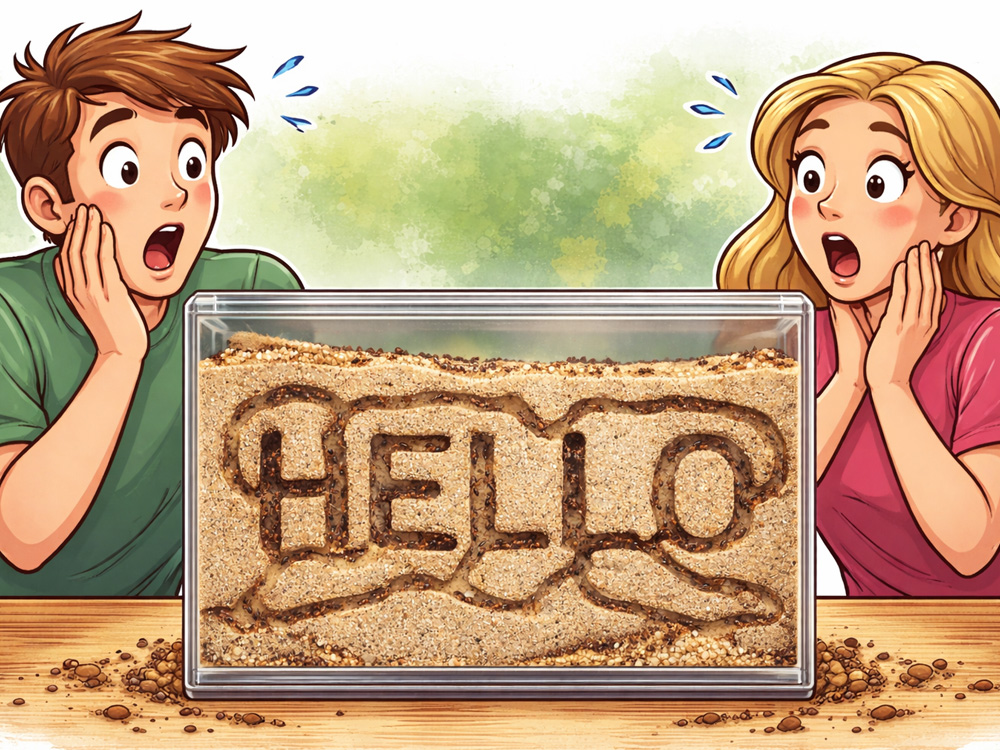
The shock on these two faces says everything. This is not a cute pattern. This is not random digging. This is intentional communication—and it’s coming from insects.
There’s something deeply unsettling about being greeted by a colony you thought you were supervising. Especially when the greeting is polite. Politeness implies planning. 🐜
Getting Started: What’s in the Image?
Let’s inventory what we’re actually seeing before we jump to conclusions.
A man and a woman stand side-by-side, both visibly startled. Their posture suggests surprise, not delight. No one is smiling. No one is reaching for the ant farm like “aw, neat.”
The ant farm itself is doing the heavy lifting. Inside the clear case, the tunnels very clearly spell out a readable word: “Hello.” This isn’t abstract. It’s legible. It’s unmistakable. The ants didn’t accidentally doodle.
The key visual tension: tiny creatures, massive implication. Ant farms are supposed to be mindless background decor. Instead, they’ve produced language. That contrast is the joke engine.
Also important: the humans are passive observers. They didn’t ask for this. The ants initiated contact.
Think Beneath the Surface
Once ants can say hello, the situation escalates fast.
A greeting suggests awareness. Awareness suggests intelligence. Intelligence suggests follow-up questions. That’s where the comedy lives—not just in the word itself, but in what might logically come next.
There’s also a power flip happening. Humans bought the ants. Humans feed the ants. And yet the ants are now controlling the tone of the interaction. They’re calm. The humans are rattled.
Another angle: this is first contact, but the least cinematic version imaginable. No spaceships. No lasers. Just a coffee-table ant farm casually breaking the rules of biology.
You can also play with the idea that “hello” is the most polite possible first move. Not a threat. Not a demand. Just a greeting. Which somehow makes it creepier. 😬
Strong captions here tend to pick one implication and lean into it, rather than listing every possible outcome. Is this about fear? Control? Social awkwardness? Customer service? Pick a lane.
General Tips on How to Be Funny
Anchor the joke in the reaction, not just the gimmick.
The ants spelling a word is funny, but the real humor comes from what that does to the humans. Fear, panic, politeness, denial—all playable.
Treat the ants as intentional actors.
The joke gets sharper when the ants seem purposeful, not magical. They chose that word. They chose that timing.
Example (labelled): When the ants finally decide to address management.
Keep the scale contrast clear.
Small creatures doing big things is the core visual joke. Don’t muddy it with unrelated ideas. Stay focused on how absurd this leap is.
Avoid over-explaining the science.
No one needs a biology lesson. The image already breaks reality. Comedy here works best when you accept the premise instantly and move on.
Use restraint with follow-ups.
One implication is usually stronger than a full paragraph of imagined consequences. Let the reader’s brain do some of the work.
Specific beats generic.
“Ants communicating” is vague. “Ants choosing this exact word” is specific—and specificity is funnier.
Example (labelled): They didn’t even start with a warning.
Final Thought
This image rewards captions that trust the visual and sharpen the implication rather than piling on noise—if you let the ants lead, the joke almost writes itself. 🐜✨
Got a take on what happens when your ant farm says hello—enter Caption Contest 82 and show us your best line.