Caption Contest 85: Recap & Review
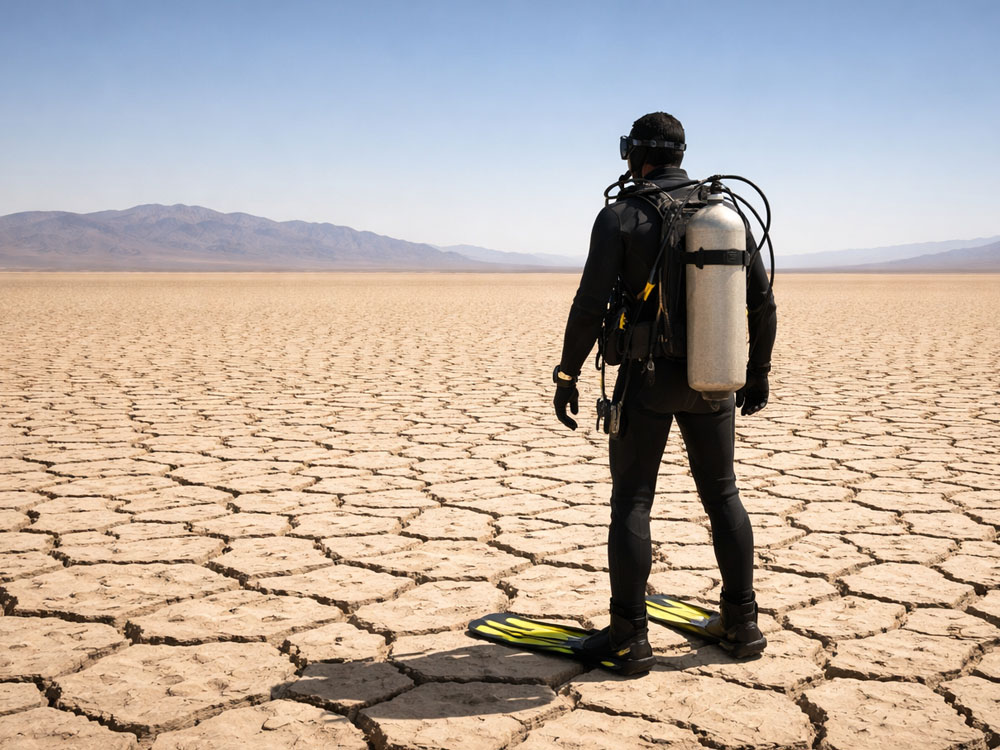
Nothing says “deep thoughts” quite like a man dressed for the ocean… standing in a place that hasn’t seen water since the invention of sandals.
This image is pure comedic dehydration. You’ve got flippers on cracked earth, goggles pointed toward nowhere, and a tank full of optimism. It’s the visual equivalent of bringing a kayak to a parking lot.
The strongest captions understood one simple truth: this joke lives in the gap between preparation and reality. He prepared perfectly — just for the wrong planet.
Let’s wade in. (Metaphorically. Obviously.)
What We Saw a Lot
Navigation failures were everywhere — GPS jokes, wrong turns, bad travel agents, misleading brochures. Lines like “I must have taken a wrong turn.” and “I have got to stop letting my assistant book my trips” show strong comedic instinct: when reality looks this wrong, audiences naturally want an explanation.
Fish-out-of-water framing also surfaced repeatedly. “When you want to know what it feels like to be a fish outa water.” and “How long was I underwater?” both tap into the literal contradiction of scuba gear in a desert.
Water-wordplay had a strong showing too: dive, depth, evaporate, dry run. This is smart territory because the image practically begs for aquatic language.
One more noticeable pattern: many captions described confusion rather than delivering the joke. Questions like “Where did all the water go😫😫😫😫” put the character in disbelief — but comedy often works better when the writer is confident and declarative.
Observation is good. Interpretation is better.
Missed Opportunities
Several captions got within arm’s reach of a strong punchline but stopped just short of sharpening it.
Take “Just add water.” The premise is clean and visual, but it feels more like a label than a joke. A great caption usually introduces either escalation or surprise — something the reader didn’t already see.
Similarly, “Alright, who pulled the plug?” has a nice cartoon logic to it, but the idea stays broad. Specificity often turns a chuckle into a laugh.
Another underused angle: overconfidence. This diver is dressed like everything is going according to plan. Leaning into misplaced certainty — instead of confusion — could have unlocked bigger laughs.
Remember: the funniest captions don’t ask what happened. They behave as if this outcome is completely reasonable.
Head to Head
Finalist:
“It was at that moment he realized he was out of his depth”
Non-finalist:
“When your hopes take a dive.”
Both lean on water metaphors, but the finalist wins on timing and familiarity. It echoes the classic storytelling phrase “It was at that moment he realized…,” which instantly creates narrative momentum.
Then comes the twist: “out of his depth.” It works both literally and idiomatically — the hallmark of efficient caption writing.
“When your hopes take a dive.” is clever, but more abstract. We understand the wordplay, yet we don’t quite see the joke happening in the scene.
The lesson: captions that feel like tiny stories often outperform captions that feel like commentary.
Red Lines
“IGoogle Maps: You have arrived at your destination. Me: …… hm…..”
There’s a funny premise here — tech betrayal is always relatable — but formatting absorbs too much attention. Comedy favors clean reads. If the structure makes the audience pause to decode it, the laugh loses momentum.
Broad lesson: reduce friction between the reader and the punchline.
“The cracks are starting to appear”
This is a solid idiom paired with a literal visual — always promising territory — but the phrase is so commonly used that it doesn’t create surprise.
Broad lesson: familiar expressions need either a twist or an escalation to feel fresh.
“Whale,what do we have here?”
A classic homophone pun. The challenge? It could apply to almost any ocean-related image.
Broad lesson: if the caption works equally well on ten different pictures, it probably needs more specificity.
Winning Captions & Why They Worked
Winner-level standout:
“When your hopes take a dive.” (+10/-1)
Simple, visual, and emotionally clear. The phrase connects instantly to the gear while hinting at crushed expectations — a strong combination. It trusts the image to do half the work, which is often the mark of confident humor.
Finalists
“It was at that moment he realized he was out of his depth”
Excellent narrative rhythm, double meaning, and restraint. No extra words, no explanation — just a clean comedic drop.
“Need to trade my flippers for flip-flops”
Great sound play and contrast. Flippers vs. flip-flops is visually perfect and easy to process in a split second.
““I could really use a mirage right now!””
Smart inversion. Normally a mirage is the problem — here it becomes the solution. That reversal adds surprise.
“I thought you meant I had to bring my own drinking water . . .”
Nice escalation. “Bring water” goes from practical advice to catastrophic misunderstanding.
“Looks like my travel plans evaporated”
Strong metaphor that ties directly to the environment. Evaporation is doing both literal and comedic work.
Across the board, these captions shared three strengths:
-
Immediate readability
-
Tight word economy
-
A clear relationship to the visual
No wandering. No overbuilding. Just clean dives.
Final Thoughts
This contest proved something important: when the visual absurdity is already sky-high, you don’t need to inflate the joke — you just need to aim it.
Think precision over splash.
The next time you see a character wildly overprepared for the wrong situation, remember: comedy lives where confidence meets catastrophe.
Until then, stay hydrated, watch your depth, and maybe confirm there’s actual water before suiting up.
Check out the next CaptionCo contest and dive in — conditions are considerably wetter.