Tips for Caption Contest 85
Some people overpack for trips. This guy overpacked for reality.
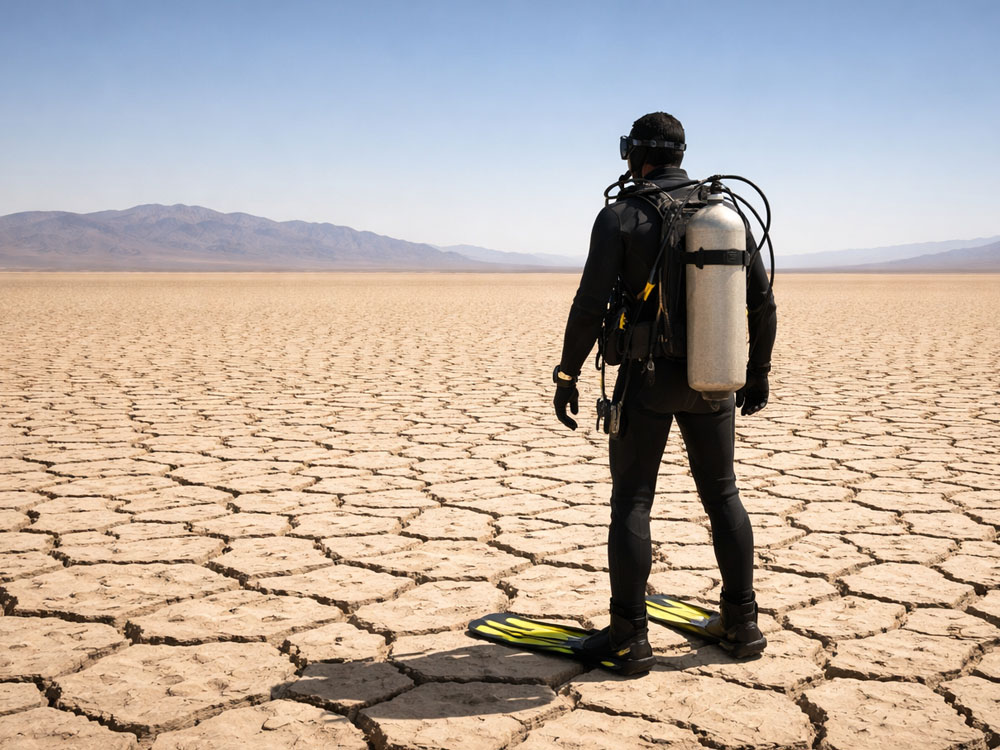
Here we have a fully suited scuba diver — tank, mask, fins, the whole aquatic starter kit — standing squarely in a place where the nearest water is probably a mirage negotiating its contract. It’s the kind of visual mismatch that makes your brain do a double take before your funny bone catches up.
There’s something wonderfully committed about it. He didn’t just bring goggles “just in case.” No, he prepared for an entirely different planet. Either the forecast was wildly misread, or this is the most aggressive example of optimism we’ve ever seen.
And that tension — extreme preparation meeting absolute uselessness — is where a lot of great captions are hiding.
Getting Started: What’s in the Image?
Let’s ground ourselves before we float away.
-
A lone man wearing full scuba gear
-
Dry, cracked desert terrain stretching outward
-
No water in sight
-
Bright, harsh conditions that scream “hydrate,” not “submerge”
The visual contrast is doing most of the comedic heavy lifting already. Your job is not to out-weird the image — it’s to frame the weirdness in a way that feels sharp and inevitable.
Pay attention to the level of commitment in the gear. This isn’t someone holding snorkels as a joke. This is serious equipment deployed in a profoundly unserious setting.
Also note the isolation. No crowd, no explanation, no context. When a character stands alone like this, it invites the caption writer to invent the story.
Think Beneath the Surface
Start by asking the most useful comedy question: How did we get here?
Is this a planning failure? A misunderstanding? Denial? Blind optimism? Wrong turn at Albuquerque energy?
Fish (ironically) for perspectives that heighten the absurdity:
Overconfidence
Someone who refuses to admit they might be wrong is always fertile comedic ground.
Example: “I’m telling you — sea levels rise fast.”
Extreme literalism
Maybe he followed instructions a bit too carefully.
Example: “The brochure said ‘once-in-a-lifetime dry dive.’”
Delayed payoff
What if he’s early? Very early.
Example: “Give it a few million years.”
You can also explore fish-out-of-water logic — arguably the most appropriate phrase imaginable here. When a character is engineered for one environment but dropped into another, the joke often writes itself if you stay concise.
Another productive angle is misplaced preparedness. Humans love preparing for the wrong problem while ignoring the obvious one.
Example: “Hydration was not the priority.”
Finally, consider leaning into modern behavior: bad directions, algorithmic recommendations, influencer culture, survival shows, climate panic — anything where confidence exceeds competence.
Just remember: pick one idea and drive it cleanly.
General Tips on How to Be Funny
Let the contrast do the work.
You don’t need extra absurdity piled on top of an already absurd image. Often the funniest captions simply acknowledge what’s happening with precision.
Short beats clever.
If your caption feels like it needs a second sentence to explain itself, trim it. Compression creates punch.
Avoid describing the photo. Frame it instead.
“The diver realized there was no water” is observation, not comedy. Tell us something the viewer couldn’t immediately say.
Commit to a perspective.
Is the diver confident? Embarrassed? Oblivious? Defiant? Pick a voice and stay there.
Escalate the logic — don’t wander.
Good captions often take a reasonable premise and push it one notch further than expected.
Example: “Google Maps has been off before, but this feels personal.”
Specificity beats vagueness.
Concrete references — brochures, forecasts, group chats, training manuals — create sharper mental images than broad statements.
Trust the reader.
You don’t need to underline the joke. Readers enjoy making the final mental connection themselves.
And perhaps most important:
Resist overengineering.
When the visual premise is strong, restraint is your friend. Think scalpel, not sledgehammer.
Final Thought
Great caption writing is often about recognizing when the image has already handed you the setup — all you need is the clean, confident turn that makes it click. Stay sharp, stay concise, and don’t be afraid to dive straight into the obvious tension… even when there’s no water in sight. 🌵
Enter Caption Contest 85 and show us your sharpest take on this perfectly misplaced diver.