Caption Contest 87: Recap & Review
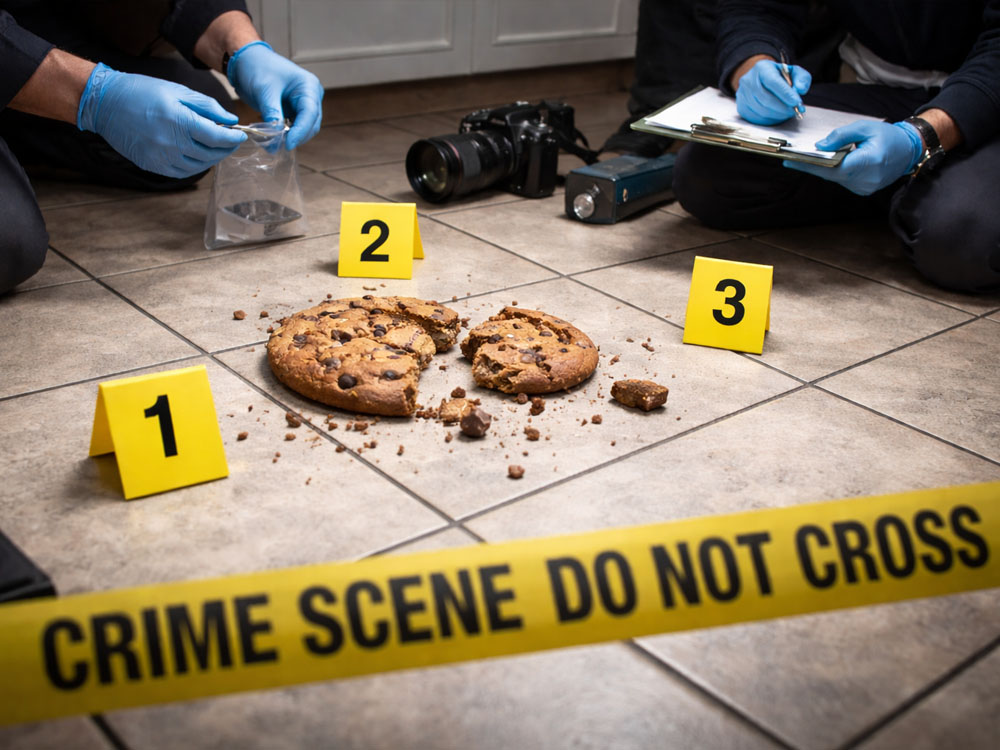
Nothing brings a team together like a high-stakes investigation… especially when the victim is a chocolate chip cookie. Yellow evidence tents, forensic focus, officers treating crumbs like classified intelligence — this image practically begged for procedural drama with a side of dessert.
Writers showed up ready to prosecute. There were monsters identified, dough tracked, crumbs analyzed, and at least one suspect probably reading their rights in a bakery lineup. It was CSI: Snack Unit.
What made this contest particularly fun was the tonal contrast. The scene is absurdly serious. The subject is deliciously unserious. That tension is comedic oxygen — and many of you breathed it in deeply.
Let’s dust for punchlines.
What We Saw a Lot
Food puns dominated the scene — and understandably so. Cookies are a linguistic playground: dough, chips, crumble, baked, smart cookie, sugarcoat. When a word bank is this rich, writers tend to grab the nearest pastry and start swinging.
Strong clusters emerged around:
-
“That’s the way the cookie crumbles.” Reliable, familiar, but difficult to elevate without a twist.
-
Dough jokes, especially suspects “taking off with a lot of dough.”
-
Cookie Monster references, often framed as a suspect.
-
Police procedural phrasing applied to dessert crimes.
-
Multi-pun stacks, where three or four bakery jokes attempted to ride shotgun in one caption.
There was also a noticeable instinct toward headline-style writing — “Breaking news,” suspect descriptions, official statements — which fits the image well. Authority language paired with a trivial crime is inherently funny.
The field showed good comedic radar. The next step is sharpening selectivity.
Missed Opportunities
Many captions found the right comedic lane but drove a little too cautiously.
Take the “cookie crumble” family. The phrase is familiar enough that it needs either escalation or misdirection to feel fresh. “How did the cookie crumble” (+9/-2) hints at investigation but stops just short of a reveal. A single added detail — forensic jargon, an absurd suspect, an emotional detective — could have pushed it from observation to joke.
Similarly, multi-pun captions often diluted their own impact:
“We have a sticky mess but eggcellent tips. Dough not worry folks”
There are good ingredients here, but comedy rewards precision. One strong pun beats three medium ones competing for attention.
Another near-miss pattern: treating the cookie as literally dead without specifying the absurdity. Lines like “Death Baked into the Sweets” sound dramatic but don’t quite deliver a comedic turn. Drama alone isn’t the joke — contrast is.
When the image already supplies seriousness, your caption can either heighten it or puncture it. Floating in the middle rarely produces the biggest laugh.
Head to Head
Finalist:
“Secured Crumb Scene”
Non-finalist:
“Those dirty rotten crumbs!”
The finalist works because it merges police jargon with cookie language cleanly and instantly. It reads like an official declaration — efficient, visual, and confident.
The non-finalist gestures toward personification but lacks a twist. Calling crumbs “dirty rotten” doesn’t quite build a comedic framework; it just assigns attitude.
The lesson: structure matters. When a caption sounds like something an officer might actually say into a radio, the absurdity becomes automatic.
Red Lines
Let’s talk about a few teachable moments.
“The real crime is you are wasting food when you could be feeding the homeless!”
This pivots into moral commentary, which pulls the reader out of the comedic universe. Humor thrives inside the premise; lectures redirect the emotional tone. Even socially conscious humor usually benefits from a lighter touch.
Lesson: Stay in the bit. Once readers feel judged, laughter exits the building.
“Has Trump’s prints all over it”
Topical humor can land — but only when the connection is unmistakably funny within the image itself. Here, the joke leans on recognition rather than comedic construction.
Lesson: Cultural references should amplify the visual, not replace the punchline.
“I’m so sorry. I gave up because. I had no milk.”
There’s an attempt at character voice here, which is promising. But the setup is foggy. Who is apologizing? Why now? Comedy prefers clarity before absurdity.
Lesson: If readers need to orient themselves mid-caption, the laugh window narrows.
Winning Captions & Why They Worked
Winner-adjacent standout:
“Snack attack? Or Snack-ccident?”
This caption succeeds through rhythm and framing. It presents two investigative possibilities like a detective briefing — and the portmanteau feels earned rather than forced.
“We’re looking at the Cookie Monster as a puppet of interest.”
A smart escalation. “Person of interest” becomes “puppet,” which adds specificity and deepens the Sesame Street reference without over-explaining it.
“Only a Monster could have done this.”
Elegant misdirection. It reads like standard detective language until the Cookie Monster implication quietly clicks.
“In other news,the suspect took off with a lot of dough.”
Classic wordplay delivered in a news voice. Familiar pun, upgraded by context.
“The crime: Batter-y! 🍪😜”
Simple, decisive, and structurally clean. One joke. No crowding.
“Secured Crumb Scene”
Arguably the tightest caption in the bunch. Immediate visualization, zero excess words.
The pattern across strong captions: clarity + commitment + restraint. They choose a lane and accelerate.
Also worth noting:
-
“The police are searching for one smart cookie” works because it sounds authentically procedural.
-
“We’re looking for someone sweet with a chip on his shoulder” layers character description onto food language — a subtle but effective upgrade.
-
“This is a tough crime to solve,definitely not a piece of cake” benefits from conversational delivery rather than pun stacking.
Strong captions didn’t try to impress. They tried to sound real inside an unreal situation.
Final Thoughts
This contest proved something important: when the image supplies absurd seriousness, you don’t need fireworks — just disciplined comedy.
Think like a detective next time. Identify the strongest clue (usually the contrast), eliminate unnecessary suspects (extra puns), and build a case around one clear comedic theory.
Remember: the goal isn’t to throw the entire bakery at the reader — just the freshest joke on the tray.
Now wipe the crumbs off your keyboard and head to the next contest… the laughs are still warm. 🍪
CTA: Go investigate the latest CaptionCo contest and submit your best evidence.