Tips for Caption Contest 87
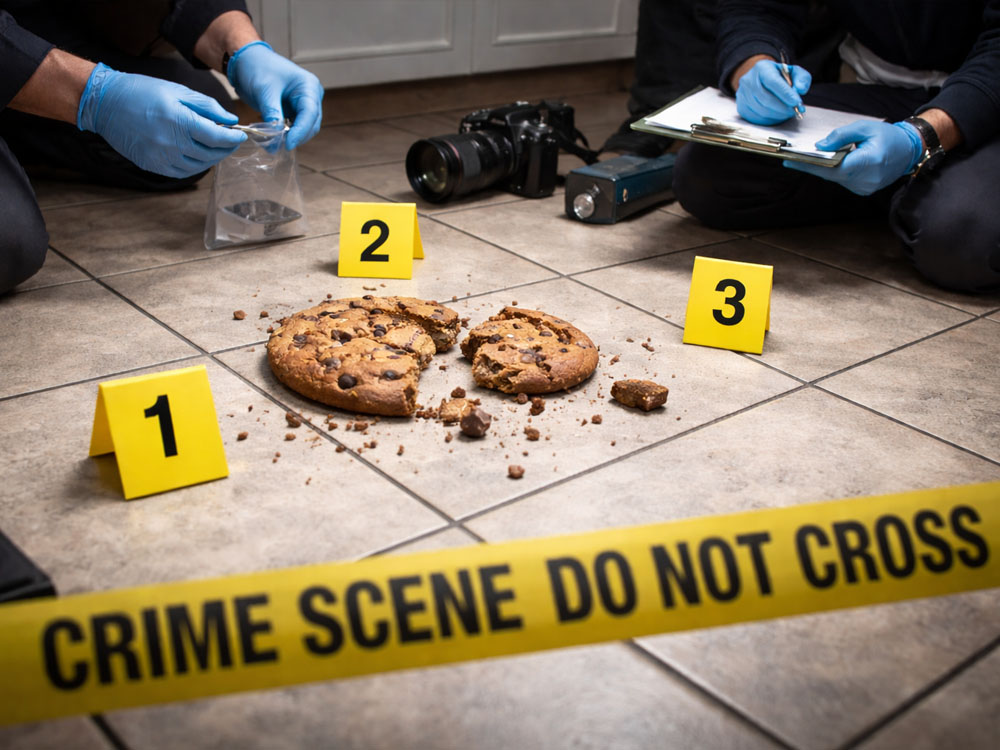
At first glance, this looks like the kind of crime scene that shuts down a city block. Evidence markers. Investigators. The whole procedural energy is there.
Then you notice the victim is… a cookie.
The comedy engine here runs on disproportion. Law-and-order seriousness colliding with baked-goods fragility is already funny before you write a single word. Someone has responded to crumbs with the urgency of a felony.
Your job is to decide what kind of world this is: one where cookies are treated like royalty, or one where investigators have completely lost perspective. Either path can work — as long as you commit to it.
Getting Started: What’s in the Image?
Let’s inventory the scene like professionals.
There’s a broken cookie on the ground, likely surrounded by numbered evidence markers. The posture of the investigators suggests focus and gravity. No one appears amused. This is being handled as a legitimate incident.
Notice the texture contrast: sterile investigative procedure versus something warm, homemade, and snackable. That tension matters.
Also pay attention to scale. Crime scenes are typically reserved for high-stakes events. Applying that level of scrutiny to dessert immediately creates comedic inflation.
Key details worth exploiting:
-
Evidence markers imply multiple “points of impact.”
-
The cookie is visibly fractured — not missing, not stolen, but destroyed.
-
Investigators appear methodical, suggesting paperwork is inevitable.
-
The seriousness is unanimous. No one is rolling their eyes.
When the image is already absurd, resist the urge to stack more absurdity. Often the funniest move is simply to interpret the situation literally.
Think Beneath the Surface
Strong captions usually answer an invisible question. Here, the question might be: How did we get here?
Maybe this cookie mattered more than it should have. Maybe the investigators are overtrained. Maybe there’s a department budget that needs justifying.
Consider the implied backstory:
-
Was this sabotage?
-
Negligence?
-
A pastry-related turf war?
-
The final straw in a long history of baked-good violence?
Another productive angle is procedural language. Bureaucratic phrasing tends to heighten trivial scenarios because it introduces formality where none belongs.
Examples:
-
Example: “We’re treating this as a crumbinal investigation.”
-
Example: “Cause of death: blunt force dunking.”
You might also explore category confusion — treating cookies like people, or investigators like overly dramatic narrators.
Examples:
-
Example: “Notify the next of tin.”
-
Example: “This is why we can’t have slice things.”
Just remember: pick one comedic premise and stay inside it. Jumping from detective jargon to cookie puns to philosophical commentary usually dilutes the laugh.
Commitment beats cleverness.
General Tips on How to Be Funny
Let the seriousness do the work.
When characters take nonsense seriously, you don’t need extra noise. Understatement is often stronger than escalation.
Favor specificity over vagueness.
“Crime scene” is broad. “Crumb analysis unit” is sharper.
Avoid explaining the joke.
If the humor depends on pointing out that the situation is ridiculous, it probably isn’t finished yet.
Choose one mechanism.
Pun, misdirection, bureaucratic tone, dramatic narration — all valid. Using three at once is rarely better than using one well.
Shorter usually lands harder.
A tight caption mirrors the efficiency of a good punchline.
Look for authority language.
Official reports, legal phrasing, detective clichés — these frameworks naturally contrast with the harmlessness of a cookie.
Examples:
-
Example: “We believe the suspect is still at large… near the milk.”
-
Example: “Bag it. Tag it. Snack it.”
Don’t overdecorate the premise.
The image already provides exaggeration. Your caption should guide the reader, not wrestle the spotlight away.
Test the “headline rule.”
If your caption could plausibly appear as a deadpan news headline, you’re probably in a strong zone.
Final Thought
This is a classic high-stakes-meets-low-stakes setup — the kind that rewards precision more than volume. Treat the joke like evidence: handle carefully, remove anything unnecessary, and present only what strengthens the case.
Now go crack the case — enter the contest and show us your best caption.