Tips for Caption Contest 89
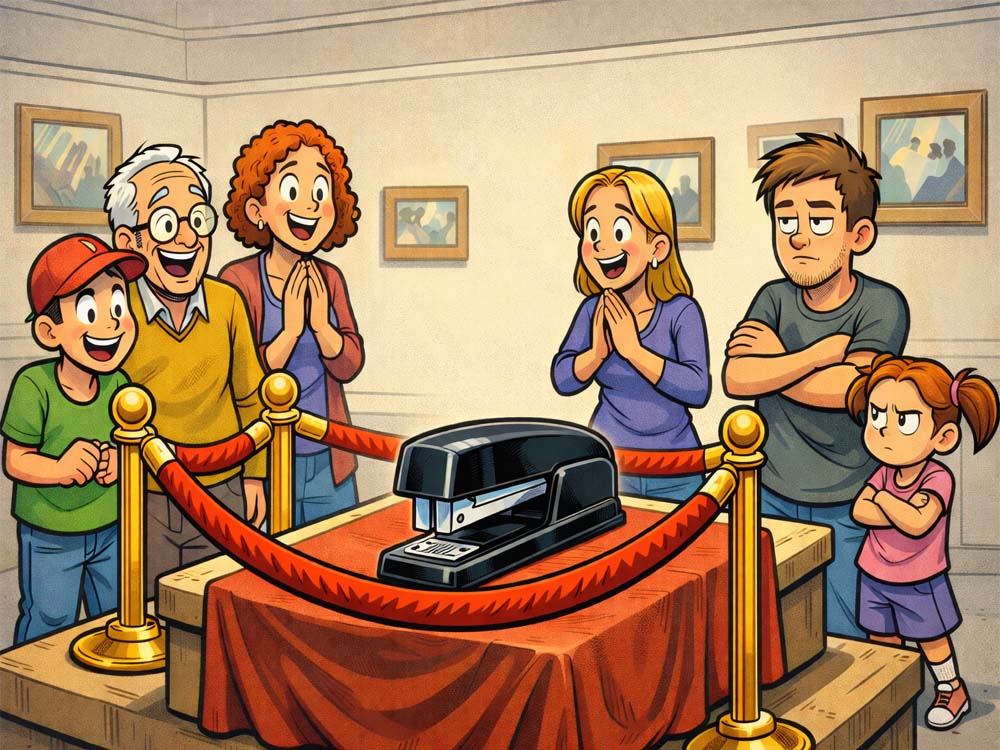
Somewhere, a curator made a decision. Not a mistake — a decision. They cleared wall space, adjusted the lighting, rolled out a velvet rope, and placed a perfectly ordinary stapler inside like it once negotiated a historic treaty.
And now people are staring at it.
One visitor leans forward, studying the craftsmanship. Another squints, trying to figure out what they’re missing. A third has already accepted that this is their afternoon now — quietly contemplating office supplies.
This image lives in the delicious gap between importance and absolute non-importance. Which is exactly where great captions thrive.
Getting Started: What’s in the Image?
Before you chase a joke, anchor yourself in what we can literally see.
There’s a museum setting — clean floors, intentional lighting, likely some blank wall space doing its best to feel prestigious. The velvet rope is doing heavy comedic lifting here. Ropes signal value. Protection. “Do not touch unless you have a doctorate.”
Behind it: a stapler so generic it could have come from a supply closet five minutes ago.
The crowd matters too. Not everyone is reacting the same way. Some appear impressed. Others look politely confused. That range gives you options — you can write from the perspective of believers, skeptics, or people pretending to understand modern art.
Also important: nothing about the stapler itself is visually remarkable. Which means the humor probably won’t come from describing the object — it will come from reframing why it’s there.
Think Beneath the Surface
The strongest angle here is manufactured importance.
Museums tell us what deserves reverence. So when something mundane gets elevated, our brains scramble to justify it. That tension is comedic gold.
Try exploring ideas like:
-
Everyday objects treated as priceless artifacts
-
Overly serious art-world language applied to something trivial
-
Visitors afraid to admit they don’t “get it”
-
A dramatic backstory no one asked for
-
The stapler as a cultural turning point
Another productive direction is false prestige — when presentation alone creates value.
Example: “Please keep your voices down — this is from the Post-it Era.”
You can also lean into interpretive exaggeration, where viewers project deep meaning onto nonsense.
Example: “The artist challenges our understanding of attachment.”
Or go the opposite route and puncture the seriousness entirely.
Example: “Finally, something from my expense report.”
Notice how each approach picks a clear comedic lens and commits to it. Hesitation weakens jokes; specificity strengthens them.
General Tips on How to Be Funny
Choose the target quickly.
Is the joke about museums? Art critics? Office culture? Human pretension? Decide early so the caption doesn’t wander.
Respect the intelligence gap.
Captions work best when the reader makes a tiny mental leap. Don’t explain the joke — set it up so the audience connects the dots.
One sharp idea beats three mild ones.
If your caption contains multiple comedic premises, pick the strongest and cut the rest.
Use confident language.
Museum humor benefits from authority. Words like exhibit, archival, rare, restored, and collection instantly build the frame.
Example: “Part of the Permanent Procrastination Collection.”
Avoid generic understatement.
Saying “this shouldn’t be in a museum” is the observation — not the joke. Push one step further into surprise.
Scale creates humor.
The bigger the reaction, the funnier the contrast.
Example: “Security was added after the Paperclip Incident.”
Write tighter than you think you need to.
Precision feels smarter — and smart captions feel funnier.
Let the rope guide you.
The velvet rope is a silent straight man. Anything protected must be valuable… which invites you to invent ridiculous reasons why.
Final Thought
Great caption writers notice when the world accidentally becomes absurd — and then they nudge it just a little further. Treat this stapler like the masterpiece it clearly isn’t, commit to your angle, and let the contrast do the heavy lifting.
Enter the contest and show us your most museum-worthy caption.