Caption Contest 91: Recap & Review
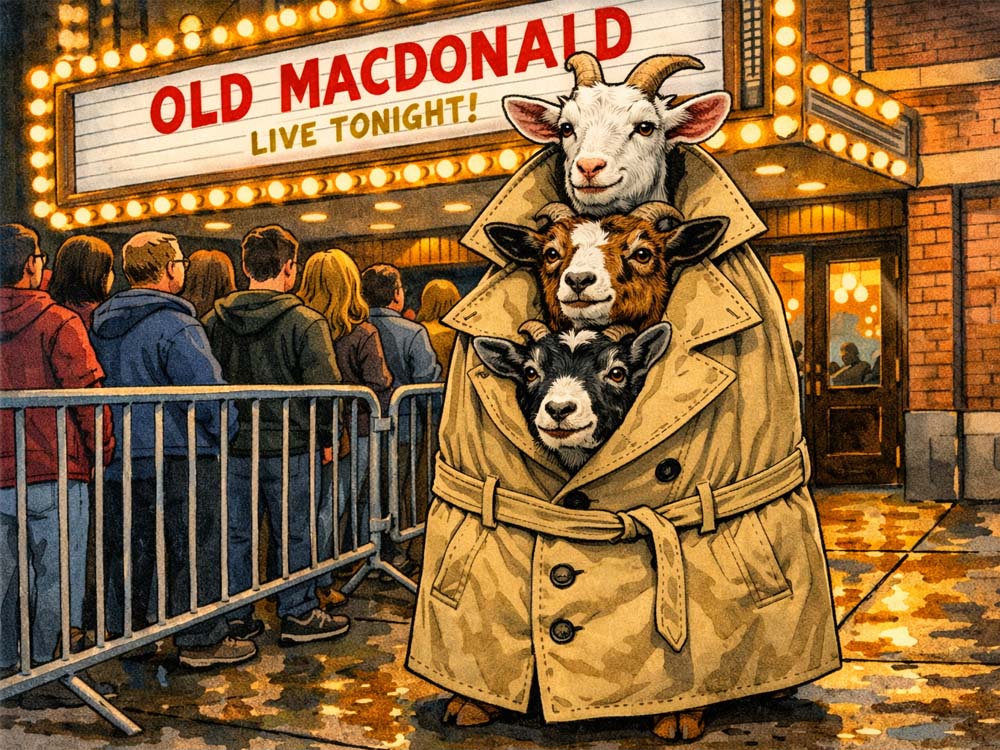
Three goats. One trench coat. Zero shame.
Caption Contest 91 gave us farm animals attempting the oldest trick in the book: “We’re definitely one adult human.” And honestly? The confidence alone deserved a standing ovation.
Between the “Old MacDonald” marquee and the suspiciously hoof-shaped silhouette, this image practically bleats for wordplay. You all showed up ready to milk it. 🐐
What We Saw a Lot
No surprise: goat puns dominated the pasture.
We saw heavy rotation on:
-
“bleat”
-
“baa-ckstage”
-
“legen-dairy”
-
trench coat mashups (“Trench Goat,” “The trench-goats at a premiere.”)
-
Old MacDonald lyric flips
There was also a strong instinct toward stacked/line jokes — “This is what you call a stacked lineup,” “3 for the price of 1,” and “Standing in line is much easier when you have ten extra legs to lean on.” That’s smart. The visual is vertical, so thinking in terms of stacking, height, and balance makes sense.
Another recurring move: “three kids in a trench coat.” That cultural reference is doing a lot of work. It’s instantly recognizable, and goats pretending to be one person is already absurd. Leaning into that trope was a solid strategic instinct.
And finally, a nice wave of Ticketmaster commentary and backstage references. Concert culture plus barnyard? A natural crossover.
Missed Opportunities
Where things slipped was mostly in density.
A lot of captions tried to layer multiple references at once — goats + Old MacDonald + film festivals + horror + sheep + puns — and the joke got crowded.
Take:
“The Horror Film Old MacDonald’s Goat Totem Lives premiere featured a Goat Totem appearance.”
There’s a fun idea buried in there — goats as a horror totem — but the sentence becomes the bit instead of the concept. When readers have to decode structure before they can laugh, momentum stalls.
Similarly:
“Tonight on Old MacDonald’s Unsolved Mysteries… Why the line? Who’s in the trench goat? Perhaps ewe”
There are three distinct punchlines fighting for space. Any one of those ideas could work. All three together dilute the hit.
The strongest submissions in this contest were clean. One turn. One visual. Done.
Head to Head
Finalist:
“The trench-goats at a premiere.”
Non-finalist:
“Trench Goat”
Both are playing the same word-mashup move. Both recognize that “trench coat” is the core mechanic of the image.
But “The trench-goats at a premiere.” wins for context.
“Trench Goat” is clever, but it feels like a label. It describes what we’re seeing.
“The trench-goats at a premiere.” adds situation. It places them at an event. It implies legitimacy. It reads like a red carpet headline. That added layer of specificity turns a pun into a scene.
Small difference. Big effect.
Red Lines
“Standing in line is much easier when you have ten extra legs to lean on”
There’s a funny physical logic here. But it reads more like an observation than a punchline. Comedy often benefits from compression. If the structure feels explanatory, the laugh loses sharpness. Consider how you might tighten the idea to create a stronger twist rather than a statement.
“This lineup is legen-dairy”
This one shows classic pun instinct. The issue isn’t the wordplay — it’s predictability. “Dairy” is one of the first associations with goats. When the punchline is the most obvious farm adjacency, it rarely outperforms more surprising angles.
“Just three kids in a trench coat trying to see their idol”
The reference works, but this version leans into sincerity instead of absurdity. “Trying to see their idol” softens the tension. The funniest versions of this trope usually heighten the lie, not justify it. Exaggeration beats explanation.
“We got to get more chickens”
This one feels like it wandered in from another contest. If the joke doesn’t directly engage the image’s core mechanic (the stack, the coat, the marquee, the line), it risks feeling untethered. Specificity to the visual is your north star.
Winning Captions & Why They Worked
Finalists:
“This is what you call a stacked lineup”
This works because it hits two meanings at once: a concert lineup and the literal stacking. It’s tight, accessible, and visually anchored.
“Are you kids out pasture bedtime?”
A strong example of a layered pun that stays readable. “Pasture” lands cleanly, and the parental scolding tone adds character.
“Old MacDonald had a line… E-I-E-I-Oh no.”
This one uses rhythm well. The musical setup primes the brain for nostalgia, and “Oh no” flips it into a modern inconvenience. Smart tonal pivot.
“Trip-Trap concert about to drop the Bleat”
Ambitious and playful. The Billy Goats Gruff reference (“Trip-Trap”) shows depth, and “drop the Bleat” gives it performance energy. It’s more complex than some others, but it commits to the bit.
“Are the beards too obvious?”
This one stands out for subtlety. It doesn’t scream pun. It hints at the disguise failing. The humor lives in understatement.
“Old MacDonald had a scam.”
Short. Sharp. Darker edge. It reframes the entire scene as intentional fraud, which heightens the stakes beyond cute goats.
“We’re here for the baa-ckstage passes.”
Probably the cleanest farm-to-concert pun of the bunch. Clear setup. Immediate payoff. No clutter.
“baaaack off”
Minimalist and confident. It reads like a defensive bleat from the coat itself. That character voice gives it life.
The common thread among the strongest entries? Restraint. One move. One clear laugh. No overfeeding the goat. 🐐
Final Thoughts
This contest was stacked — literally and competitively.
You all showed strong pun instincts, solid visual anchoring, and a good feel for cultural references. The next step for many of you is tightening. Ask: can this joke lose three words and gain three laughs?
Keep disguising three animals as one adult human. It’s working.
Now head over and see what’s waiting in the next contest — and try not to tip the coat on your way in.