Caption Contest 93: Recap & Review
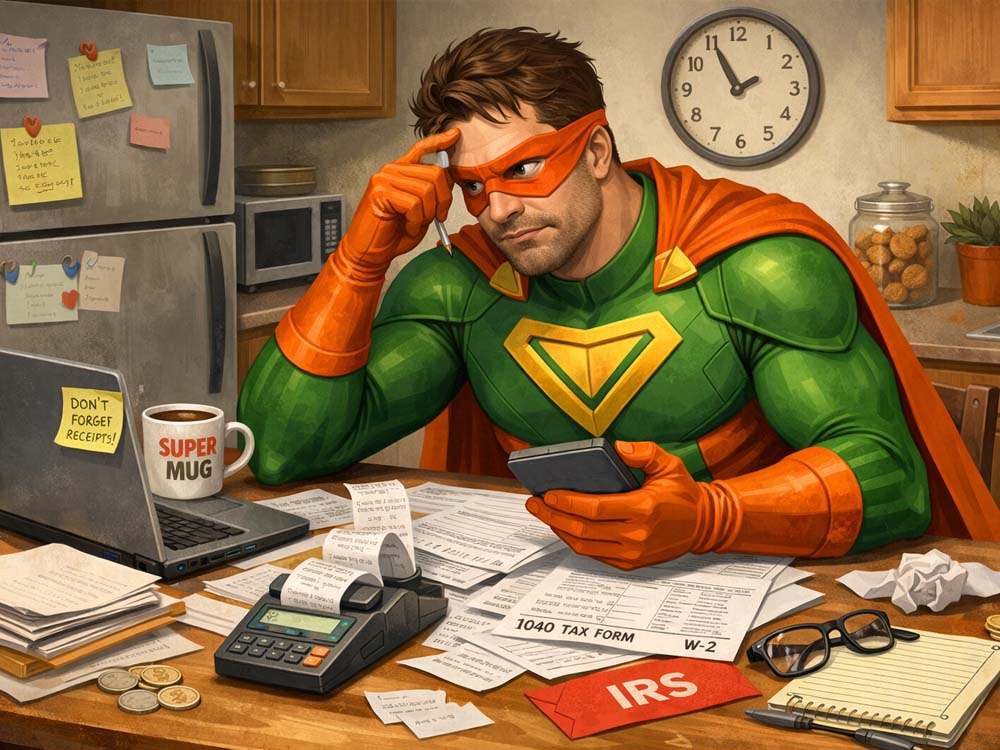
Nothing humbles a caped crusader faster than a stack of W-2s.
This image works because the fantasy isn’t fighting crime — it’s fighting a calculator. A man who can bend steel is being bent by Form 1040. The cluttered office matters: papers everywhere, posture defeated, hero reduced to intern. You don’t need kryptonite when you have itemized deductions.
The comedy tension here is simple and strong: infinite power vs. finite paperwork. Every caption lives or dies by which side it commits to.
What We Saw a Lot
Writers immediately recognized the two joke engines available:
• superhero references
• tax terminology
Many entries leaned into name-dropping other heroes:
“I wonder if Flash can help me with this mess!”
“I wonder if Superman has the same problem?”
Others leaned into general financial frustration:
“These magic powers just don’t pay the bills. I need an upgrade.”
“I should have paid more attention in math class”
A third cluster tried to merge the two worlds with accounting logic:
“Sidekicks count as employees until they unionize”
“Hmmm Can I deduct all the money I saved from bank robbers?”
Overall instinct: correct target, but often too broad. The best jokes weren’t just “superhero + taxes.” They were a specific collision between the identities.
Missed Opportunities
A lot of captions treated taxes as generic hardship instead of a bureaucratic system.
For example, math confusion appeared frequently:
“I can leap a tall building in a single bound try to do a little math and 2+2=22”
Math is adjacent to taxes, but it’s not the same comedic object. The humor here loses precision. Filing taxes isn’t hard because of arithmetic — it’s hard because of rules, categories, loopholes, and absurd classifications. The more legal-sounding the problem, the funnier the contrast.
Another near-miss was emotional complaint without escalation:
“These magic powers just don’t pay the bills.”
“I have enough for three more months. When is this Super Hero thing going to start paying off?”
They establish a premise but stop before the twist. We understand the hero is broke. What we want is how the IRS interprets heroism. That’s the real engine.
Head to Head
Finalist:
“Does a sidekick count as a dependent?”
Non-finalist:
“Sidekicks count as employees until they unionize”
The finalist works because it frames a believable tax question. It sounds like something a real person would nervously Google at 1:12 AM. The joke comes from bureaucratic misclassification — child vs. employee — which perfectly merges both worlds.
The non-finalist adds an extra concept (unionization). That adds distance from the image. Instead of one clean absurdity, we get a sketch premise. More words, less clarity.
Comedy favors plausible nonsense over elaborate nonsense.
Red Lines
“He never sees me.”
This is a different joke entirely — invisibility humor. The image doesn’t suggest that power, so the audience must invent a new scene before laughing. When a caption requires adding missing information, it slows the punchline. Anchor to what the viewer already sees.
“I have super powers, I should know this by now.”
This states frustration but doesn’t reframe the situation. It’s commentary, not a joke. A caption should change our understanding of the image, not just describe the character’s feelings about it.
“Hmmm…my earned annual income?!?!”
Questions can work, but they need specificity. “Income” is neutral. Something like hero-specific income classification creates the comic turn. The more official the wording, the funnier the absurdity.
Winning Captions & Why They Worked
“Does a sidekick count as a dependent?”
This is the cleanest marriage of worlds. A domestic tax question applied to vigilante life. Specific, visual, and instantly imaginable. You can picture Robin sitting in a booster seat at H&R Block.
“Can I deduct for my cape cleaning?”
Great object specificity. The cape exists in the image, and the mundane maintenance of a dramatic garment is inherently funny. The joke works because it treats the extraordinary as dry household upkeep.
“With great power comes… great tax complexity.”
Solid parody structure. It modifies a known phrase but shifts the stakes from moral burden to administrative burden. The ellipsis does the work — it signals expectation before subversion.
“Audit-Man: protecting the city from creative accounting”
Nice inversion: the hero isn’t fighting crime, he is the enforcement. The joke reframes the character entirely while still matching the paperwork setting.
“Maskematician… is here to save the day!”
This one relies on wordplay but succeeds because the setting justifies it — numbers everywhere. A pun works best when the environment endorses it, and this one does.
Final Thoughts
Superhero humor works best when the powers stay intact and the world refuses to care. The city needs saving, but the IRS needs documentation. Stakes collide, and paperwork wins.
In this contest, the strongest captions didn’t make the hero less heroic — they made society more administrative. That’s where the laugh lives: not that heroes struggle, but that bureaucracy is stronger than super strength.
Next time, look for the form number hiding inside the fantasy. Every cape has a receipt attached.
Go file your funniest entry in the next contest before penalties apply.