Caption Contest 96: Recap & Review
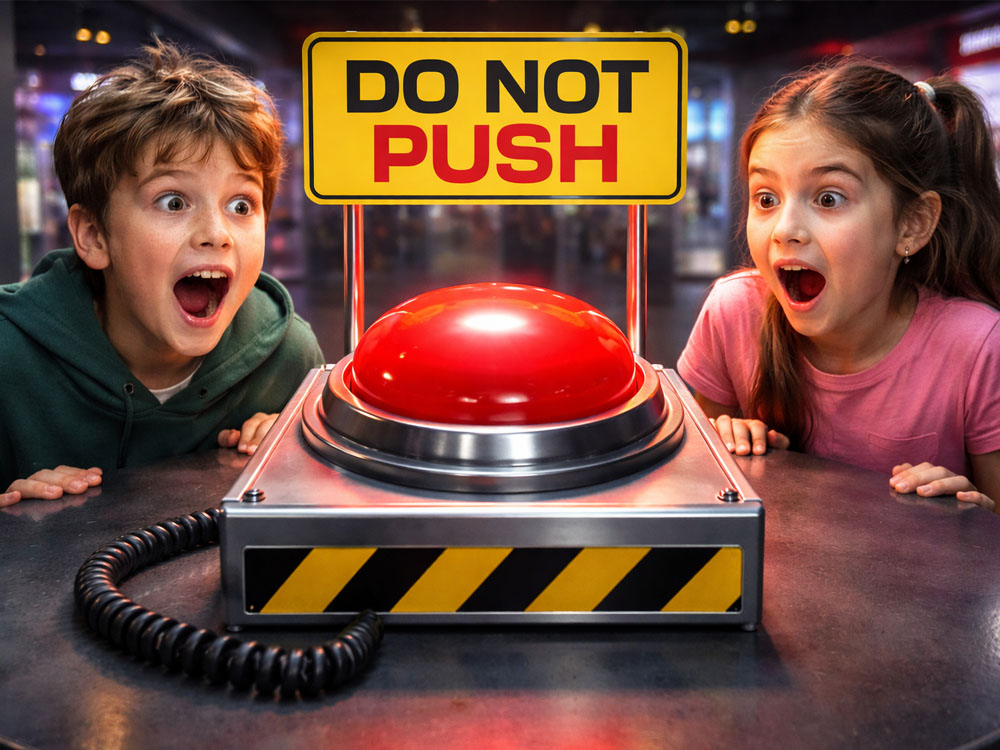
Nothing motivates a child like a clearly labeled boundary and a conveniently reachable finger. This image is essentially a behavioral study: two kids, one button, and a sign that reads less like a warning and more like a challenge coin.
The comedy tension here isn’t subtle. The kids aren’t debating morality. They’re negotiating timing. The sign isn’t preventative — it’s promotional.
You can almost hear the silent logic: If the adults went to the trouble of labeling it… it must do something cool.
This contest became less about “will they push it?” and more about how quickly your caption could push the joke past the obvious.
What We Saw a Lot
Three big instincts showed up repeatedly:
Pun-on-push wordplay
Examples:
-
“Don’t push your luck!”
-
“They’re under a lot of press-sure”
-
“Just a couple of ‘pushy’ kids.”
-
“Consider this a pressing matter”
These worked when clean and immediate. They struggled when stretched too far or layered with extra explanation.
Curiosity vs authority framing
Examples:
-
“Science is about asking questions and ignoring warnings”
-
“We’re gonna learn why the sign exists”
-
“Kids rush when they’re told ‘no’”
This was the image’s backbone — kids + forbidden object — but captions needed a twist beyond simply restating the premise.
Dare culture / negotiation dialogue
Examples:
-
“You push it! No, you push it!”
-
“I dare you to push it !!!!”
-
“3… 2… 1… KABOOM!”
These leaned into realism, which helped relatability, but sometimes sacrificed surprise.
Missed Opportunities
Many captions described the decision instead of the logic. The funniest angle here isn’t that they will push it — that’s guaranteed. The humor lives in why the kids believe pushing it is correct behavior.
For instance:
-
“It’s like they didn’t even see the ‘Do Not’ part.”
-
“You know we have too push it”
Both sit at observation level. They confirm the premise but don’t reinterpret it.
Another near-miss pattern was escalation without specificity:
-
“3… 2… 1… KABOOM!”
The explosion is expected. Without a twist (emotional, social, or absurd), the brain arrives before the punchline does.
The strongest submissions treated the sign not as a warning — but as information kids process incorrectly.
Head to Head
Finalist:
“Finally, a group project we agree on.”
Non-finalist:
“You push it! No, you push it!”
Both capture collaborative childhood behavior. But the finalist wins because it reframes the moment through a school-aged lens instead of just reenacting the scene.
“You push it! No, you push it!” is realistic dialogue — we can already imagine it happening. The caption adds nothing new.
“Finally, a group project we agree on.” introduces a second shared experience (school frustration) and overlays it onto the image. The kids aren’t just kids anymore — they’re students encountering the first cooperative assignment they actually want.
The joke doesn’t describe the image. It interprets it.
Red Lines
“We’re gonna learn why the sign exists”
This lands close to funny but stops one step early. It states the curiosity but not the flawed reasoning. A stronger version would reveal what they expect to happen, not just that they want to find out.
Lesson: Curiosity is setup. Misguided confidence is punchline.
“Science is about asking questions and ignoring warnings”
Nice idea, but adult phrasing distances us from the characters. The kids don’t think they’re doing science — they think they’re doing something smart. Comedy improves when the caption matches the characters’ mindset, not the narrator’s commentary.
Lesson: Write from inside the moment, not above it.
“If you didn’t want it pushed, why is it so red and shiny?”
Good logic direction — the kid reasoning angle works — but length weakens the impact. The joke arrives halfway through the sentence, then keeps explaining itself.
Lesson: Once the audience understands the logic, stop talking.
“Repressed childhood memories”
A solid pun, but abstract. The button is concrete, immediate, tactile. The caption jumps to psychology instead of behavior, which lowers visual connection.
Lesson: The closer the joke stays to the physical object, the stronger the laugh.
Winning Captions & Why They Worked
“What does “TON OD HSUP mean”?”
This one thrives on kid logic. Instead of defying the rule, the children accidentally reinterpret it. The joke replaces rebellion with misunderstanding — a cleaner and more original angle than “they’re ignoring the sign.”
“Finally, a group project we agree on.”
Relatable, concise, and layered. It connects childhood cooperation to academic frustration without overexplaining.
“Just a couple of ‘pushy’ kids.”
Simple wordplay, but effective because it describes personality rather than action. The kids become a type of person, not just participants in an event.
“They’re under a lot of press-sure”
Classic pun structure, clean delivery. The joke attaches pressure to both the button and the kids’ anticipation — dual meaning without extra words.
“Repressed childhood memories”
While abstract compared to others, it earned finalist status because it pivots from physical button to emotional trigger quickly and cleanly. The brevity carries it.
Across the finalists, notice the pattern: none merely say the kids will push it. They reinterpret how the kids understand the situation.
Final Thoughts
A “Do Not Push” button is comedy shorthand — like a banana peel or a rake on the ground. Everyone knows the outcome. The job isn’t predicting it; it’s explaining the mental gymnastics that make it inevitable.
The best captions turned the warning into either a misunderstanding, a collaboration opportunity, or an accidental invitation. The weakest ones simply waited for the explosion.
Remember: in a forbidden-button cartoon, the punchline isn’t the boom — it’s the reasoning that made the boom feel like a good idea.
Go press your luck again in the next contest.