Tips for Caption Contest 96
Every museum has one rule you instantly want to break.
This image is that rule, concentrated into a single shiny circle.
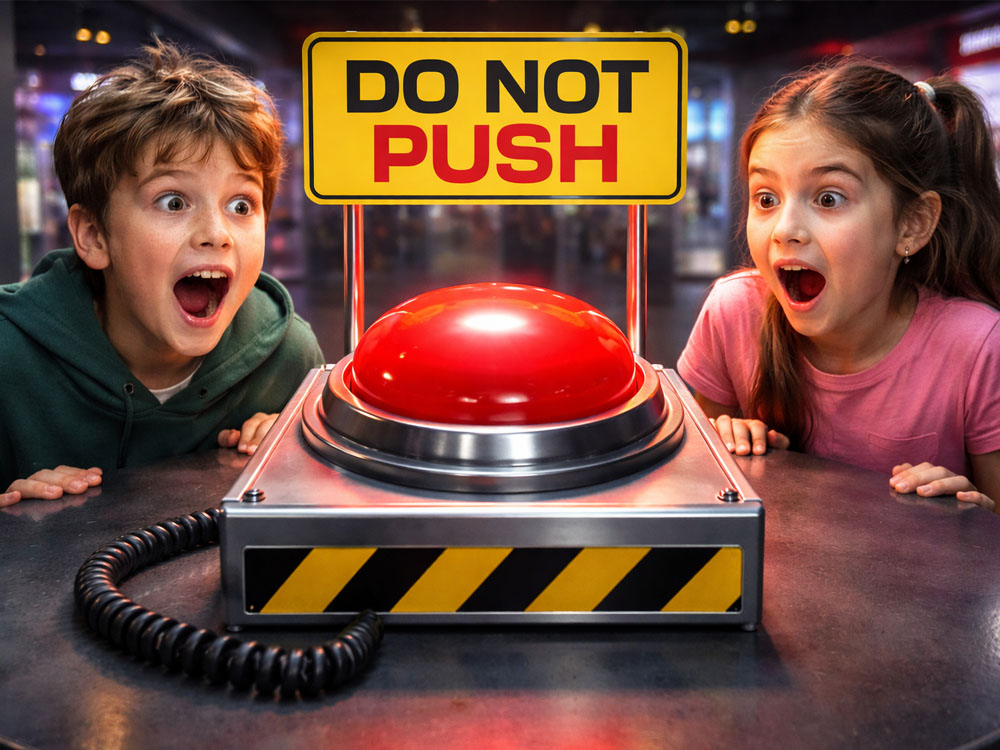
Two kids stand next to a giant red button labeled “Do not push,” and they are vibrating with the exact energy of people about to invent consequences.
The humor lives in anticipation. Nothing has happened yet — which means everything already has.
This is the purest form of comedy tension: a setup so obvious that your brain starts writing disaster fan-fiction before the joke even begins.
Getting Started: What’s in the Image?
Start literal. The basics matter here.
-
Two children
-
A large red button
-
A warning sign: “Do not push”
-
Visible excitement — not hesitation
-
No adults in frame
-
No visible explanation for what the button does
The button is oversized and theatrical. This isn’t a normal control panel; it’s a cartoon version of temptation.
Also important: the kids are happy, not scared. That shifts the joke from danger to inevitability. We aren’t wondering if it will be pushed — we’re wondering what kind of bad decision logic will justify pushing it.
Focus your joke on the moment before impact. Once it’s pressed, the image becomes ordinary chaos. Right now, it’s potential energy.
Think Beneath the Surface
This image isn’t really about a button. It’s about forbidden action psychology.
Humans don’t resist rules — we audit them.
The sign is the straight man. The kids are the internal monologue. Your caption is the rationalization.
Good angles to explore:
-
Loophole logic (“technically not pushing”)
-
Authority misunderstanding
-
Overconfidence in consequences
-
Scientific curiosity gone wrong
-
Sibling influence dynamics
-
Legalistic interpretation of wording
-
Corporate disclaimers vs human behavior
-
The universal urge to test boundaries
You can also invert scale. The bigger the warning, the smaller the self-control.
Another useful path: treat the button as mundane. The less catastrophic the outcome, the funnier the obsession becomes.
Example: “It just restarts the Wi-Fi.”
Now the tension collapses into petty stakes — which is often stronger than explosions.
Or go existential: the kids aren’t reckless, they’re participating in destiny.
Example: “History keeps giving me these opportunities.”
Comedy thrives when the characters feel smarter than they are.
General Tips on How to Be Funny
Name the decision, not the disaster.
The funniest moment is the reasoning that leads to pressing the button, not the explosion after.
Use confident logic.
Bad decisions delivered with certainty outperform obvious stupidity.
Example: “It says do not push, not do not tap.”
Shrink the scale.
Gigantic setup, tiny payoff = reliable contrast.
Example: “Turns off the classroom fish tank filter.”
Avoid describing the photo.
We already see kids and a button. Add perspective, not narration.
Write from inside the character’s head.
Captions work best as thoughts, negotiations, or conclusions — not commentary.
Example: “We should at least know why we’re grounded.”
Choose one idea.
Don’t stack apocalypse, science lab, and sibling rivalry in the same caption. Precision beats abundance.
Let the reader finish the joke.
The best caption ends half a step early. The audience presses the button mentally.
Example: “Okay but what if the sign is outdated?”
Final Thought
This image rewards restraint: the button is loud, so your joke should be calm — the quieter the logic, the bigger the laugh.
Now go justify a terrible decision and enter the contest.