Caption Contest 98: Recap & Review
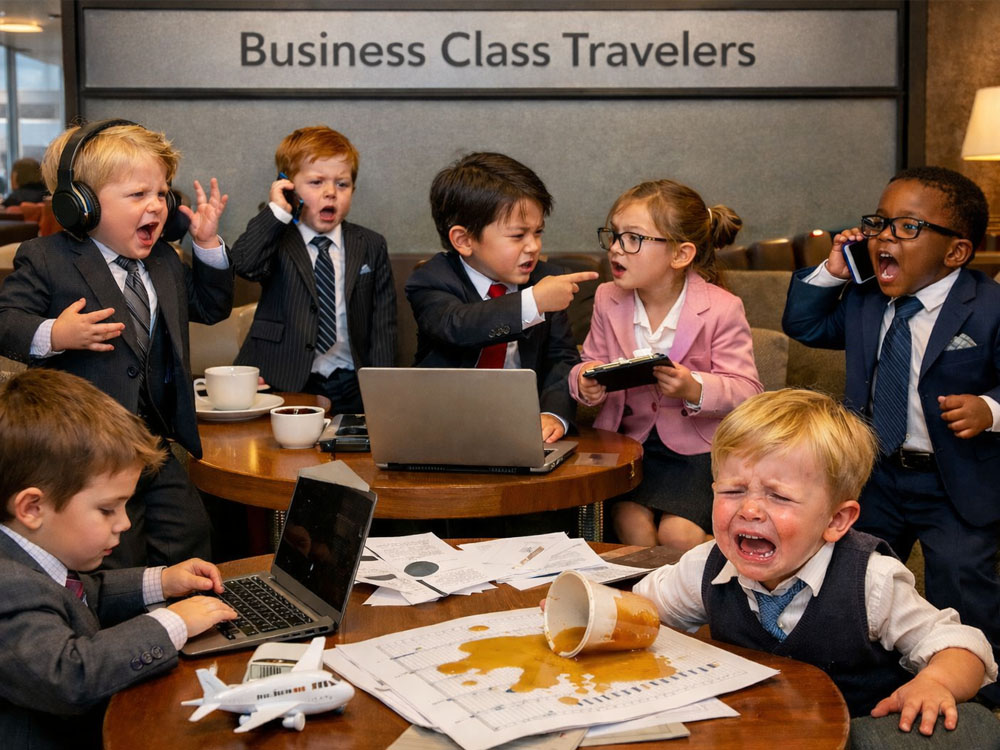
Few environments are more serious than a business lounge: hushed voices, tense negotiations, passive-aggressive laptop typing. Now replace every executive with a toddler in a blazer who just discovered object permanence 15 minutes ago.
This image works because the adults aren’t acting like children — the children are acting like adults, badly. It’s not chaos for chaos’ sake. It’s corporate chaos. Strategic meltdowns. Hostile takeovers involving juice boxes.
So the best captions didn’t just say “kids behaving badly.” They identified which specific business behavior the toddlers were parodying — and then let the contrast do the punchline.
When the joke clicked, it felt less like daycare and more like a quarterly earnings call with nap time looming.
What We Saw a Lot
A strong instinct across submissions was translating corporate jargon into toddler equivalents: IPOs, C-suite, earnings calls, ladders, mergers. That was the correct target.
We also saw many captions leaning on the broader idea that adults act like babies. That’s related, but weaker — it removes the visual specificity. The image isn’t saying adults are childish. It’s showing a functioning business ecosystem built entirely out of childish behavior.
Another recurring pattern: generic tantrums. Crying, yelling, wanting parents, spilled drinks. Those details are in the image, but they’re not yet jokes. They’re ingredients. The humor comes from mapping them onto business structure.
The most successful entries didn’t describe what toddlers do — they described what corporations do, and let toddlers perform it.
Missed Opportunities
Several captions hovered near a sharp idea but stopped at commentary instead of committing to a premise.
For example, broad statements about society or “corporate America” recognized the satire but didn’t dramatize it. The image already is the commentary. The caption’s job is to specify the mechanism.
Another near-miss was overexplaining the metaphor. If the reader has to process both halves of the comparison, the joke slows down. The stronger captions let one side remain implicit.
There was also room for more role specificity: HR, mergers, hostile seating takeovers, networking, layoffs, startups — the more concrete the business behavior, the funnier the toddler performance becomes.
In short: don’t explain the satire. Stage it.
Head to Head
Finalist:
“Corporate ladder replaced with a foam climbing structure”
Non-finalist:
“What corporate America feels like.”
Both aim at the same observation: business culture mirrors childish behavior.
The finalist works because it replaces one precise element with another precise element. The reader instantly pictures a promotion system made literal in daycare terms. Clean translation, clear visual, quick laugh.
The non-finalist names the theme instead of demonstrating it. It’s commentary, not a scenario. Once the audience agrees, the joke ends — there’s nowhere to imagine further.
Comedy improves when abstraction becomes physical.
Red Lines
“Buy! Sell! I want my Mom !”
This tries to merge trading jargon with toddler panic, but both halves compete for attention. The structure becomes two punchlines stitched together. When combining ideas, the humor should emerge from the collision — not from alternating between them.
“Everyone has something to say”
This is observational but unspecific. Any meeting, airport, or playground fits it. If a caption still works on ten different images, it usually hasn’t used the image yet.
“Your all in time out!”
Close conceptually — workplace discipline mapped to childcare — but the joke stops at the first obvious equivalent. Pushing one step further (HR policy, performance review, compliance training) would create novelty.
Broad lesson: when a premise is obvious, the second layer is the punchline.
Winning Captions & Why They Worked
“The bottom line? Diapers.”
A strong, clean business phrase translated into a bodily reality. The structure mirrors a financial conclusion while landing on a toddler necessity. Fast and efficient.
“IPO: Initial Pacifier Offering”
Pure wordplay, but perfectly aligned with the image. It works because startups and toddlers both revolve around soothing investors — or guardians. Compact and memorable.
“Corporate ladder replaced with a foam climbing structure”
Highly visual and specific. It converts metaphor into literal object, letting the audience visualize promotion culture as playground equipment.
“He’s been here three months and still hasn’t made partner.”
Great status humor. It treats the toddler as a legitimate junior associate, which preserves the business world instead of breaking it. The seriousness creates the absurdity.
“I TOLD you to sell before the juice market crashed!”
The standout escalation. It introduces a fully functioning financial market within toddler logic. The tantrum becomes an economic meltdown. Clear stakes, clear setting, and the juice box grounds it perfectly.
Final Thoughts
This contest showed a reliable rule: the joke lives in the organizational chart. The funnier captions didn’t rely on kids being silly — they relied on business being inherently ridiculous once rendered literally.
Whenever an image gives you a system (law, finance, academia, corporate culture), don’t summarize it. Build it. Populate it. Then let the wrong people run it.
In this lounge, the Wi-Fi is fast, the networking is aggressive, and the performance reviews end in tears — which, to be fair, isn’t that far from reality.
Check out the next contest and submit a caption before these executives unionize their nap schedule.