Tips for Caption Contest 98
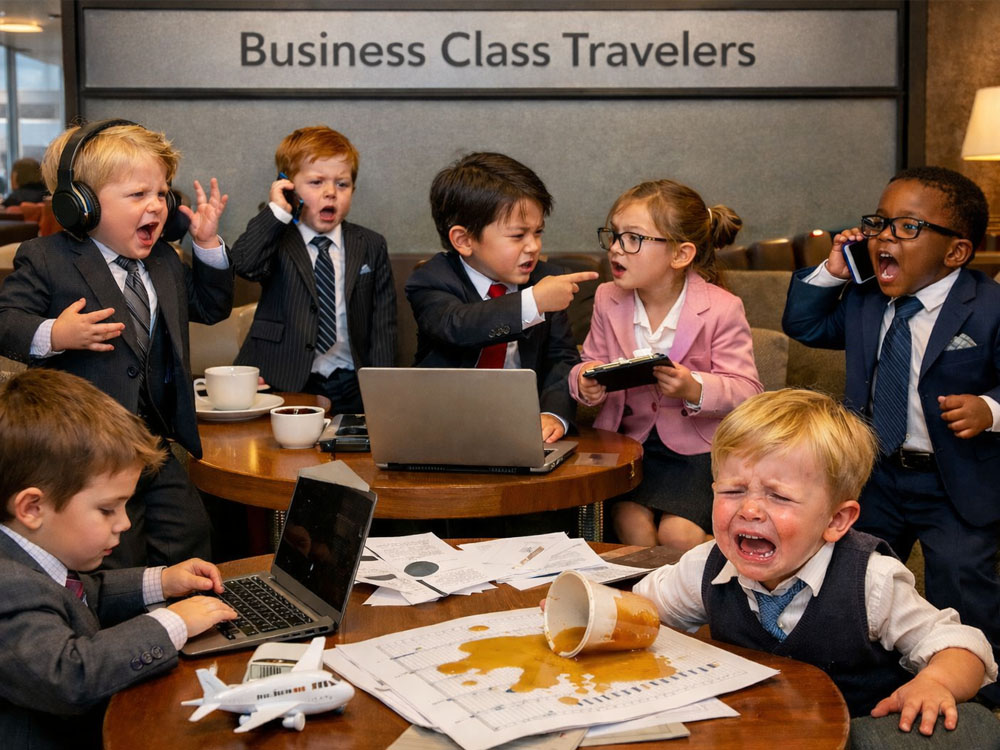
The velvet rope says Business Class Travelers.
Inside: quarterly earnings are being presented by someone who still calls pants “leg sleeves.”
Tiny loafers squeak across marble floors. A toddler aggressively taps a dead laptop while insisting the Wi-Fi is “unacceptable for this price point.” Another storms past dragging a stuffed giraffe like a briefcase.
Somewhere, a juice box explodes. A meltdown follows — not emotional, but financial. The room freezes as a small executive explains that the spreadsheet was “saved locally.”
This is less airport lounge, more daycare for people who learned buzzwords before tying shoes.
Getting Started: What’s in the Image?
Start literal before clever.
We have:
-
A high-end airport lounge
-
A sign specifically for business travelers
-
Every occupant: toddlers in miniature suits
-
Laptops open (functional or not)
-
Loud fake phone calls
-
Heated discussions about mergers
-
One crying over apple juice spilled on a spreadsheet
Details matter here. The humor isn’t just “kids acting like adults.” It’s kids performing corporate adulthood.
They’re not playing house — they’re playing middle management.
Notice the setting contrast:
Luxury, quiet, premium space vs. chaotic, sticky-finger energy.
Also notice the props:
-
Tiny suits (intentional professionalism)
-
Corporate jargon
-
Technology they don’t understand
-
A workplace crisis caused by juice
Your caption should anchor to at least one visible element. If the reader can’t point to it in the image, the joke floats away.
Think Beneath the Surface
The strongest angles usually come from parallel worlds colliding.
This image invites comparisons between:
-
Corporate behavior and playground behavior
-
Adult professionalism and toddler logic
-
High-stakes business vs. extremely low stakes reality
Try flipping assumptions.
Maybe the kids aren’t pretending to be adults.
Maybe adults actually behave like this.
Maybe the airport lounge isn’t exclusive — it’s developmental.
Maybe the “business class” label is accidentally accurate.
Another useful lens: corporate language is already absurd.
Putting it in a toddler’s mouth doesn’t change meaning — it exposes it.
You can also explore hierarchy:
-
Promotions
-
Performance reviews
-
Office politics
-
Negotiation tactics
All of those map frighteningly well onto preschool dynamics.
Avoid defaulting to “kids are cute.”
The image works because they’re not cute — they’re intense professionals with zero emotional regulation.
General Tips on How to Be Funny
1. Choose a single idea.
Don’t list multiple business jokes. Pick one clean angle and commit.
Example: “HR requested we use indoor voices.”
2. Replace, don’t describe.
If your caption merely narrates what we see, it dies quietly. Add interpretation.
Weak: describing toddlers in suits
Strong: explaining what their behavior means
3. Use precise language.
Corporate jargon is funny because it’s specific. Generic business talk isn’t.
“Synergy” beats “meeting.”
“Stakeholders” beats “people.”
4. Contrast drives humor.
Pair serious tone with trivial problem — or trivial tone with serious problem.
Example: “We lost a key investor (his nap).”
5. Shorter reads smarter.
The audience should understand instantly. Complexity belongs in the idea, not the sentence.
6. Avoid piling punchlines.
One clear laugh beats three partial ones. Trim anything after the first hit.
Final Thought
This image works because it quietly suggests adulthood may just be rehearsed childhood with better vocabulary — lean into that tension and the joke will land.
Enter the contest and see if your caption survives the board meeting.