Caption Contest 99: Recap & Review
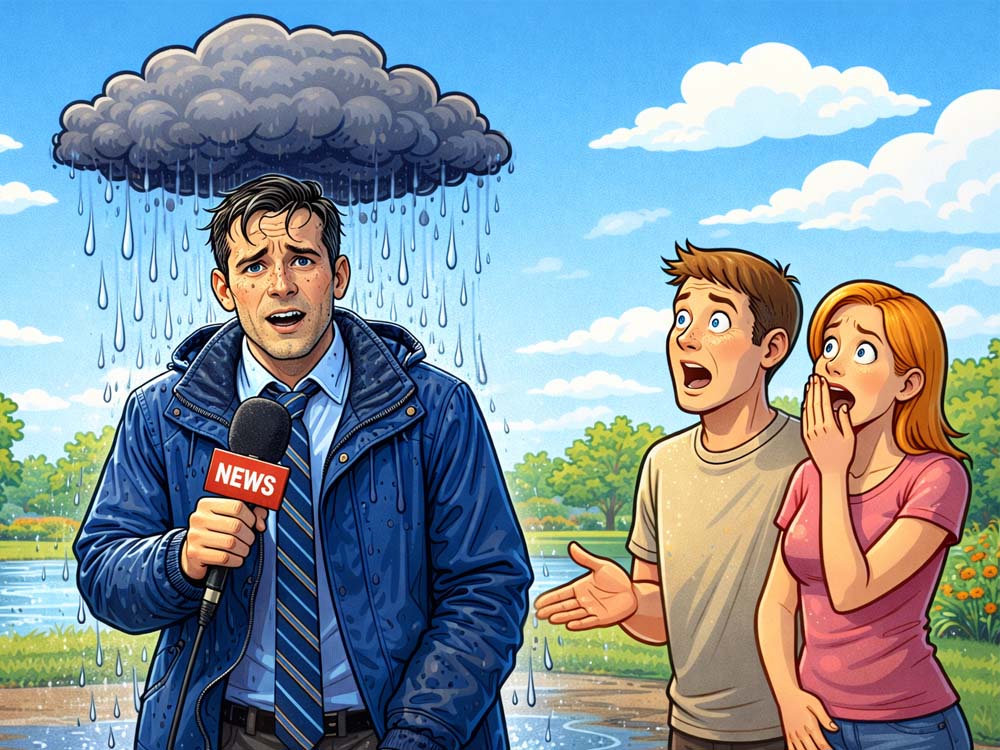
Meteorologists promise scattered showers. This guy promised commitment.
There’s something uniquely funny about a weather report becoming a weather event. Not nearby. Not regional. Not “in the tri-state area.” Just… him. The universe skipped Doppler radar and went straight to personal vendetta.
The couple behind him completes the scene: two witnesses to a crime the sky clearly planned in advance. This isn’t forecasting anymore — it’s character assassination by cumulonimbus.
And as always, the comedy question: is the joke about weather… or about destiny wearing a tie?
What We Saw a Lot
The dominant instinct was to lean into familiar weather phrases — especially “under the weather,” “isolated shower,” and cloud terminology like cirrus/overcast. That’s logical: the image practically invites meteorological vocabulary.
We also saw a strong pull toward song references and pop culture (“Rain Man,” “Raindrops keep falling,” “Ain’t no sunshine”). When an image is visually simple but conceptually absurd, writers often reach for recognition humor — anchoring the joke in something the audience already knows.
Finally, a lot of entries framed the moment as forecast accuracy: the weatherman predicting his own fate. That’s a good comedic angle because it creates irony — the expert becomes the victim of his expertise.
Overall, the submissions clustered around three reliable paths:
weather terminology
ironic prediction
bad luck metaphors
Solid instincts — but competitive fields demand sharper turns.
Missed Opportunities
Many captions noticed the joke but didn’t escalate it.
The image isn’t just rain. It’s targeted rain. Hyper-specificity is the engine here. The sky didn’t malfunction — it chose him. That turns the premise from coincidence into narrative. The best jokes treated the cloud like an intentional actor.
Another opportunity was the audience in the frame. The couple isn’t decoration; they are the proof. They validate the absurdity. A joke that acknowledges witnesses gains credibility — the universe is publicly humiliating this man.
Finally, there’s emotional contrast. He’s professionally neutral. The weather is aggressively personal. Comedy lives in that mismatch. When captions stayed generic (“it’s raining”), they described the picture instead of interpreting it.
Head to Head
Finalist:
“Local weatherman finally finds the ‘isolated shower’ he predicted”
Non-finalist:
“There will be a temporary rain shower today”
Both use forecast phrasing. The difference is perspective.
The non-finalist reads like a standard report — accurate but observational. It doesn’t acknowledge the absurd specificity.
The finalist reframes the language. “Finds” turns prediction into consequence. The meteorologist didn’t report the weather; he encountered it. That shift creates irony and agency. The phrase “isolated shower” suddenly becomes literal and personal, which is exactly the image’s comedic core.
Same vocabulary, different storytelling.
Red Lines
“Raindrops keep falling in my head”
This references a familiar lyric but stops at recognition. The audience smiles because they recognize it, not because they discovered something new about the scene. Recognition is a shortcut; interpretation is a punchline.
“A new meaning to the term ‘weatherman’”
Phrases like “a new meaning” signal the joke instead of delivering it. Comedy works better when the reader experiences the shift themselves. If the caption explains that something changed, the humor has already happened elsewhere.
“Failed Forecast”
Extremely clean, but too broad. The image isn’t about incorrect weather — it’s about absurdly correct weather. Precision matters. When the premise is specific, general wording weakens the effect.
“He’s really under the weather today”
A perfectly relevant idiom… which is why it’s crowded territory. When dozens of writers independently land on the same phrasing, the joke becomes informational instead of surprising. Familiar language needs an extra turn to compete.
Winning Captions & Why They Worked
Finalists:
“Local weatherman finally finds the ‘isolated shower’ he predicted”
“The storm really followed the model”
“The raining champion of bad luck”
“I guess you could say he’s over-cast for this role”
“He’s really cirrus about his job”
The strongest captions share a trait: they reinterpret technical language rather than merely use it.
“Local weatherman finally finds the ‘isolated shower’ he predicted” works because it literalizes jargon. The phrase becomes a plot twist.
“The storm really followed the model” subtly anthropomorphizes the weather — the storm obeys instructions, implying the forecast summoned it.
“The raining champion of bad luck” shifts from meteorology to fate. The humor moves from science to superstition.
“I guess you could say he’s over-cast for this role” treats the situation like casting in a production — weather as theatrical miscasting. That’s a conceptual leap beyond description.
“He’s really cirrus about his job” lands through clean wordplay, but importantly ties seriousness to the absurd commitment of the cloud.
The common thread: each caption treats the rain as intentional. Not atmospheric — personal.
Final Thoughts
This image rewarded writers who treated the sky like a coworker with a grudge.
When a visual joke is simple, the winning move isn’t adding complexity — it’s adding intention. The rain isn’t happening. The rain decided.
Forecasting humor is tricky because the vocabulary is familiar to everyone. The challenge is transforming language people hear daily into something they’ve never considered personally humiliating.
So next time the weather singles someone out, don’t just report the storm — assign motive to it. Comedy starts where coincidence ends.
Go check out the next contest and bring an umbrella — just in case it’s only over you.