Tips for Caption Contest 99
Weather is usually the one safe topic left in polite society. Too boring to fight about, too universal to argue. You can always point outside and agree: yep, that’s happening.
Unless it’s not outside.
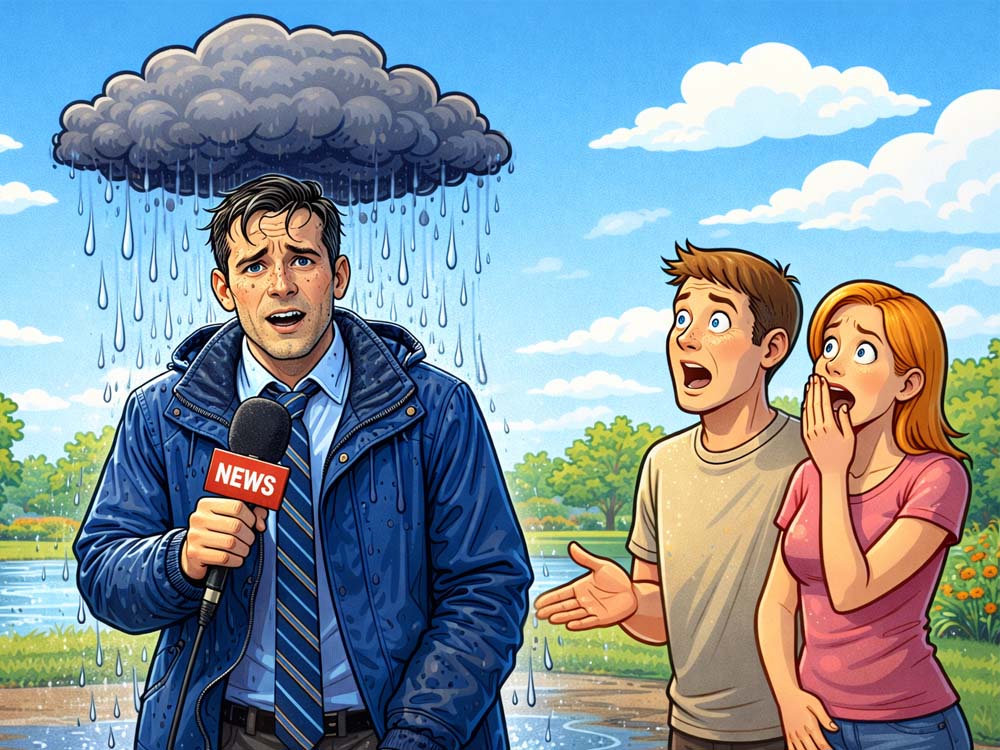
Today’s forecast has unionized and filed a personal grievance. The weatherman isn’t describing the storm — he’s hosting it. The radar map says “scattered showers,” but the sky has decided on “targeted harassment.”
Meanwhile, two civilians stand nearby realizing the most terrifying possibility of all: the forecast might be… emotional.
Getting Started: What’s in the Image?
A TV weatherman stands mid-report.
Directly above his head: a single rain cloud, dumping rain exclusively onto him.
Not the room. Not the couple watching. Just him.
The couple looks shocked — they’re dry, confused, and witnessing a violation of both meteorology and workplace boundaries.
Important joke ingredients:
-
A professional delivering information he clearly cannot control
-
A weather system behaving with intent
-
Bystanders reacting like this is somehow his fault
-
A hyper-specific inconvenience rather than a natural disaster
This image works because the scale is wrong. It’s not apocalyptic weather. It’s personal weather.
Think Beneath the Surface
The joke space here isn’t “rain.” It’s accountability.
Weather is famously nobody’s fault. So the moment it is someone’s fault, your brain starts assigning blame, motive, and HR paperwork.
You can approach it from multiple angles:
The universe vs. one guy
The cloud has chosen a protagonist. Now it’s a story, not a forecast.
Professional credibility
Experts look silly when the problem is happening to them in real time.
Customer service expectations
Viewers expect solutions from someone who normally only explains problems.
Emotional metaphor
The cloud behaves like anxiety, guilt, bad karma, or consequences finally catching up.
Social reaction
The couple becomes the audience surrogate — confused whether to sympathize or complain.
The strongest captions here usually pick one interpretation and commit. Don’t explain the physics. Explain the meaning.
General Tips on How to Be Funny
Treat the absurd as normal.
Comedy improves when characters accept nonsense calmly.
Example: “We’re seeing a localized system of accountability.”
Give the cloud intention.
Objects with motives are funnier than objects with mechanics.
Example: “It remembers what you did.”
Use the wrong professional language.
Serious tone + ridiculous situation = contrast.
Example: “This falls under internal precipitation.”
Blame management.
Turn the moment into a service failure.
Example: “We’ll circle back on dryness.”
Avoid describing the picture.
If a reader can already see it, don’t narrate it. Add interpretation, not observation.
Smaller stakes are stronger stakes.
The joke isn’t danger — it’s inconvenience, embarrassment, or reputation damage.
Specific beats generic.
“Rain” is broad. “Performance review weather” is a joke.
Most importantly: decide whether the cloud is punishment, policy, personality, or relationship. Then write as if that’s objectively true.
Final Thought
The funniest angle here treats weather like office politics — unpredictable, unfair, and somehow always concentrated on one coworker. Write the forecast like it’s a workplace memo and you’ll be in the right storm path.
Enter the contest and make it rain (but professionally).