Caption Contest 112: Recap & Review
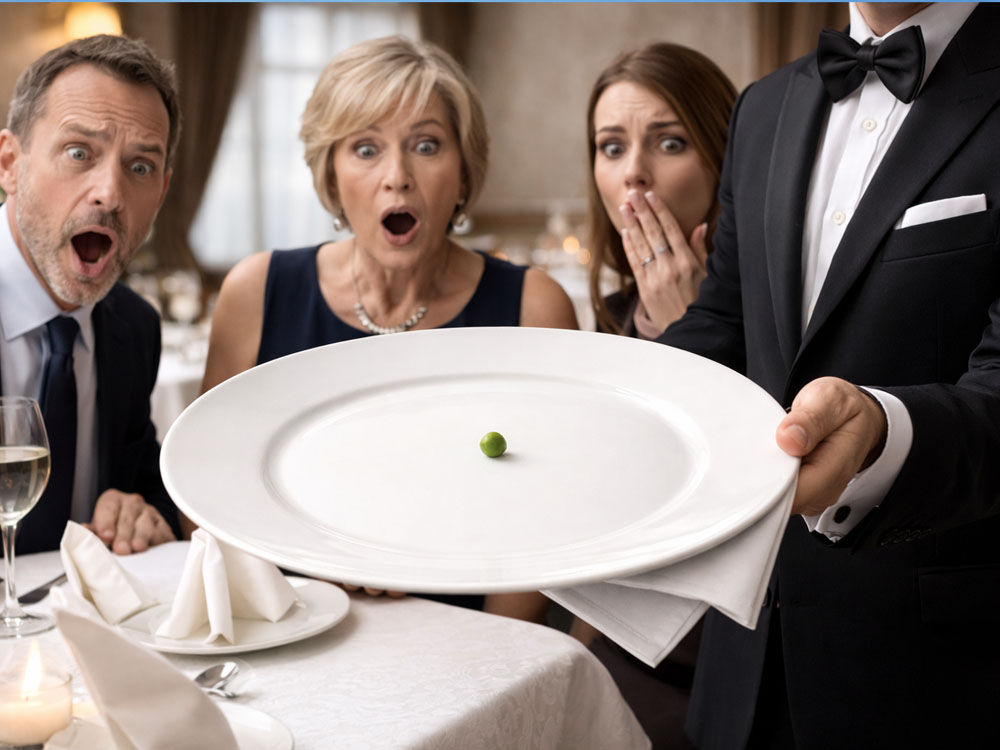
Fine dining promises many things: artistry, restraint, and occasionally the experience of paying $42 for something that fits on a spoon. Caption Contest 112 captured that exact moment of culinary minimalism — a tuxedoed table staring in stunned silence at a single, lonely pea sitting on a vast white plate like it just bought the entire restaurant.
The visual contrast here did a lot of the heavy lifting. Black-tie diners. White-glove service. A massive plate. And then… one pea. Not a garnish. Not a component. The whole show.
Naturally, the captions went straight for the pea puns, the tiny portion jokes, and the general suspicion that the kitchen may have misplaced the rest of dinner somewhere between the appetizer and the bill. Let’s dig into what worked, what almost worked, and what this field of peas taught us about comedic economy.
What We Saw a Lot
The most obvious gravitational pull here was the word “pea.” And understandably so — it’s practically begging to be inserted into other words.
We saw a large number of “pea inside another word” constructions, like:
-
“Bon apPEAtit”
-
“Don’t a-Pea-ze me”
-
“App-a-Pea-zer”
-
“There are no words, we can’t s”pea”k”
This is a classic caption instinct: find the pun engine and turn the crank. It can work — but only if the result still feels like something a human would plausibly say. When the inserted pun becomes the entire joke, the caption starts feeling more like a word puzzle than a comedic idea.
Another common lane was tiny portion commentary, which the image practically invites:
-
“Serving sizes are getting ridiculous here!”
-
“That’s a small portion at these prices!”
-
“I’ve heard of cheap receptions, but this is ridiculous!”
These all land on the same core observation: that’s not much food. The challenge is that once that idea is stated plainly, there’s not much surprise left.
We also saw a cluster of Princess and the Pea references, such as:
-
“Is that the pea the princess slept on?”
-
“Now show me to the princess . . .”
-
“Your telling us, THIS is the Pea From the Matress with the Princess! AMAZING.”
The fairy tale connection is logical, but it requires an extra mental step that the image itself doesn’t set up. The diners aren’t in a bedroom or near mattresses — they’re at what looks like a very serious restaurant. When a reference pulls the scene away from the image rather than deepening it, it tends to feel less grounded.
Missed Opportunities
One thing this image offered — but relatively few captions fully exploited — was fine dining culture itself.
High-end restaurants have their own vocabulary, rituals, and absurdities: tasting menus, dramatic descriptions, chefs presenting dishes tableside, and waiters explaining ingredients as if they’ve just returned from a polar expedition.
A few captions moved in that direction:
“For your first fancy course, an imported pea from the fields of Seville”
This idea is promising because it leans into the pretentious narration of food. With a sharper turn or slightly tighter phrasing, this lane could have produced several strong contenders.
Another underused angle was the enormous plate. The comedy isn’t just the pea — it’s the giant expanse of porcelain surrounding it. That contrast is the visual joke the photographer is really leaning on.
Finally, a handful of captions gestured toward shared dining or splitting food, which fits the visual well:
“Would anyone care to split the entrée?”
That idea is strong because it acknowledges both the portion size and the group of diners reacting together. A little more specificity or twist could have elevated it into finalist territory.
Head to Head
Let’s compare a finalist with a similar idea that didn’t quite land.
Finalist:
“And for the table… our seasonal pea.”
Non-finalist:
“For your first fancy course, an imported pea from the fields of Seville”
Both captions lean into the fine-dining presentation voice. The waiter as narrator is doing the joke.
The finalist works better for a few reasons.
First, brevity. The line sounds exactly like something a server might say while setting down a dish. The phrase “for the table” is especially effective because it implies this microscopic portion is meant to be shared among everyone.
Second, clean timing. The punchline lands on “pea,” which matches the visual reveal perfectly.
The non-finalist is close, but the extra phrasing (“from the fields of Seville”) dilutes the moment. The idea becomes about geography rather than the absurd portion size, and the line loses some comedic focus.
In caption writing, trimming often sharpens the laugh.
Red Lines
A few submissions illustrate useful lessons about comedic framing.
“Someone pea-d on my plate”
This is an example of a pun that overrides the scene. The humor here comes entirely from the phonetic similarity between “pea” and “pee.” But the image itself doesn’t suggest that scenario at all. When the joke ignores what’s visually happening, it tends to feel disconnected.
Another example:
“The house specialty causes expressions of shock among the customers.”
This caption describes the image rather than adding a comedic interpretation. The audience already sees the shocked diners. Effective captions usually introduce a new perspective or explanation for why the scene looks this way.
One more instructive case:
“Is this what you meant, when you said you were taking us out for pea-k fine dining???”
This caption identifies a promising phrase (“peak fine dining”) but gets bogged down in explanation. The more words it takes to deliver a pun, the less impact the punchline tends to have. A tighter version of the same idea might have landed much more cleanly.
Winning Captions & Why They Worked
“Ho ho ho, Green Diet!”
This one succeeds because it creates an unexpected voice. Instead of the diners or waiter speaking, the line evokes a Santa-like character approving of the single pea as a healthy meal. It’s odd, playful, and just absurd enough to stick.
“And for the table… our seasonal pea.”
This is a textbook caption: concise, image-driven, and perfectly aligned with the restaurant setting. The phrase “for the table” amplifies the absurdity of sharing a single pea among several diners.
“Tonight’s special: split pea — five ways.”
A strong example of menu humor. Fine dining menus often describe dishes in elaborate terms, and this caption parodies that style nicely. The phrase “five ways” implies the chef has heroically divided the pea into multiple preparations.
“We call this dish Pea à la Minimum Wage.”
This one works because it adds social commentary without getting heavy. The joke reframes the tiny portion as a metaphor for underpayment — small, pointed, and easy to grasp.
“If you’re still hungry, dessert is half a blueberry.”
Another strong escalation joke. It builds on the absurd portion size and pushes it further, suggesting the restaurant’s entire menu operates on microscopic scale. The specificity of “half a blueberry” makes the visual even funnier.
Each of these captions keeps the focus squarely on the central comedic engine: one pea, presented with extreme seriousness.
Final Thoughts
This contest proved something important: when the plate is mostly empty, the caption has to do a little more work.
The strongest entries didn’t just notice the pea — they built a world around it. A world where chefs proudly plate microscopic vegetables, diners politely share them, and dessert somehow gets even smaller.
And in the strange ecosystem of fine dining, that world doesn’t even feel that unrealistic.
So whether your comedic style leans toward sharp puns, observational twists, or menu satire, remember: sometimes the smallest ingredient on the plate can still deliver a full serving of laughs.
Now go check out the next CaptionCo contest and see what other tiny ideas are waiting to grow into big jokes.