Caption Contest 115: Recap & Review
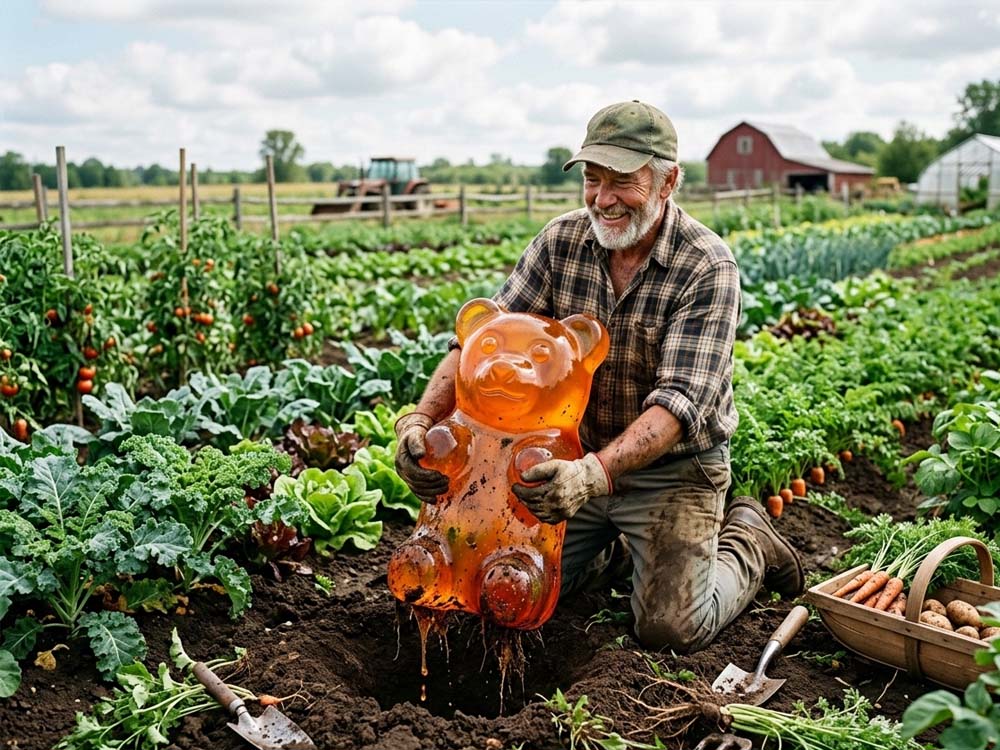
Farming is already full of surprises. One year it’s drought. The next it’s pests. And every so often, apparently, it’s a six-foot gummy bear emerging from the soil like Willy Wonka went into agriculture.
Our farmer looks both proud and confused—like someone who followed the instructions on the seed packet but is now reconsidering his life choices. Is this crop edible? Marketable? Or just extremely sticky?
The image had everything CaptionCo contestants love: visual absurdity, farm clichés, and a suspicious amount of opportunity for bear puns. And as expected, you all dug right in. 🌱
What We Saw a Lot
Three big comedic instincts surfaced in this contest.
Bear wordplay.
This was by far the most common approach. Submissions leaned heavily on the “bear/bare/bear-y/bear-ly” family of puns. Examples included:
-
“The harvest is really bearing fruit.”
-
“This isn’t exactly what I meant when I said I wanted to grow bear-ries.”
-
“A beary good crop this year.”
-
“I can bearly lift it out!”
-
“This is bearry good”
The image practically invites it. When a giant gummy bear appears in a garden, pun instincts kick in like reflexes.
Candy agriculture.
Another strong theme imagined the garden as a candy ecosystem:
-
“The gummy worms were great for the soil.”
-
“Gummy bear harvest National Enquirer exclusive”
-
“START YOUR OWN GUMMIE BEAR FARM !”
This works because it extends the image logically. If gummy bears grow, then gummy worms probably fertilize the soil. Comedy often lives in those small extensions of the premise.
Veggie jokes and farming clichés.
Some captions leaned into general agriculture language:
-
“Finally a veggie i like”
-
“My experiment worked! Now kids will eat their veggies!”
-
“The seed packet did say ‘bear fruit.’”
These were solid instincts because they contrast normal farm expectations with an obviously unnatural harvest.
Missed Opportunities
The image offered a few angles that didn’t get explored as much as they could have.
Scale.
A gummy bear that large raises obvious practical questions. How much sugar is that? What happens when it rains? How do you transport it? A caption that leaned into the absurd logistics could have landed strongly.
The farmer’s reaction.
He looks surprisingly calm for someone pulling a carnival candy mascot out of the dirt. There’s comic potential in treating this like a routine harvest—or in showing mild disappointment instead of amazement.
Food trends.
Farm-to-table, organic produce, specialty markets—this gummy bear could easily be framed as a boutique food item or wellness trend. A few submissions hinted at this, but it remained mostly untapped.
Often the funniest captions don’t just describe the weird object. They explore the world that would exist if that object were normal.
Head to Head
Let’s compare two similar ideas.
Finalist:
“The harvest is really bearing fruit.”
Non-finalist:
“This isn’t exactly what I meant when I said I wanted to grow bear-ries.”
Both captions hinge on bear wordplay tied to farming.
The finalist works better because of simplicity and timing. “Bearing fruit” is already a familiar agricultural phrase. The caption flips the meaning instantly when paired with the visual of a literal bear being harvested.
The non-finalist adds extra explanation. The “what I meant when I said I wanted to grow…” structure slows the joke down and makes the reader work harder to reach the punchline.
In caption contests, shorter paths to the laugh usually win.
Red Lines
A few captions illustrate useful lessons about framing.
“And that is how to grow a gummy bear”
This caption narrates the obvious action in the image. The viewer already sees the farmer pulling up a gummy bear, so the joke doesn’t add a new idea. Strong captions usually introduce a new interpretation, not just a description.
“Gummy bears harvest is looking good!”
This leans on the concept but doesn’t introduce a twist. The setup is correct—the farmer harvesting gummy bears—but the caption stops right before adding the comedic angle.
A helpful rule: once you state the premise, ask yourself “what’s the next surprising step?”
“Size Matters!”
Short captions can work, but they still need to connect specifically to the image. Without a clear tie to farming or gummy bears, the joke feels generic.
Specificity almost always beats general humor.
Winning Captions & Why They Worked
This contest produced several strong finalists that combined clarity, surprise, and tight phrasing.
This caption stood out for a few reasons. It blends a recognizable rhythm from The Wizard of Oz with classic garden produce, then lands the twist on “bears.” The structure feels playful and familiar, which makes the absurd visual hit even harder.
It also works because the joke belongs specifically to a garden setting.
Finalists:
“The harvest is really bearing fruit.”
Clean, fast, and effective. The caption uses a familiar phrase and lets the visual deliver the punchline. It’s a good reminder that sometimes the best caption is the one that trusts the image.
“Finally a veggie i like”
This one succeeds by shifting perspective. The farmer becomes someone who dislikes vegetables but is thrilled about this particular “produce.” It reframes the scene with a simple character idea.
“The gummy worms were great for the soil.”
A strong extension of the candy-garden premise. The humor comes from imagining a fully functioning candy ecosystem, where gummy worms act like fertilizer.
“I thought I planted high-fructose corn”
This caption works because it plays with agricultural expectations and modern food jokes at the same time. The phrase “high-fructose corn” is a clever twist on high-fructose corn syrup, and the absurd harvest pays it off.
Together, the finalists show three effective strategies:
-
Tight wordplay
-
Premise expansion
-
Character perspective
Final Thoughts
This contest proved that if you plant a joke, water it with a little wordplay, and give it enough sunlight, sometimes you end up harvesting a full-size gummy bear.
The field leaned heavily on bear puns, which makes sense given the visual. But the captions that rose to the top either delivered the cleanest phrasing or expanded the world of the image in a fresh way.
In other words: sometimes the difference between a good caption and a great one is just one more twist of the soil.
Now grab your shovel, sharpen those punchlines, and see what grows in the next contest. 🌱
Check out the next CaptionCo contest and plant your own caption before the harvest begins.