Tips for Caption Contest 118
Every mail carrier knows the classic threat: the neighborhood dog. Barking, lunging, chasing the truck down the block like it’s the Indy 500. It’s practically part of the job description.
But this dog? This dog is different.
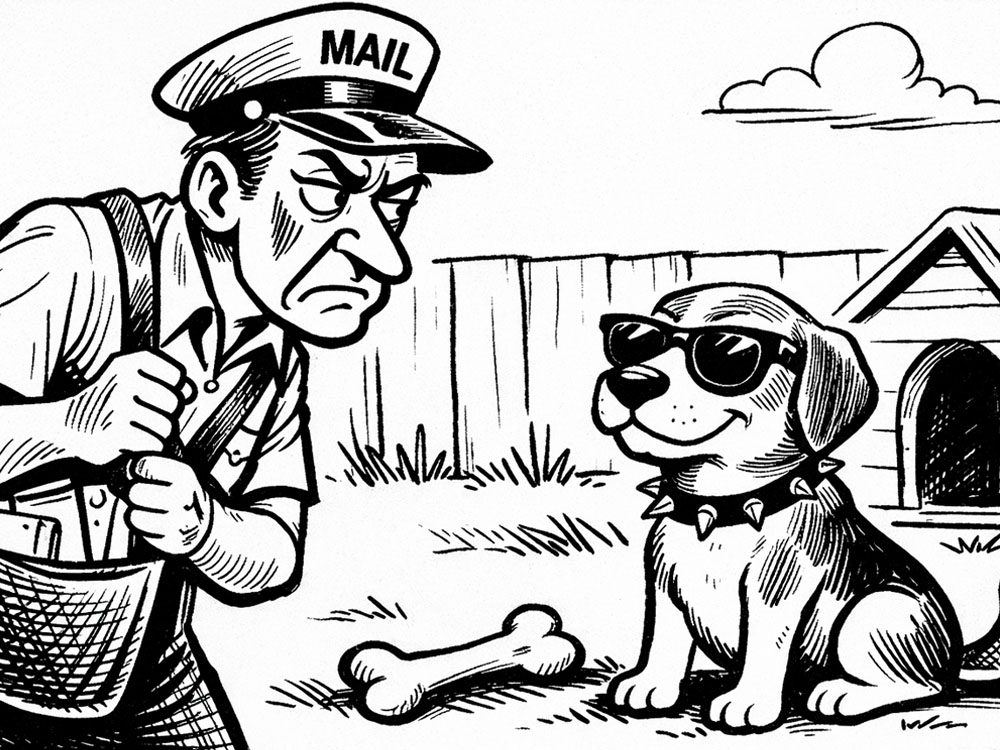
This dog is wearing sunglasses. And not the goofy novelty kind either — the kind that suggest he might know something. Something about your route. Something about the mail. Something about… you.
The mail carrier in this image seems to realize this immediately. He’s not afraid. He’s suspicious. And suspicion is fertile ground for comedy.
Because when a dog looks cooler than the human delivering the mail, the story possibilities start multiplying fast. 😎
Getting Started: What’s in the Image?
Start with the literal details. They’re the scaffolding for the joke.
We see a mail carrier mid-delivery — uniform, mailbag, the whole official postal situation. He’s paused and staring at a dog.
The dog is sitting calmly, wearing sunglasses. Not barking. Not chasing. Just… observing.
That calmness matters. A normal aggressive dog would suggest danger. This one suggests intent.
A few visual details to keep in mind:
-
The mail carrier’s cautious or suspicious posture
-
The dog’s sunglasses, which instantly humanize it
-
The quiet standoff between them
-
The everyday setting of a typical delivery moment
Nothing chaotic is happening. That’s important. The humor comes from the tension between a normal task (delivering mail) and a very abnormal dog.
When the visual is simple like this, the caption often works best when it introduces the strange idea that explains the moment.
Think Beneath the Surface
Good captions don’t just describe what we see. They answer the question: Why is this happening?
Why would a dog wear sunglasses?
Why is the mail carrier suspicious instead of scared?
And most importantly — what does this dog know?
Once you start asking those questions, the joke space opens up quickly.
Maybe the dog is running some kind of operation.
Maybe the mail carrier has encountered this dog before.
Maybe the sunglasses signal a personality: cool, secretive, or oddly authoritative.
Another angle: role reversal.
Usually the dog is the unpredictable one and the mail carrier is the professional. But the sunglasses make the dog seem composed, maybe even in charge.
You can also explore the idea that this dog is behaving like a person — a celebrity, a spy, a detective, or someone waiting for a very important package.
The key is to build a story that explains the suspicious stare. Once the reader understands the implied situation, the punchline lands naturally.
General Tips on How to Be Funny
Start with the visual tension.
The best captions resolve the odd moment we’re seeing. Ask yourself: what explanation would make this stare make sense?
Lean into the sunglasses.
That single prop transforms the dog from animal to character. Sunglasses suggest attitude, secrecy, or confidence — all great comedic signals.
Example: “Example: The witness finally agreed to talk.”
Favor specific scenarios.
Vague jokes fade quickly. Concrete situations — jobs, roles, or relationships — give the joke sharper edges.
Example: “Example: The neighborhood watch has questions.”
Keep the setup short.
Long explanations slow the joke down. The image already does half the storytelling, so your caption should deliver the twist quickly.
Surprise beats description.
If your caption only restates the scene, it won’t create the laugh. Instead, add a new idea that reframes what we’re seeing.
Example: “Example: ‘Sir, this package requires a signature.’”
Try authority reversal.
One reliable angle is flipping who’s in charge. The sunglasses already hint that the dog might be the confident one here.
Example: “Example: The new route supervisor.”
Avoid explaining the joke.
Trust the reader. The best captions hint at a bigger situation without spelling everything out.
Final Thought
When an image contains a tiny detail that feels oddly deliberate — like a dog wearing sunglasses — that detail is usually the key to the whole joke. Follow that clue, build a quick story around it, and let the punchline do the rest.
Now grab your sharpest idea and submit your caption for the contest.