Tips for Caption Contest 163
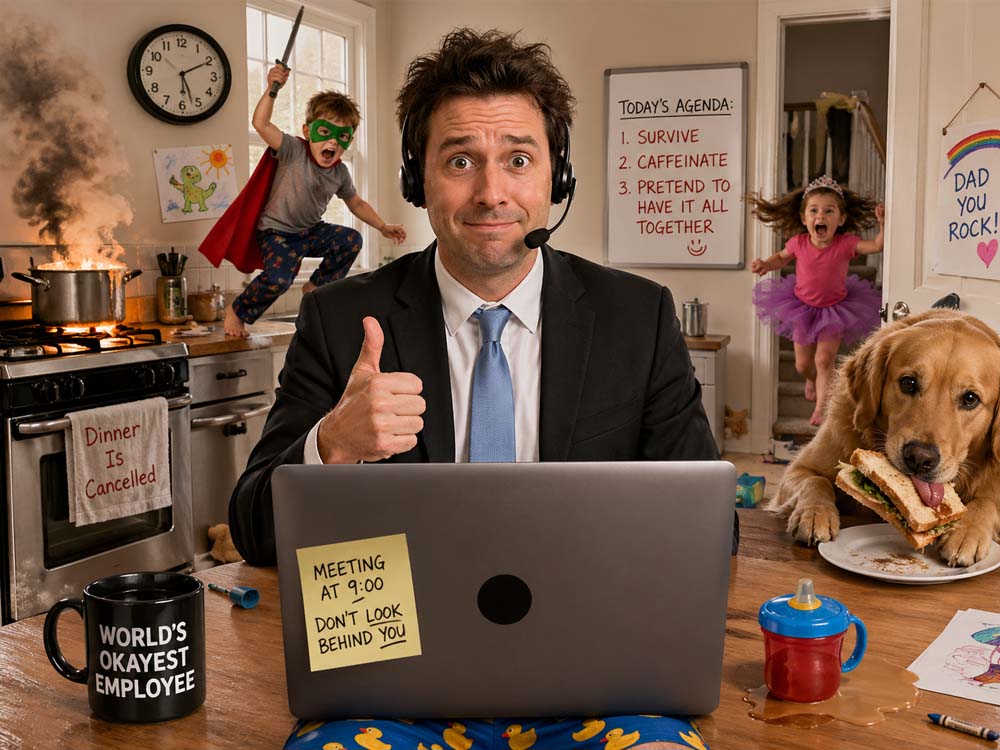
There’s a very specific kind of lie we all tell on video calls: “Everything’s under control.” This image is that lie, fully exposed.
Front and center, we’ve got a calm, composed professional—shoulders squared, polite smile, probably mid-sentence about “circling back.” Behind him? Total domestic collapse. It’s not just chaos—it’s synchronized chaos.
The humor here comes from the split screen of reality vs. performance. One man. Two worlds. Only one of them is muted.
Getting Started: What’s in the Image?
Start with the literal inventory.
A man in a suit sits on a Zoom call, smiling directly at his camera. He looks polished, focused, and completely unaware—or at least pretending to be.
Behind him, the house is unraveling:
- Kids are running around, likely yelling or fighting.
- A dog is casually eating at the table like it pays rent.
- Something on the stove is burning, unattended.
Every element behind him contradicts the image he’s presenting on screen.
Key comedic details:
- The contrast between his stillness and the motion behind him.
- The dog behaving more like a human than the humans.
- The escalating stakes (kids → dog → literal fire hazard).
- His total commitment to ignoring all of it.
This is a layered scene. Multiple joke entry points, all happening at once.
Think Beneath the Surface
Now move past what’s happening into what it means.
This image is about control—or the illusion of it. It taps into remote work culture, where professionalism is often just a well-framed camera angle.
There’s also a strong tension between public and private life. The man is presenting a curated version of himself, while reality keeps leaking into frame.
You can explore:
- The absurdity of pretending everything is fine.
- The idea that chaos is now the norm.
- How “work mode” ignores real life until it can’t.
- The mismatch between corporate language and domestic disasters.
Try flipping perspectives:
- What would a coworker assume vs. what’s actually happening?
- What if the chaos is intentional?
- What if this is his version of “handling it well”?
Example: “Performance review: strong composure under extremely flammable conditions.”
The deeper layer is relatability. Most people have lived some version of this—maybe not the full disaster stack, but enough to recognize the tension instantly.
General Tips on How to Be Funny
1. Pick one lane, not all of them.
There are multiple jokes here—kids, dog, fire, Zoom culture. Don’t try to hit everything. Choose the strongest angle and commit.
2. Contrast is your engine.
Calm vs. chaos. Professional vs. personal. What’s said vs. what’s seen. The sharper the contrast, the cleaner the joke.
3. Be specific about the chaos.
Vague = forgettable. Specific = funny.
Example: “We’re experiencing minor background noise” works better if the “noise” is clearly absurd.
4. Use understatement strategically.
Downplaying obvious disaster is a reliable comedic move here. The bigger the chaos, the calmer the description.
5. Avoid explaining the joke.
Trust the image. You don’t need to describe everything happening—just frame it in a way that reveals the humor.
6. Surprise the reader.
Set up an expected corporate phrase, then twist it with what’s actually happening in the background.
Example: “Circling back once the fire department weighs in.”
7. Keep it tight.
One clean idea beats a crowded sentence. If it feels like two jokes, it probably is—pick the better one.
Final Thought
This image rewards focus. The chaos is loud, but the best captions are controlled—just like the guy on the call, holding it together one sentence at a time. Lean into that tension, and let the humor do the work.