Tips for Caption Contest 86
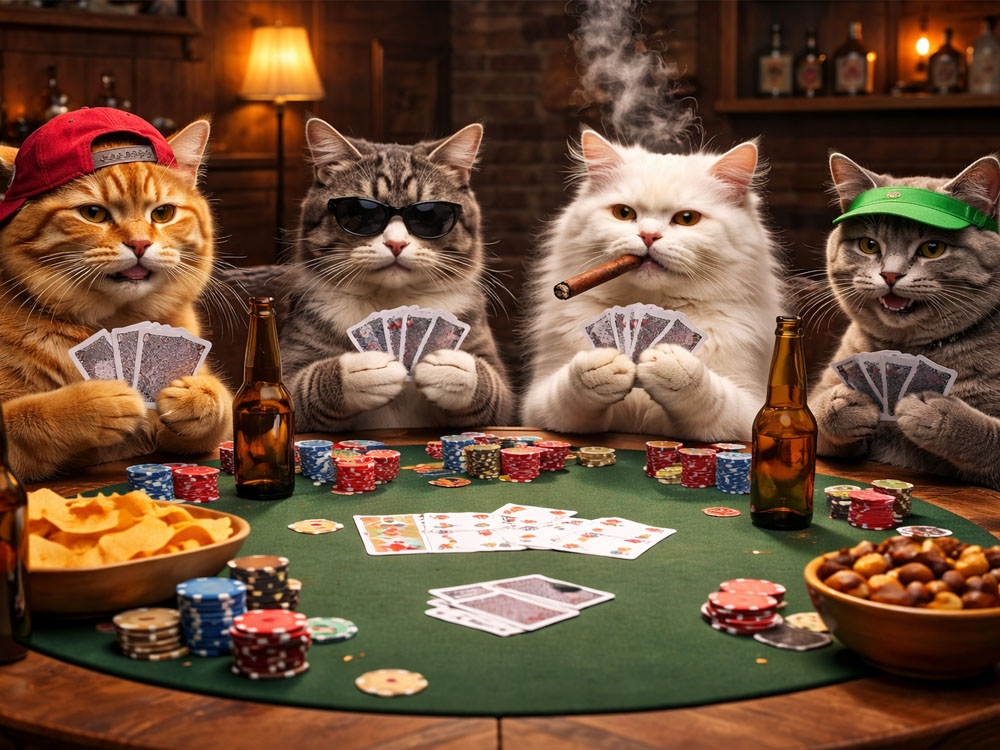
There are few sights more quietly chaotic than a group of cats attempting organized crime. Poker is supposed to be about discipline, patience, and reading tells — three qualities cats famously replace with knocking things off tables and staring into the middle distance.
What makes this image tick is the seriousness of it all. No yarn balls, no laser pointers — just hard-eyed competitors treating this like the feline World Series. Somewhere, a tiny green visor feels implied.
Anthropomorphic animals always give comedy writers a gift: instant contrast. Cats are creatures of impulse. Poker is a game of control. Put them together and you’ve already got comedic tension before a single chip hits the pot.
Your job isn’t to invent funny from scratch — it’s to notice the absurd professionalism happening right in front of you and frame it clearly.
Getting Started: What’s in the Image?
Let’s inventory the literal details first.
We’ve got multiple cats seated around a poker table, engaged like seasoned gamblers. Cards are in play. Chips are stacked. The posture suggests intention, not randomness — these cats didn’t wander here; they bought in.
Notice the faces. Cats already look judgmental without trying. Around a poker table, that natural intensity becomes comedic fuel. Every expression can read as suspicion, bluffing, arrogance, or existential regret.
Also important: scale and normalcy. Nothing about the setup screams “novelty.” The humor comes from how ordinary the scene looks — aside from the fact that everyone has whiskers.
Good captions often start by anchoring themselves in what the viewer immediately recognizes.
Example: “The buy-in was one unopened can.”
Example: “No one trusted the guy with nine lives.”
Focus on what’s unmistakably happening before chasing elaborate ideas.
Think Beneath the Surface
Once you’ve captured the literal scene, go one layer deeper. What are the implications of cats playing poker?
For starters: cats are notoriously unreadable. That makes them perfect poker players. Suddenly, their emotional vacancy becomes a strategic advantage.
There’s also territory humor here. Cats are possessive. Imagine the stakes when the prize might simply be ownership of the couch.
Another angle is behavioral translation. Cats already exhibit gambler-like traits — curiosity, risk-taking, sudden aggression. You don’t have to stretch reality far.
Try exploring hierarchy. Is there a table boss? A reckless rookie? A shark quietly cleaning up?
Or consider human parallels. Poker culture is full of archetypes: the overconfident bluffer, the silent professional, the player who learned the rules five minutes ago.
Example: “He watched one tutorial and got cocky.”
You can also lean into cat-specific mythology.
Example: “He refused to fold on principle.”
Finally, don’t overlook tonal contrast. Playing it straight often makes the absurdity louder than pointing at it.
Example: “Gentlemen, let’s keep this professional.”
Unexpected seriousness is a reliable engine for humor.
General Tips on How to Be Funny
Prefer precision over busyness.
One sharp idea beats three crowded ones. If your caption needs multiple clauses to function, simplify until the joke is instantly legible.
Write toward the tension.
Comedy lives where opposites collide — instinct vs. strategy, chaos vs. etiquette, predator vs. card shark. Identify the contradiction and spotlight it.
Avoid describing the obvious punchline.
We can already see cats playing poker. The laugh usually comes from the interpretation, not the observation.
Example: Instead of “Cats playing poker,” try “The bluff was mostly hissing.”
Stay specific.
Generic humor feels interchangeable. Specific humor feels discovered.
Example: “Winner gets the sunbeam.”
Let status do the work.
Who holds power at this table? Confidence — deserved or not — is inherently funny.
Example: “He’d never lost a game he didn’t understand.”
Use restraint.
If the image is loud, your caption can whisper. Understatement often signals confidence and invites the reader to connect the dots.
And remember: clarity beats cleverness every time. A joke that lands immediately will outperform a brilliant one that requires decoding.
Final Thought
Great captions don’t fight the image — they partner with it. This scene already has built-in drama, personalities, and stakes. Your job is simply to notice what kind of game these cats think they’re playing… and let the audience in on it.
Now take your seat at the table and enter Caption Contest 86 before the dealer calls time.