Caption Contest 82: Recap & Review
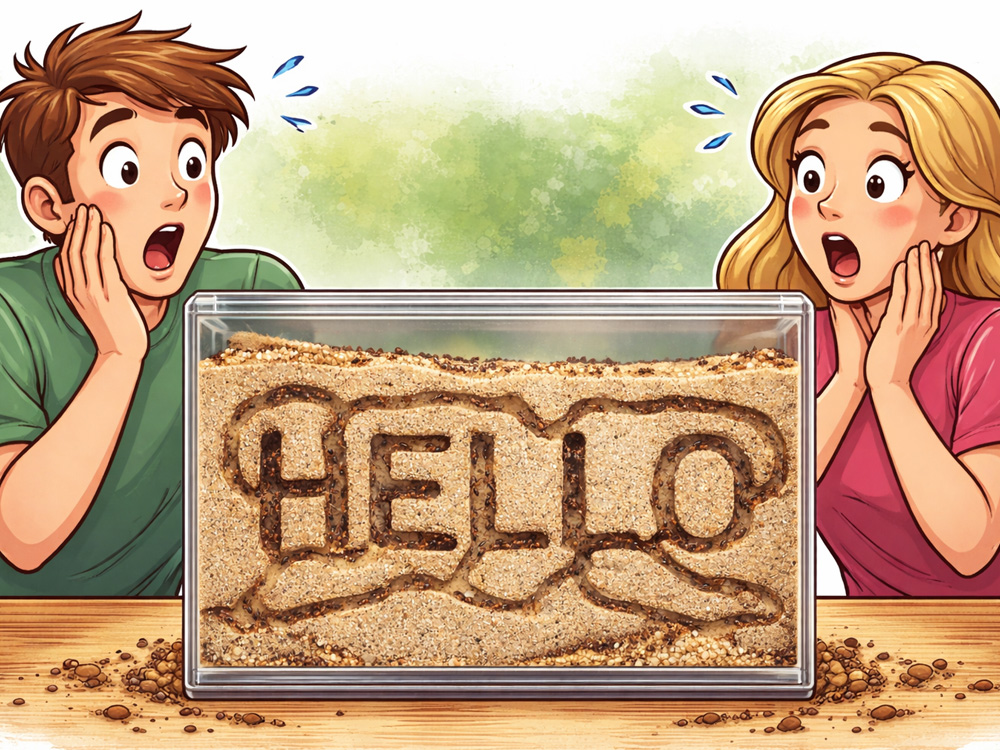
Nothing says “we’re no longer the dominant species” quite like being politely greeted by your ant farm.
You sign up for industrious little tunnel architects, maybe a relaxing desktop distraction. Instead, you get a fully literate underground civilization sliding into your DMs with a cheerful “Hello.” That’s not habitat-building — that’s branding.
The shock on the humans’ faces tells us everything we need to know: these ants skipped the crawling phase and went straight to correspondence. At this point, you’re not feeding them. You’re hosting them.
And once insects start initiating conversation, it raises uncomfortable questions. Are they unionizing? Do they want voting rights? Should you… respond?
Let’s dig in. (They certainly did.)
What We Saw a Lot
Contestants showed strong instincts toward language-based humor — which makes sense, because the image itself is literally about language appearing where it absolutely should not.
Several themes tunneled their way through the submissions:
Wordplay around communication.
Captions leaned into conversations, greetings, spelling, and education. Writers recognized that the ants spelling “Hello” is the comedic engine and tried to build from that premise.
Bug puns.
Ant-icipation, bees, butterflies — the insect cinematic universe was well represented. Puns are a natural move here because the image hands you the vocabulary.
Sci-fi invasion energy.
References to leadership, planetary takeover, and intelligent species hinted at a bigger narrative: humans may have just lost control of the food chain.
Underlying dread.
A few captions tapped into the quiet horror of being greeted by creatures you thought were beneath you. That tonal tension — cute meets existential — is fertile comedic ground.
Overall, the field demonstrated good premise recognition. Most writers understood what was strange about the image, which is half the battle in caption writing.
Missed Opportunities
Where some captions stopped short was escalation.
The funniest versions of this image don’t just acknowledge that the ants can communicate — they imply what happens next.
Are the ants negotiating rent?
Demanding better working conditions?
Asking why you keep tapping the glass like a clueless giant?
Comedy thrives on consequences. Once the ants spell “Hello,” the logical next beat should heighten the stakes.
Another underused angle was status reversal. The humans look startled for a reason: they’re no longer observers. They’re being observed.
Captions that frame the humans as the exhibit — that’s where the power flips, and flips are funny.
Finally, specificity could have been pushed further. “Ants communicating” is the setup; the laugh usually lives in the unexpected detail that follows.
Head to Head
Finalist:
“They dug deep to find the right words”
Non-finalist:
“A deep conversation”
Both captions orbit the same metaphor: depth as both physical tunneling and intellectual exchange.
The finalist succeeds because it adds intention. “Find the right words” suggests planning, care, even emotional intelligence. Suddenly these ants aren’t just talking — they’re composing.
“A deep conversation,” by contrast, stops at the obvious descriptor. It labels the joke rather than extending it.
This is a classic caption lesson: when two ideas share the same premise, the winner is usually the one that adds agency or narrative.
Don’t just describe the tunnel. Show us why it was dug.
Red Lines
“Planet of the ants”
Cultural references can be effective shorthand, but they need a twist to feel fresh. Dropping the reference alone leaves the reader doing all the comedic work. Consider adding a perspective shift or specific implication — something that makes the reference uniquely tied to the image rather than broadly applicable to any “smart insects” scenario.
“So… do we say hello back or burn the house down?”
There’s a strong comedic tension here — politeness versus panic — but the caption splits its focus between two reactions. Often, choosing the more surprising of the two creates a sharper laugh. Indecision dilutes timing; commitment amplifies it.
“They’ve stopped digging tunnels and started drafting a lease.”
Excellent premise. Ants as tenants is inherently funny. Where it could climb higher is in specificity: What kind of lease? What demands? Humor loves details because details imply a fully realized world.
When you sense a caption brushing up against world-building, lean in.
Winning Captions & Why They Worked
Winner: “But I was teaching them math!”
This caption understands escalation.
It takes us from basic literacy to a full educational curriculum — and it implies the ants have now exceeded expectations in a way that feels both absurd and inevitable.
The humor comes from the narrator’s mild betrayal. Teaching math was supposed to be enrichment, not a gateway to written correspondence. It reframes the ants as overachievers and the human as someone who accidentally created their intellectual equal.
Clear premise. Immediate twist. Strong point of view.
That combination is hard to beat.
“Hello from down under”
Simple, clean, and confident. It leverages the physical geography of the ant farm without overcomplicating the joke. Sometimes efficiency wins — especially in captions where extra words can clog the tunnel.
“You should see the spelling bees”
A tidy cross-species pun that expands the world just enough to suggest academic competition among insects. It rewards the reader quickly, which is often the mark of a durable caption.
“I heard they were strong. I didn’t know they could carry a conversation.”
A strong double-meaning structure. The first clause sets up familiar ant lore; the second pivots neatly into linguistic strength. That pivot is doing real comedic labor.
“When your presence is ant-icipated.” 🐜😏
Pun-forward but controlled. Importantly, it ties directly to the act of greeting rather than floating as a generic ant joke. Relevance keeps puns from feeling ornamental.
“They dug deep to find the right words”
As discussed earlier, this one adds intention — and intention makes the ants feel eerily human, which is precisely why it lands.
Final Thoughts
This contest proved something important: when the image itself is already absurd, you don’t need to over-engineer the joke. Often the best move is to treat the impossible as completely normal — and let that calm acceptance generate the laugh.
Remember:
Spot the anomaly.
Escalate the implication.
Commit to the perspective.
And if your ants ever start using punctuation, it may already be too late.
Keep writing, keep experimenting, and above all, keep listening — because apparently, the insects have plenty to say.
Now march yourself over to the next contest and see what laughs you can excavate.