Tips for Caption Contest 160
This is the culinary equivalent of bringing a flamethrower to toast bread. One man, one kitchen, and absolutely no control over either.
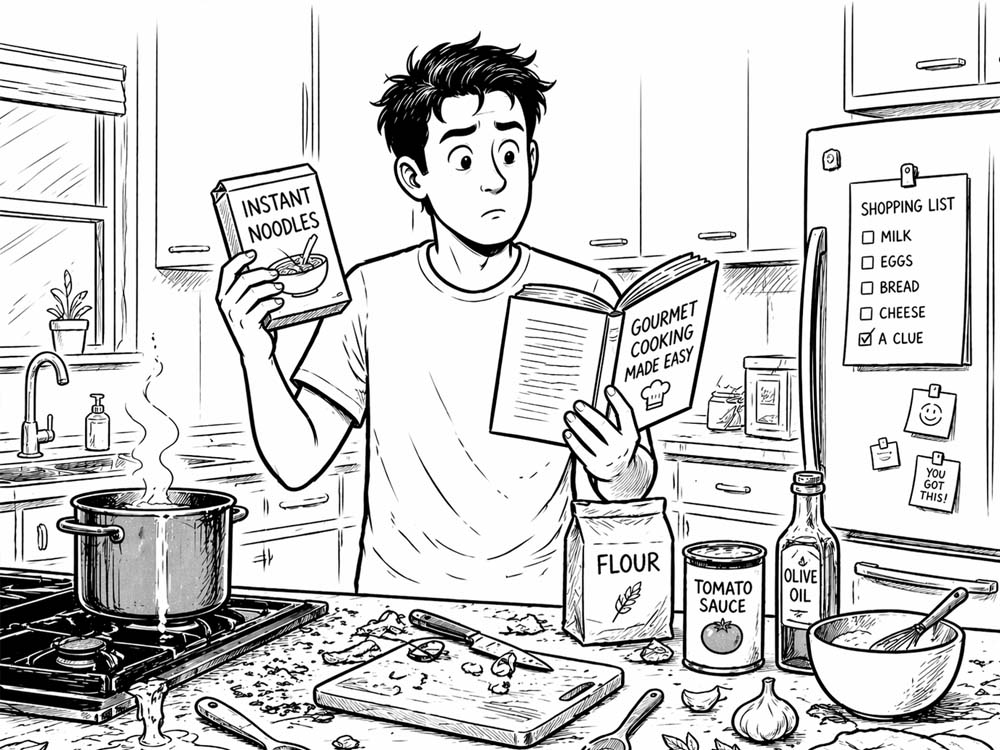
He stands there clutching instant noodles like a life raft, while a gourmet cookbook silently judges him from the other hand. Around him: chaos. The kind of chaos that suggests he tried something ambitious… and the kitchen fought back.
It’s a perfect snapshot of that moment between confidence and collapse—when you think you’re about to become a chef and instead become a cautionary tale.
And that tension? That’s where your joke lives.
Getting Started: What’s in the Image?
A black-and-white line drawing of a man in a messy kitchen.
He’s holding two very different things: a packet of instant noodles and a high-end gourmet cookbook. His expression reads confused, possibly overwhelmed.
The kitchen itself is in disarray—ingredients scattered, cookware likely misused, and the general vibe is “something went wrong fast.”
Key details that matter:
- The contrast between instant noodles (simple, cheap, foolproof) and a gourmet cookbook (complex, aspirational)
- His confused expression, not confident or proud
- The visible aftermath of cooking chaos, suggesting failure or overreach
- The fact that he’s paused mid-decision, stuck between two paths
This is not a calm cooking scene. This is a crossroads.
Think Beneath the Surface
At its core, this image is about overcomplication vs. simplicity.
He could make instant noodles in three minutes. Instead, something led him into culinary ambition—and now he’s lost in it.
That opens up several comedic directions:
- The danger of trying too hard
- The gap between who we think we are vs. who we actually are
- The moment when instructions become overwhelming
- The idea that basic solutions were always right there
There’s also a subtle identity crisis here. He’s not just cooking—he’s deciding what kind of person he is:
- A microwave realist
- Or a Michelin-star dreamer
And right now, he’s failing at both.
You can also lean into escalation. This kitchen didn’t get messy by accident—it suggests a series of increasingly bad decisions. What happened before this moment? What’s about to happen next?
Unexpected angles to explore:
- Treating instant noodles like a high-end dish
- Treating the cookbook like it’s actively sabotaging him
- Framing the kitchen as the “winner” of this situation
- Turning the moment into a larger life metaphor (career, relationships, etc.)
General Tips on How to Be Funny
Pick a lane and commit.
This image gives you multiple ideas—don’t try to use all of them. Choose one clear comedic angle and push it fully.
Lean into contrast.
The joke is strongest when it highlights the gap between simple and complex, confident and confused, intention and outcome.
Keep it specific.
Vague frustration isn’t funny. Specific failure is.
Example: “Followed step one. Lost the will to live at step two.”
Let the image do the setup.
You don’t need to explain the mess. It’s already there. Your caption should add a twist, not restate the obvious.
Use restraint.
Shorter captions tend to hit harder. One clean idea beats a cluttered one.
Surprise the reader.
Avoid the first joke that comes to mind. Push one step further—what’s the slightly weirder, sharper take?
Play with perspective.
The caption doesn’t have to be the man speaking. It could be:
- The cookbook
- The noodles
- A future version of him
- A cooking show narrator
Example: “Tonight on ‘Ambition vs. Reality.’”
Final Thought
This image isn’t just about cooking—it’s about the moment things spiral. Find that exact moment, sharpen it, and deliver it clean. The simpler your setup, the stronger your punchline.
Now go ruin this man’s night in the funniest possible way—enter the contest.