Caption Contest 156: Recap & Review
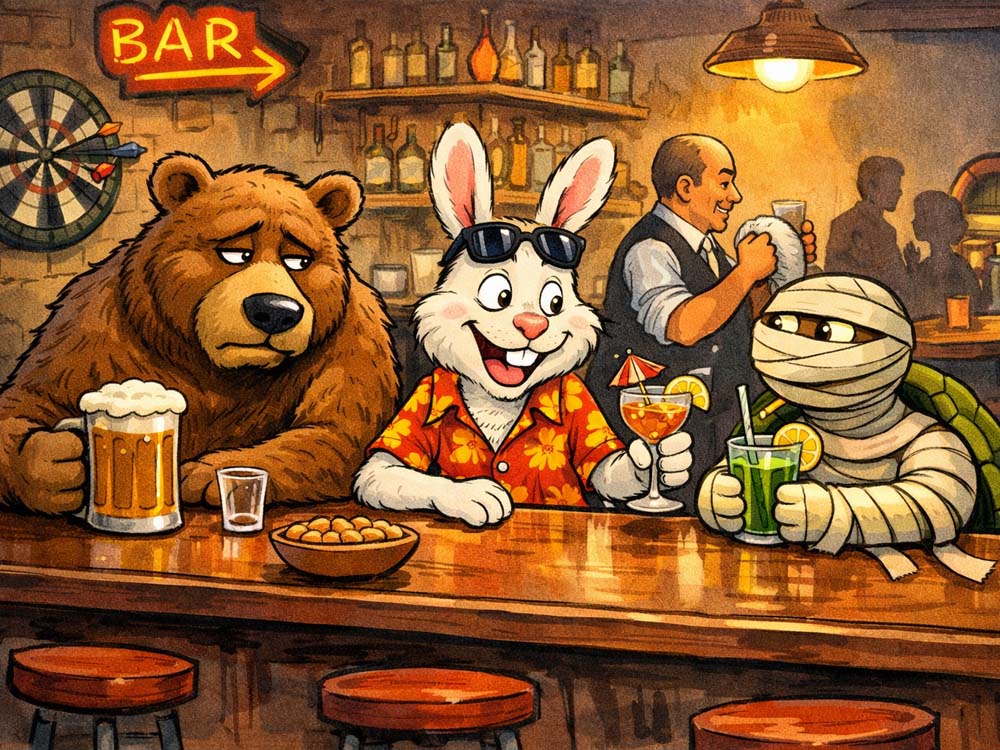
This bar has seen some things. A bear nursing a drink, a rabbit in a Hawaiian shirt who looks suspiciously upbeat, and a turtle wrapped like he just lost a fight with both gravity and fate. If this is happy hour, it’s doing a lot of emotional heavy lifting.
There’s a quiet brilliance to the setup: three animals, three wildly different vibes, one shared location. It’s basically a group therapy session with worse lighting and better liquor. The humor lives in that contrast—same bar, same drinks, entirely different backstories.
And that’s exactly where a lot of you went: not just “funny animals,” but “why are they here, together, right now?” That instinct paid off.
What We Saw a Lot
A few clear lanes emerged.
First, the injury angle. The bandaged turtle did a lot of the heavy lifting for setups about accidents, rough weeks, or recovery. Lines like “Next time, use the sidewalk.” and “a little to fast around the corner ehhh.” leaned into cause-and-effect humor—something bad happened, now we’re dealing with the aftermath.
Second, wordplay. Unsurprisingly, animals plus a bar equals a buffet of puns. “Shell,” “bear,” “hare,” “hair of the dog”—they were everywhere. Some submissions stacked multiple puns into a single line, while others kept it cleaner.
Third, emotional contrast. A lot of captions treated this like a mismatched support group: one character thriving, one struggling, one barely hanging on. “One’s buzzed, one’s bruised, one’s barely holding it together.” is a clear example of that framing.
Finally, “bar as metaphor.” Several captions turned the setting into something bigger—coping mechanisms, trauma bonding, origin stories. Lines like “When your support group meets at happy hour.” and “Three drinks in and suddenly we’re all telling origin stories.” pushed beyond the literal scene.
Missed Opportunities
Where things slipped was often in over-explaining or under-choosing.
A lot of captions tried to account for everything in the image—the turtle’s injury, the rabbit’s vibe, the bear’s mood, the bar setting—all in one sentence. The result was crowded setups that diluted the punchline. When you try to explain every character, you often lose the sharpest joke.
On the flip side, some captions leaned too heavily on generic bar humor. “now this is a drink!!!” or “This place really brings out your inner animal.” could apply to dozens of images. They’re not wrong—they’re just not specific enough to this scene.
There were also near-misses in the pun category. The instinct was strong, but the execution sometimes stopped at recognition rather than escalation. A pun alone isn’t the joke—it’s the entry point. The best versions added a twist or context that made the pun feel earned, not just spotted.
Head to Head
“Slow and steady… still ends up at the bar.”
vs.
“The tortoise and the hair of the dog.”
Both captions play in the same sandbox: classic tortoise-and-hare references.
The finalist works because it updates the familiar phrase (“slow and steady”) with a clean, modern twist. It’s simple, readable, and lands immediately. The humor comes from subverting expectations—yes, slow and steady wins the race, but also… ends up drinking about it.
“The tortoise and the hair of the dog.” is clever wordplay, but it asks the reader to do more decoding. You have to process the original phrase, notice the substitution, and then connect it to the bar setting. By the time you get there, the laugh has softened.
Clarity and immediacy gave the edge to the finalist.
Red Lines
“Hey Bob close race you almost won until that Owl swept up and dropped you like a flying saucer.”
There’s a fun instinct here—giving the turtle a backstory—but it becomes too detailed. Comedy benefits from selective information. When you overload the setup with specifics, the punchline gets buried. A tighter version that hints at the incident rather than narrates it would land harder.
“Hop to it Hanky She’ll, Boo Bear needs to cheer up or it’s turtle soup for dinner”
This one tries to juggle multiple characters, nicknames, and a threat. The energy is there, but the focus isn’t. Strong captions usually pick one clear comedic idea and push it. When you stack too many moving parts, the reader spends more time parsing than laughing.
“Same bar, wildly different life choices.”
This is a solid observation, but it stays at the surface level. It labels the contrast without adding a twist or specific angle. A small push—something unexpected about those “life choices”—would elevate it from true to funny.
“Hare of the dog.”
A clean pun, but it stops at recognition. It doesn’t interact with the scene beyond the wordplay. Adding context (who’s saying it, why it matters here) would give it more comedic weight.
Winning Captions & Why They Worked
“Cheers to you coming out of your shell.”
This one hits multiple levels cleanly. It’s a natural bar phrase (“cheers”), it ties directly to the turtle, and it frames the injury as growth rather than just damage. It’s simple, specific, and feels like something one character would actually say in that moment.
“One’s buzzed, one’s bruised, one’s barely holding it together.”
Strong rhythm and structure carry this. The repetition sets expectations, and the escalation (“buzzed” → “bruised” → “barely holding it together”) adds depth. It captures all three characters without over-explaining them.
“I know it’s only because you are injured, but we got to celebrate my first race win”
This works because it gives the rabbit a voice and a personality—self-centered, slightly oblivious, and very on-brand. The humor comes from the mismatch between the turtle’s condition and the rabbit’s priorities.
“Bear with me, but I’m gonna jump right to it. You have mummy issues”
A layered joke that rewards the reader. The “bear with me” pun sets the tone, and “mummy issues” cleverly ties to the turtle’s bandages. It’s a bit more complex than others, but the connections are clear enough to land.
“Slow and steady… still ends up at the bar.”
Clean, familiar, and efficiently twisted. It takes a known phrase and nudges it just enough to feel fresh.
Final Thoughts
This was a strong field with a clear pattern: the best captions didn’t just notice the animals—they gave them motives, relationships, and a reason to be at that exact bar, at that exact moment.
If there’s one takeaway, it’s this: don’t just describe the scene—cast it. Who’s talking? What just happened? Why is this funny now? The tighter your answers, the sharper your joke.
Also worth noting: the turtle may be bandaged, but the real injury here is to anyone trying to out-pun a bar full of animals. That’s a risky pour.
Check out the next contest and see if you can raise the bar—preferably without needing medical attention.