Tips for Caption Contest 159
Some cats bring home mice. This one brings home a diploma—and a minor existential crisis.
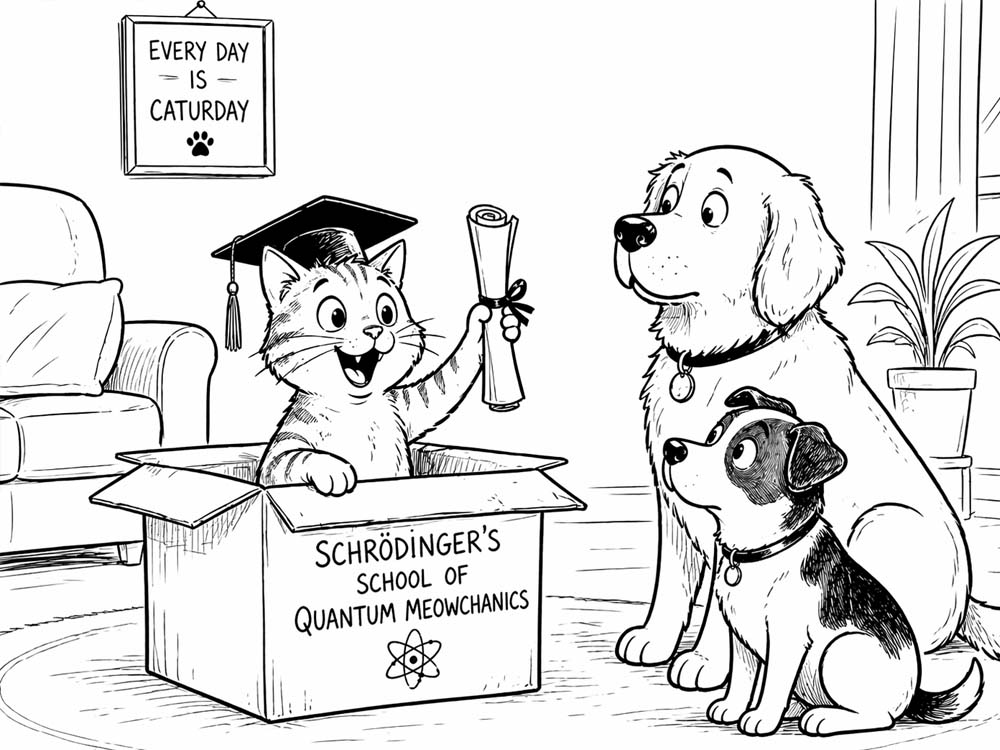
You’ve got a smug, freshly graduated feline emerging from a box that may or may not contain it, proudly clutching proof of higher education. Meanwhile, two dogs stand nearby, trying to process whether they’re witnessing achievement… or a physics problem gone rogue.
It’s academic excellence meets quantum confusion. The kind of ceremony where the valedictorian might simultaneously exist and not exist until someone claps.
This image is doing a lot—and that’s good news for you. It means there are multiple angles to attack, as long as you pick one and commit.
Getting Started: What’s in the Image?
Let’s inventory the scene before we get clever:
- A cat wearing a graduation cap (already funny—cats don’t respect institutions)
- The cat is holding a diploma (suggesting pride, accomplishment, ceremony)
- It’s popping out of a box labeled “Schrödinger’s School of Quantum Meowchanics” (wordplay + science reference)
- Two dogs are watching, visibly confused (critical reaction shot energy)
- The entire thing is a clean, black-and-white line drawing (simple setup, idea-driven humor)
Key details that matter:
- The box isn’t random—it’s the core joke engine (Schrödinger reference = alive/dead ambiguity)
- The cat’s confidence contrasts with the absurdity of the situation
- The dogs’ confusion gives you a built-in audience surrogate
- The pun-heavy school name signals that wordplay is fair game—but not required
This is a high-concept image with a clear premise: intelligence, uncertainty, and species-based misunderstanding all colliding in one frame.
Think Beneath the Surface
Now push past the literal.
This isn’t just a cat graduating—it’s a cat graduating from a school based on a paradox where outcomes are unknowable until observed. That opens up themes like:
- Certainty vs. uncertainty
- Intelligence vs. confusion
- Academic prestige vs. total nonsense
- Cats acting superior vs. dogs being baffled
There’s also a social layer:
- The cat clearly thinks it’s accomplished something meaningful
- The dogs clearly don’t get it
- Who’s right? Doesn’t matter—that tension is the joke
You can also play with:
- Overqualification (what job does this cat even want?)
- Misapplied knowledge (quantum theory in everyday life)
- The idea that the cat might both have and not have graduated
Unexpected angles worth exploring:
- The dogs as critics, skeptics, or jealous bystanders
- The diploma as meaningless, fraudulent, or incomprehensible
- The cat as smug, delusional, or legitimately brilliant
- The box as something more mundane (reframed as a cardboard box obsession)
Example: Example: “Graduated top of my class—pending observation.”
General Tips on How to Be Funny
Pick one idea and sharpen it.
This image offers multiple joke paths—quantum physics, cat behavior, academic satire, dog confusion. Don’t try to hit all of them. Choose one lane and make it precise.
Use the dogs wisely.
They’re your audience stand-ins. Confusion, skepticism, or disbelief can anchor your joke and make the cat’s behavior funnier by contrast.
Don’t rely solely on the pun.
The image already includes a strong pun (“Quantum Meowchanics”). If your caption is just another similar pun, it risks feeling redundant. Add a twist or a perspective shift.
Clarity beats cleverness.
If your joke requires the reader to fully understand Schrödinger’s thought experiment to work, you’re narrowing your audience. Aim for something that lands even if the science is fuzzy.
Leverage confidence.
The cat looks proud. That confidence is funny when it’s misplaced, exaggerated, or completely unearned.
Example: Example: “Four years of school and still can’t decide if I exist.”
Keep it tight.
This is a one-line setup with a visual punchline already baked in. Your caption should feel like the final click, not a paragraph of explanation.
Final Thought
This image rewards focus: take one clear idea—certainty, intelligence, or total nonsense—and push it just far enough to surprise, without overcomplicating it.
Now go make something that exists—and doesn’t exist—until it wins.